Public safety workshop focus on community issues, police-public relationship
By CHRISTIAN MAITRE
Waltham Times Contributing Writer
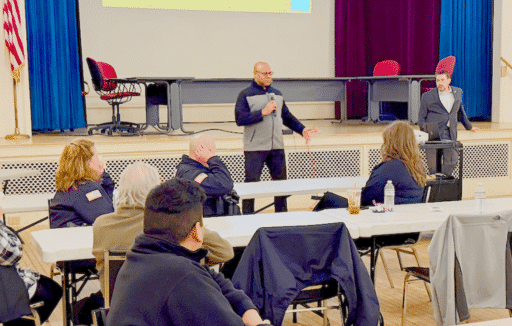
Law enforcement professionals, 911 dispatchers and community members gathered in Clark Government Center last Wednesday night to learn about the issues affecting their daily lives.
It was one of eight scheduled workshops on “Serving in the 21st Century” aiming to foster a positive relationship and open dialogue between public safety workers and the community.
The program is part of a joint partnership between the Waltham Police Department and Dedication to Community (D2C), a nonprofit founded by M. Quentin Williams in 2012. It is funded through a grant from the U.S. Department of Justice’s Office of Community-Oriented Policing Services.
Last Wednesday’s event was the last of the eight sessions held here in Waltham.
Leader’s journeys into law enforcement
Williams himself was on hand to lead the workshop, together with D2C’s Senior Vice President Cory McGookin. They shared their journeys into law enforcement to explain why D2C’s mission became important to them.
Williams grew up in Yonkers, NY, and attended Boston College as an undergraduate on a football scholarship. He received a law degree from St. John’s University School of Law in 1991. He was appointed a special agent for the Federal Bureau of Investigation in 1992 after serving as an associate attorney for the law firm Martin Clearwater & Bell. He went on to serve as an assistant U.S. attorney in New Haven, Conn., and later held various executive positions in the NFL and NBA.
While he was an FBI agent, Williams was detained by police during a trip to Newport, RI, he told the audience. The officers mistook him as a suspect in a crime. Despite identifying himself as an FBI agent, Williams said he was detained for hours.
He was eventually released, but Williams felt he wasn’t given adequate space to communicate with law enforcement and said he wasn’t given an apology for the mix-up.
“All I wanted that day was my 20 seconds” to explain that he was simply on a trip to visit friends, he said.
McGookin served as a Spanish linguist for the U.S. Air Force before becoming an FBI agent investigating violent crimes and gang-related activity in Chicago and Washington, D.C. McGookin worked for the FBI’s National Academy, an educational program for law enforcement professionals, teaching classes and later became its Unit Chief in 2019.
Discussion groups drill down on issues
Issues brought up by attendees at the Feb. 6 evening varied.
Attendees in one group discussed how they often work with individuals suffering from mental health and substance abuse issues.
They said dispatchers and police work together to provide resources for people experiencing these issues but can be limited by how many public safety workers can be devoted to a particular call, or person at a time.
The group suggested that a public inpatient program that cares for patients in a safe and controlled environment could provide long-term treatment to more people who need it.
Attendees in another group discussed the language barrier that exists between officers and some community members and the communication issues that creates.
This barrier was acknowledged by police officers at the event, with one explaining that more diverse representation within the police force could close these gaps of understanding between the public and law enforcement.
“The more diverse our experiences the better off we’re gonna be,” said Lt. Kaitlyn Mercurio of the Waltham Police Department.
Another attendee spoke about bicycle safety, saying aggressive drivers could endanger cyclists and that a social media campaign could raise awareness of the issue.
Groups were tasked with sharing perceptions they might have about law enforcement and their jobs versus the reality.
One officer shared that students had misconceptions about the role of school resource officers (SRO). The officer explained that a common sentiment heard among younger children is that police are there just to “catch bad guys” when, in fact, SROs have many other tasks, such as securing the school building and ensuring student safety.
Williams spoke to the commitment officers bring to their roles.
“Cops to me are heights of compassion, because you’re putting on the vest for people you don’t even know,” said Williams.
Williams said that for law enforcement to move forward, it must reconcile with its sometimes problematic past. Williams, author of “A Survival Guide: How NOT to get KILLED by the POLICE, Part I,” noted that police in the past have engaged in racist practices. That contributes to a generational distrust of police that continues to persist in certain communities. Institutions such as the NAACP share similar sentiments on this.
Acknowledging this generational distrust is key to understanding the relationship between law enforcement and the community, he explained.
Jeffrey Rodley, captain of the Waltham Police Department’s community services division, said events like these workshops, where police and community members collaborate, are key to solving local issues.
“Acknowledgement equips us with the tools to counter that generational distrust,” said Williams.
Author