Program in Waltham integrates high-level content and mastery of English through project-based learning

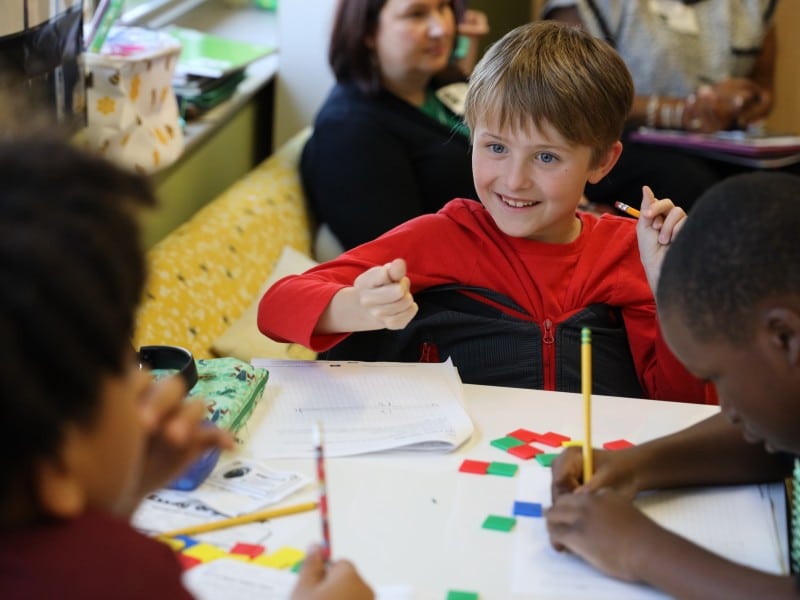
Attend Diksha Kaur and Emily Flanagan’s combined physics classes at the Waltham High School and you might witness a raucous game of science Jeopardy or a fascinating physics lab.
You’ll also see students having fun and collaborating with each other.
“I think they’re making new friends,” Flanagan said about the students.
These combined classes are part of a pilot project called “Integrating Language and Content Through Project Based Learning.” The project, according to the grant application, was created in an effort to provide English learners with “peers who are language models” in a classroom “with high quality instruction” that prioritizes both learning the language and learning the content.
Project Based Learning (PBL) is a strategy that centers “real-world and personally meaningful projects” in classroom lessons. The high school already weaves PBL into its curriculum, but this project works within the PBL framework to integrate language and content learning.
Last June, the Massachusetts English Learner (M.E.L.) Community Foundation awarded Waltham Public Schools (WPS) a $10,000 grant to implement this project at the high school.
Starting this school year, the project paired Kaur and Flanagan together, each one teaching the same material, though at different levels, at the same time. Kaur teaches a sheltered English instruction (SEI) class, which focuses on teaching both language and content skills, and Flanagan teaches a college preparatory level class.
For one week per month, the classes meet to work on a real-world project together.
Monday’s gathering

Sitting around two pushed-together lab benches in a science classroom in the high school, Kaur and Flanagan discussed their reflections from the first six months of the project at a gathering with M.E.L. representatives and district administrators on Monday.
The combined classes weren’t always so collaborative, they said. At first, there was some reluctance from the students.
“They weren’t excited about this [project],” Kaur said.
Once the students were tasked with more hands-on assignments, they began working together and diving into the social aspects of the program. It encourages the students to socialize and make new friends.
“Some kids have been with the same kids since elementary school,” Flanagan said about her students. The initiative helps everyone to branch out and meet other students at the newly renovated high school.
It’s a win-win situation, Sara Hamerla, administrator of the multilingual department at WPS, said. The English learners gain vocabulary skills and the other students learn to see the world through a new perspective.
M.E.L. Community Foundation and Waltham partnership
The partnership began when John Maynard, founder and executive director of the M.E.L. Community Foundation, reached out to Hamerla a year ago. He told her that he started the foundation and welcomed any project proposals she had.
The two worked together 15 years earlier at Fuller Middle School, where Hamerla was a teacher and Maynard was the assistant principal.
Maynard formed the foundation in 2022 to address the need for innovative and impactful approaches to teaching a growing number of English learners in Massachusetts. “Language,” the foundation’s website notes, “should build bridges, not barriers.”
Waltham’s proposal resonated with the foundation because it was science focused, a topic that many students, regardless of language level, struggle with, Maynard said. It also made high level classes more accessible to students, supported the teachers and focused on the vast number of students enrolled in the multilingual programs.
The multilingual department at WPS serves 1,500 students who speak 35 languages.
Also in attendance at Monday’s gathering were Veronica Montanez and Robin Welch, both M.E.L. board members, and Kaytie Dowcett, who is the grants manager, Title I director, and MKV homeless education liaison at WPS.
The M.E.L. funds cover planning time for the teachers — a couple hours per month — as well as other expenses, such as transportation costs for field trips including one next month to the Museum of Science.
Kaur and Flanagan said that the students are looking forward to their next adventure together.
Share anonymous news tips
You can leave a news tip anonymously, but if you would like us to follow up with you, please include your contact information
Author