
City councilors weigh privacy concerns, public safety benefits of surveillance cameras
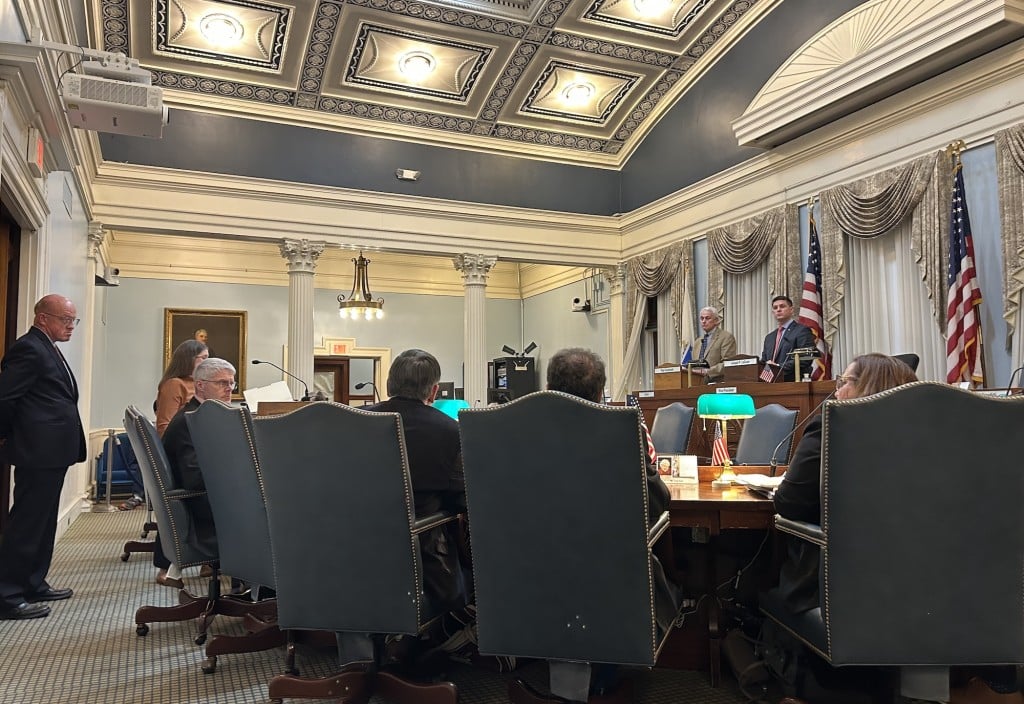
The city’s contract with Flock Safety, the company that provides Waltham with cameras that read license plates and collect related data, dominated discussion at the City Council’s Committee of the Whole meeting earlier this week.
The discussion centered on the Police Department’s use of the cameras for law enforcement needs and whether its contract with Flock contains the privacy safeguards that local officials and city residents want.
Monday’s meeting, however, ended without definitive answers, as the committee sent the issue to the City Council’s Ordinances and Rules Committee meeting on Dec. 1.
Still, councilors at Monday night’s meeting gleaned more information about Waltham Police Department’s contract with Flock and the department’s use of Flock technology.
First Assistant City Solicitor Luke Stanton explained that Waltham owns the data obtained by Flock cameras, but the company stores it for 30 days before deletion and states that it will share information with third parties if legally required or if it has a “good faith” reason to believe the information is necessary for a law enforcement or technical matter.
Staton said concerns about whether and when other parties can access Waltham’s data are valid, saying the city should ensure the data isn’t used for purposes that violate state law. He said if Flock used Waltham’s data to violate local laws such as the state’s Shield Law, which prevents sharing sensitive data concerning abortion and reproductive rights, the state could potentially prosecute the company.
Ward 9 Councilor Robert G. Logan shared information from a 90-page document he said he had received from a constituent who had filed a Freedom of Information Act request with the Police Department. The list details organizations with whom the WPD has shared data obtained through the Flock cameras. According to Logan, the list includes local police departments in North Carolina, Alabama and Tennessee; the Air Force; and the United States Postal Service.
“I also trust the Waltham Police Department. I don’t trust Flock Safety systems,” Logan said. “I don’t trust the unnamed third parties that they claim that they may share data with, and I certainly don’t trust the Wichita, Kansas, Police Department or the Cobb County, Georgia, Police Department.”
City Solicitor Katherine Laughman noted that the WPD recently opted to share its Flock data only with organizations inside of the state that are bound by Massachusetts law.
Ward 7 Councilor Paul S. Katz told the council that he supports the use of Flock’s technology but that he has heard from a few constituents voicing what he considered valid privacy concerns.
Katz said he had a list of unanswered questions about the use of data that’s collected by police- and privately owned cameras, including whether federal agencies such as Immigration and Customs Enforcement could use a search warrant to compel Waltham to share data collected by its cameras, how developers using Flock’s API can access data and what controls the company imposes on them, and where Flock stores Waltham’s data.
Laughman told Katz that the WPD’s new policy addressed some but not all of his questions.
Katz also said he would like the city to offer guidelines for how city agencies should use data from licence plate readers.
Laughman said the city cannot change internal police policy but could collaborate with the WPD to create regulatory policies.
Ward 1 Councilor Anthony LaFauci said he, too, has heard concerns from constituents. He also said that although technology like license plate readers can be misused, the city should trust the WPD to use it properly. “I want to assume… the Waltham Police Department is working in the best interest of Waltham residents,” he said.
Ward 6 Councilor Sean T. Durkee echoed that sentiment, adding that he also didn’t want to undercut the Police Department’s operations by limiting the information officers could receive through Flock’s database.
He suggested that he thought that some concerns he heard from residents may come from a misunderstanding of how Flock collects data and asked that the WPD share a sample of what the cameras capture.
Flock is a surveillance technology company that sells license plate readers to law enforcement agencies and maintains a database of information shared by its customers. The company’s information portal for the WPD’s cameras states that the cameras do not collect facial recognition data or data about individual’s gender or race.
Stanton emphasized that the WPD could collect the same information without using Flock cameras by deploying officers to record intersections or requesting footage from private cameras, although such methods would be more expensive.
At the Nov. 6 Committee of the Whole meeting, O’Connell told the committee that the WPD purchased its 16 cameras in June using funds seized during operations involving controlled substances. The Police Department can use such funds to purchase certain types of tools without going through a standard city budget appropriations process.
According to Stanton, the Police Department did not have the Law Department review its contract with Flock before signing it.
Authors


Comments (4)
Comments are closed.


Thank you for this article. I had no idea. And the link was enlightening. A while back, a friend concerned about surveillance explained to me how Baltimore had cameras parked on a main street with speed monitors. They were outraged because the city then issued speeding tickets, without the drivers ever being aware they were being tracked. While I can’t vouch for the accuracy of that statement, it did make me notice those long nosed white cameras in some of the city’s major intersections. My assumption was they were there to monitor traffic and record the accidents that usually occurred at these intersections. I didn’t know they were specifically recording my license plate just because I happened to be driving through there. Your reporting is much appreciated!
“Stanton emphasized that the WPD could collect the same information without using Flock cameras by deploying officers to record intersections or requesting footage from private cameras, although such methods would be more expensive”
Well, sure. But crucially, data collected by the WPD in this way would not be stored on the servers of, and potentially accessible to, a company whose CEO has called concerned citizens “terrorists” for raising privacy-rights questions and concerns about mass surveillance like those that our councilors are rightly raising.
As a concerned citizen, I (mostly) trust the WPD and I genuinely appreciate their and the city’s engagement with these questions. I think they are trying to do the right thing here, though we may have slightly different perspectives on the details of what “the right thing” is. I do *not* trust a massive corporation like Flock, which in the end is only beholden to people trying to make money from it, nor do I trust many of the other police departments that could potentially access WPD’s footage. I appreciate that WPD has put policies in place to limit which police departments can access images from the cameras, but quite honestly I expect that Flock will continue sharing this footage outside of those restrictions somehow, without WPD necessarily knowing about it.
This was a great article, especially the level of detail of the discussion and concerns. Is it known how many of these cameras are in use and where they are located? Thanks.
Here is a map of all the flock cameras in operation currently in Waltham: https://deflock.me/map#map=14/42.388817/-71.234837