
Advocates see promise in initial zoning reform proposal
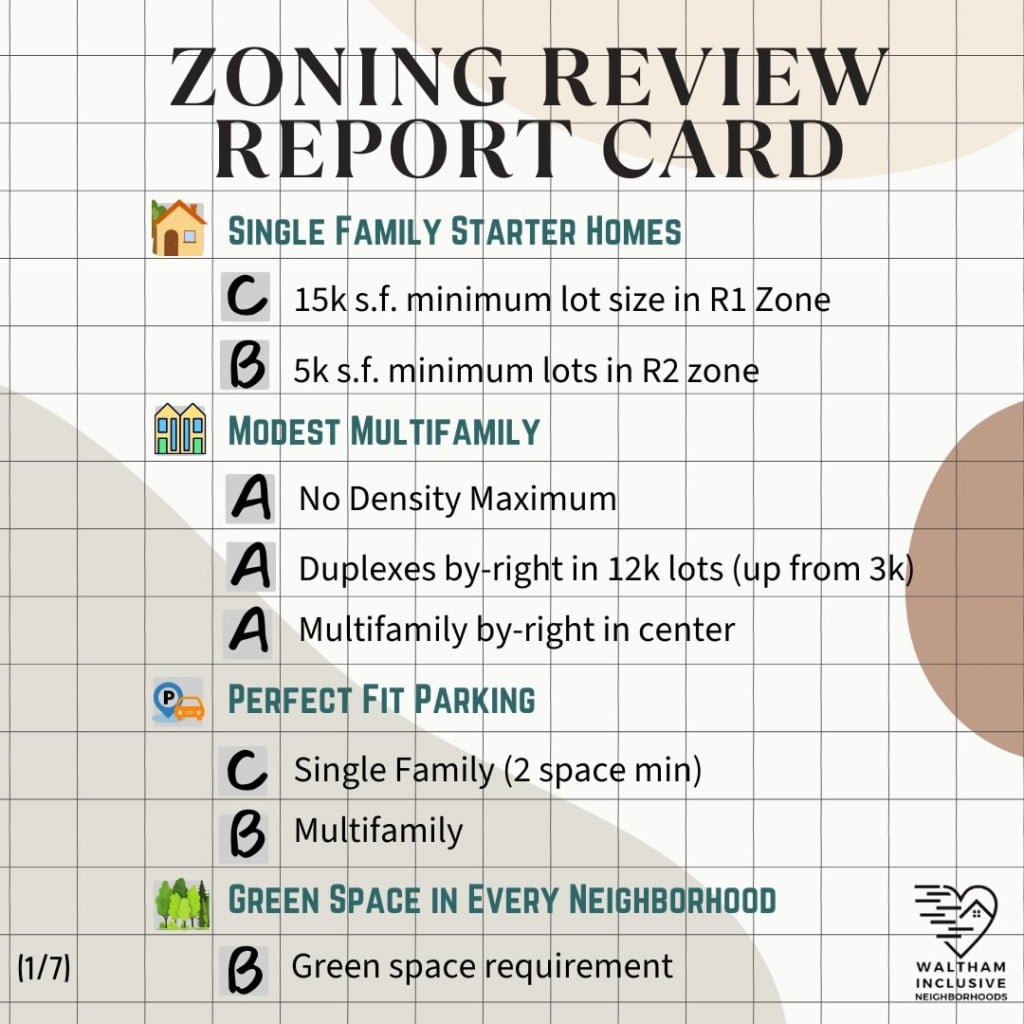
Housing group Waltham Inclusive Neighborhoods, which has been vocal in its advocacy throughout Waltham’s ongoing zoning code reform, has published its evaluation of the first proposed steps of the rezoning process.
City-hired contractor CommunityScale LLC in September submitted the first parts of its proposal to revise Waltham’s zoning code. The proposal so far consists of a map of different zoning districts, a table outlining what buildings lot owners can build in those zones and a list of definitions.
In a December “report card” WIN wrote that these changes made real progress in its affordable housing goals.
Zach Shapiro, who is a member of WIN’s media team, said the organization made the report card because the current proposal is dense and hard to navigate but contains information important to many residents.
“The MBTA Communities Act you can describe in a sentence. An ADU you can describe in one to two sentences, [but] this zoning change is so complicated,” he said. “What we’ve learned is that a lot of people actually do want more housing, they just don’t realize it.”
WIN gives mixed grades
WIN advocates for five main priorities in zoning changes: allowing for more small single- and multifamily homes, lowering parking requirements, creating more green spaces and supplying more citywide support for affordable development.
The report card applauds the fact that CommunityScale’s initial proposal doesn’t set any caps on the number of units per acre in any district; WIN argues that eliminating these maximums allows neighborhoods to be more flexible. The code also allows duplexes and multifamily housing by right in more lots, which WIN said will help “in neighborhoods where [multifamily housing is] already common, but may not be permitted by right.”
By comparison, however, the organization does not rate the reforms for single-family lots quite as highly. WIN advocates for smaller lot sizes to allow for more affordable single-family homes, and stated that CommunityScale’s proposed reforms don’t hit its marks, although the rezoning proposal does shrink some single-family lot minimums.
“If you listen to a lot of the city councilors, most of them actually do reference wanting to build more affordable single-family homes, and it’s interesting that [in] this proposal that’s one of the areas that’s weaker,” Shapiro said.
One necessary step toward that goal, he said, is reducing parking requirements. The current zoning code requires two parking spaces for every single-family home, which Shapiro said doesn’t actually reflect the proportion of Waltham households that have two cars.
CommunityScale’s proposed reforms don’t reduce the single-family house parking minimums but do lower parking minimums to 1.2 spaces per unit in small developments and 0.5 spaces per unit in large ones. WIN said this policy change is an improvement but could be more useful if simplified.
In terms of green space, the WIN report card highlights two new measures the proposal introduces: maximums on the amount of a lot developers can pave and additional green space minimums. These newly-proposed measures are less stringent in the city’s single-family neighborhoods, and Shapiro said that WIN would prefer higher green space minimums and the elimination of caps on the buildable proportion of lots.
These zoning proposals don’t directly address WIN’s aim of increasing affordable housing, Shapiro said. The organization wants Waltham to revisit its affordable housing policies, which is something the City Council is tackling separately.
Shapiro said that these changes would go a long way toward creating more housing, which he argues would improve affordability for everyone.
The road so far
Shapiro said it’s important for the City Council to move CommunityScale’s proposed reforms forward.
“What we’re trying to do is to get this out to the public so this doesn’t become another thing that holds promise for real change in the city but doesn’t ever get implemented,” he said. “This is something that, frankly, a large number of people really do care about.”
The City Council’s last attempt at large-scale zoning reform was in 2015, but almost no policy changes came of it.
In the fall of 2024 the city commissioned CommunityScale to revamp the city’s zoning code. This code dictates what property owners can build by right in districts throughout Waltham, including building uses, sizes and density. The city held an initial public input hearing in June for residents to submit feedback on the current zoning code.
When the City Council’s Ordinances and Rules Committee accepted this first offering from CommunityScale, emails in the submission package indicated the company planned to complete a draft of the full code in August.
The committee said it would not take action on the recommendations until it received a complete audit of immediate changes to improve the zoning code, which it said was supposed to be CommunityScale’s first deliverable. The City Council has not publicly received any more proposed reforms from CommunityScale since its initial September offering.
Share anonymous news tips
You can leave a news tip anonymously, but if you would like us to follow up with you, please include your contact information
Author



Comments (0)
There are no comments on this article.