
School Committee debates categorization of Valor School, hears from concerned faculty
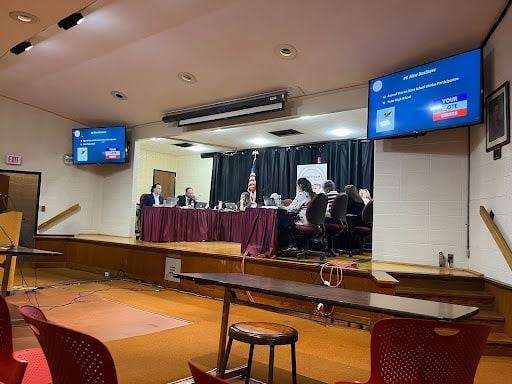
At its April 8 meeting, the School Committee took up the question of Waltham Valor School’s designation as its own school and whether it should just be a program under Waltham High School. Ultimately, it moved away from combining the two after hearing input from Valor’s teachers and Superintendent Marisa Mendonsa.
Mayor Jeannette A. McCarthy first brought up the discussion, highlighting concerns that the Valor School was not accessible to all students and that enrollment methods were not transparent for the community. Her proposed solution was to establish a more concrete connection between Valor and WHS, thereby making Valor into an alternative program under the umbrella of WHS.
Because the Valor School is its own school and not technically an alternative program, it can keep enrollment low and exercise much more control over its model and educational methods. If its school status was dissolved and enrollment was raised, it would become subject to the recommendations of the Department of Elementary and Secondary Education—something Mendonsa said could jeopardize the integrity of the care staff provide.
Mendonsa told the mayor that Valor’s low enrollment keeps it autonomous. Once it reaches 75 students, it comes under the purview of DESE and receives an accountability rating. Additionally, because Valor’s dropout rate is very high relative to its small size, she said that accountability rating would likely be very low—under the 10th percentile. WHS is also ranked below the 10th percentile.
When a school is ranked so low, DESE takes on a support process that includes increased oversight over the school’s operations. “And so,” Mendonsa explained, “the school district would have two schools that would be identified as under the 10th percentile. DESE would begin supporting [Valor], and may make recommendations that go against what Valor has been trying to do in their innovative way.”
Mendonsa said that these recommendations could include imposing a minimum amount of time that students need to be on campus. Valor’s model is designed for students with special circumstances outside the classroom, and allows them to have unique schedules that accommodate their needs. Students at Valor might be financially supporting their families and have work obligations, or have children of their own.
She also clarified the process of enrolling at the Valor School. Students at Valor are over-aged and under-credited, meaning they are over the age of 17 and are far behind their appropriate grade level. Valor also enrolls young parents who are under the age of 17. Generally, students are referred to Valor from WHS by counselors who observe their performance and trajectory toward graduation, and sometimes after they have dropped out. Some are also automatically referred to Valor when they first register at WHS if they already meet the criteria.
The case for keeping enrollment limited
The mayor questioned why enrollment at Valor had not grown, and said that perhaps referral processes needed to be streamlined so more students could have access to it.
Mendonsa assured that more enrollment at Valor would actually be a cause for concern, because it exists to give students another chance when they are behind at WHS. “I would be concerned if Valor had 500 students in it … [I would ask] what are we doing wrong at Waltham High School that’s resulting in 500 students being over age and under credit?”
Additionally, Mendonsa said that she personally requested Valor be capped at 55 students for its second year so that it could stabilize amidst leadership changes.
All of Valor’s staff attended the meeting as a show of support for keeping the schools separate. Melissa Chen, a founding teacher at Valor, addressed the committee directly during the public input section. She reported that in its first year Valor graduated 14 students, with 22 more expected this year. Those 36 students would likely have become dropouts for the district without the Valor School, she said.
Chen raised the concern that the committee’s motivation to raise the low dropout rate at WHS might be entangled with the conversation about Valor students’ needs. “Discussions thus far have focused on lowering Waltham High’s dropout data rather than the specific needs of at-risk students … If we are forced to expand beyond capacity or shift to a program model, I fear we will lose the student-centered joy and community that makes us successful,” Chen warned.
Valor teachers noted the convenient effect that combining the two schools would have on WHS’s dropout numbers. Students who graduate from Valor are currently counted as Valor graduates. If Valor were folded into WHS as a program, those graduates would count toward WHS’s numbers, giving WHS more graduates it had already lost and that Valor’s staff had worked to bring back.
A plea to let Valor complete three-year plan
Mike Russo, a founding teacher at Valor who worked at WHS for decades, voiced his frustration after the meeting. “If you move Valor under the roof of Waltham High, it will give you that quick boost. Then everybody can pat themselves on the back and say what a wonderful job they did.”
Russo said the more pressing issue for WHS is the implementation of techniques to recover more dropouts for themselves, rather than taking them from Valor.
He argued that before any structural change was made, WHS should first act on recommendations that Valor’s interim principal, Linda Flueckinger had made to WHS leadership before she joined Valor. “Her recommendations are still in their mailboxes,” he said. “They’re welcome to institute those tiered interventions.” Chen agreed that tiered interventions, which identify and support students before they fall behind, are integral to Valor’s success.
Russo also cautioned against interrupting Valor in the middle of its three-year plan to build intervention models and curriculum. “Let me finish the three years of curriculum before you flood me with students, because it’s socioemotional care. You stretch it too thin and we’re not going to be able to support these students as a whole.”
After the discussion, the mayor made a motion for more formalized information sharing between the two schools. She requested a “transfer policy both ways … that needs to be in writing, and be communicated in various languages in the school system. I want to make sure that all students in the city of Waltham have this opportunity to go there and get the pride of a diploma while they’re having all these issues in their life.” The motion passed. No vote on combining the schools or reclassifying Valor was taken.
Chen and Russo nonetheless felt disregarded by the lack of transparency from the committee. They had only found out about the possibility of reclassification from social connections, rather than from the mayor or the committee. “It feels dismissive to change a school after two years without a collaborative conversation,” Chen said during the meeting. “We are not disposable. We are a vital part of this community.”
Author

Comments (2)
Leave a comment
When commenting, please keep in mind we are a small non-profit focused on serving our community. Our commenting policy is simple:
- Common sense civility: we’re all neighbors, but we can disagree.
- Full name required: no anonymous comments.
- Assume the best of your neighbors.



Thank you, Lea, for this important reporting.
I spent seven years on the board of Boston Day and Evening Academy, a public charter school that serves students who need a different approach to succeed. It is a model built on strong relationships, small learning communities, and steady progress over time. I also ran a community based non profit that partnered with this school to provide essential skills training and paid after school employment geared towards post secondary success.
From that experience, one thing is clear: small size is not a limitation—it is what makes these schools effective. It allows for the consistency and attention that many students need to stay engaged and succeed.
That’s why the current discussion in Waltham stands out. If changes are being considered that could affect the size or structure of Valor, it will be important to proceed with clarity and care.
I hope the district will:
Communicate openly about any potential changes
Keep the needs and outcomes of students at the center
Engage Valor’s educators, students, and families in the process
Valor appears to play an important role for students who may not succeed in more traditional settings. Preserving what makes them work matters.
Thank you to the educators leading this effort—and to those working to ensure these students continue to be well served. I hope that city leaders will slow down look more deeply into what is working here before making hasty changes that may be ill-informed and unwarranted.
I am so impressed by Valor School’s mission and success with an incredibly challenged student body. As a recently retired child psychiatrist I have had a career that has given me a close inside view of the struggle of public schools to support the social and emotional needs of their students. As I have witnessed over and over, once again decisions that have a profound effect on the functioning and effectiveness of a program like this are being undertaken by administration with NO input from the staff (or students!) who will be most affected by the changes. I am always shocked by the short-sightedness of a process that is so demoralizing, disrespectful and destructive to the successful functioning of a school, especially one with an innovative approach. I am very aware of and sympathetic to the pressures that are on public school systems, but losing this precious resource would be a tragedy. Teachers are professionals! Consult them!