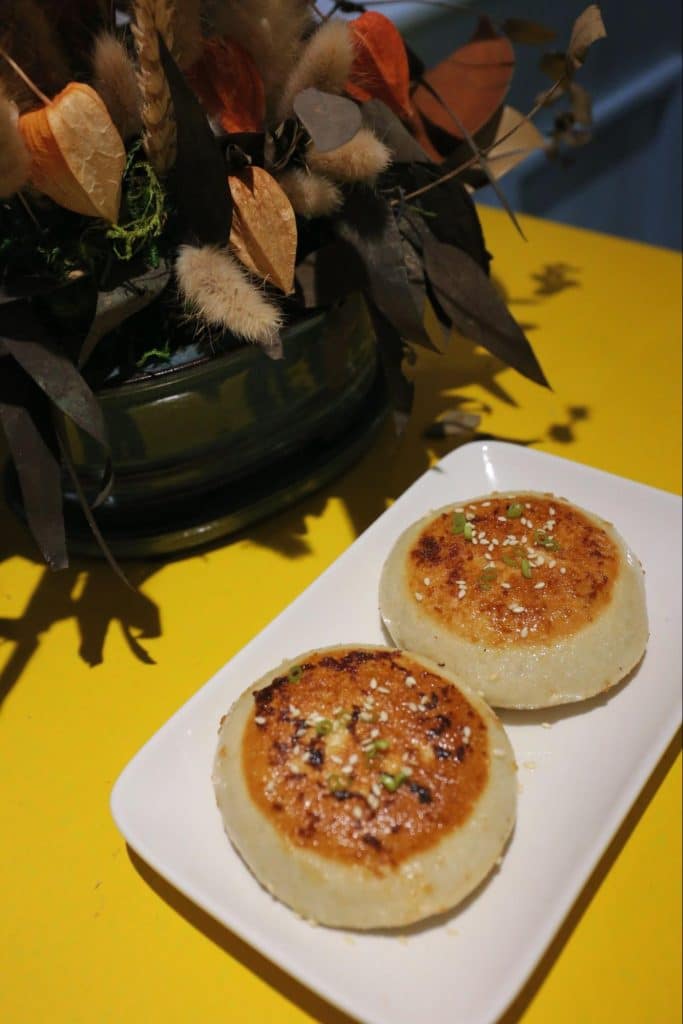
The griddle hisses and a sweet-savory aroma blooms. A beef veggie fried bun rises from the pan, balanced on a spatula, its blistered crust puffed and golden from the heat. At the counter, a barista calls out a tiramisu mocha, a dusting of chocolate powder melting into the cream and coffee below, leaving a faint mustache across the glass.
For a moment, the intimate café settles into the calm it was built for: a pause, a sip, a bite, a chat.
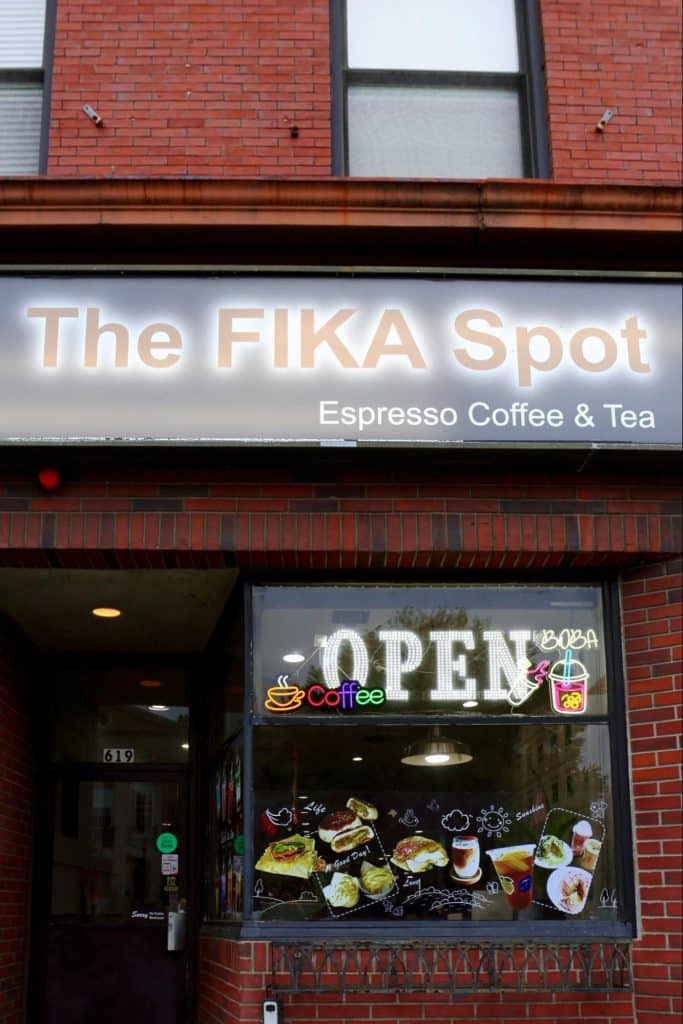
Tucked in downtown Waltham, just across from Waltham Common, The Fika Spot takes its name from the Swedish ritual of fika, the daily habit of stopping to share coffee with company.
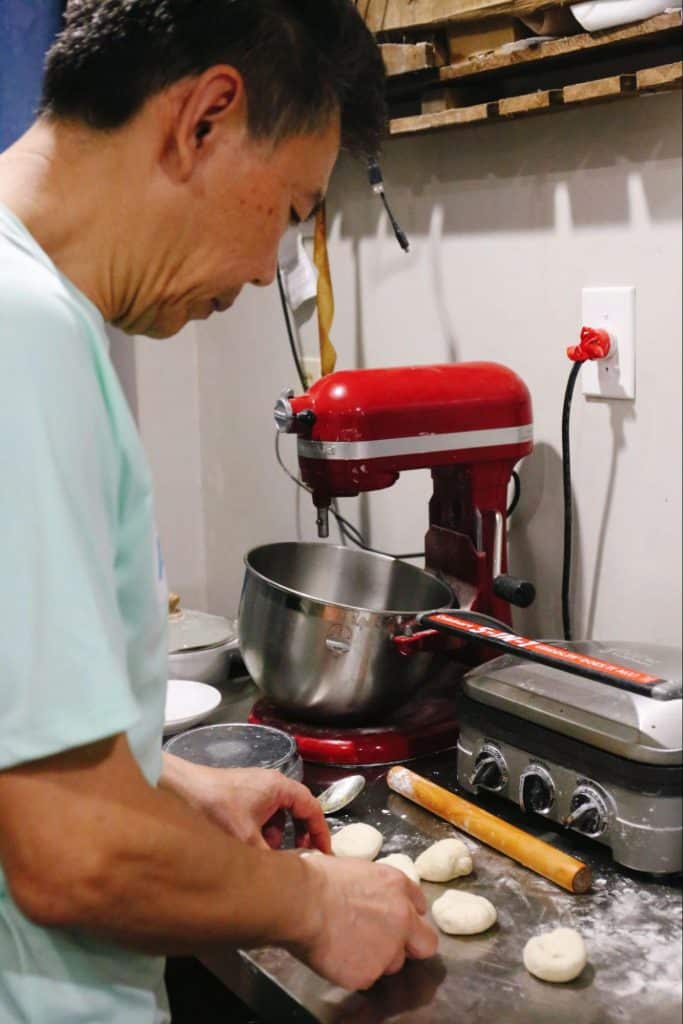
Inside, Jessie Ling and Kevin Zhang, a husband-and-wife team originally from Shanghai, dance through the narrow space, stepping from griddle to espresso machine to counter with practiced precision. Their menu is part Europe, part Shanghai, mostly Waltham.
Long before opening the café, Ling and Zhang built their own rituals around food. She once worked in private banking in China, where many of her clients, despite busy careers, spoke with surprising passion about cooking and eating well.
“Watching them, I realized food was more than fuel,” Ling said. “I started to think of myself as a foodie too.”
Before they had children, Ling and Zhang traveled several times a year, chasing new flavors and then staging playful contests at home to see who could best recreate the dishes they had discovered around the world. About eight years ago, after their son was born, they settled in Waltham. Now in their early 40s, the couple turned that passion into something more permanent.
A place that feels like home
Ling said she and her husband set out to create more than just another coffee shop. “We wanted a place with warmth,” she said, “somewhere people can slow down, talk and feel at home.”
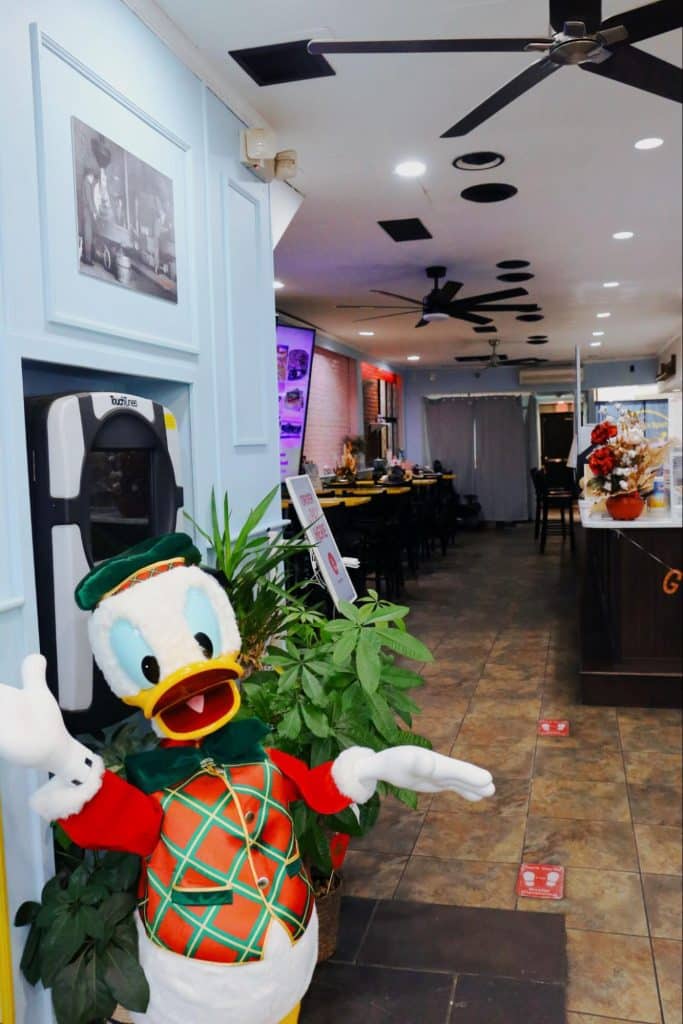
An eclectic hospitality radiates from the space. Near the entrance, the walls are painted blue, hung with vintage posters, and a side table is cluttered with straws and stirrers. Near the front door, a Donald Duck figurine greets customers as they walk in. Further in, the blue walls give way to exposed brick. A small white shelf holds a teapot and cups painted with blue Chinese landscapes. Nearby, panels of smiling flowers by Japanese contemporary artist, Takashi Murakami, hang on the wall. The mix feels less like decoration than layers of memory, giving the café the texture of a lived-in room.
Ling said two customer moments have stayed with her. “An Italian regular once told me our espresso tasted like the first cup his grandfather let him try in the North End,” she said.
Another involved an American who had studied in Wuhan, China. He noticed the Chinese sign for fried buns and joked with her about a missing character. “Those little moments remind me a café can carry people’s memories as much as it carries food,” Ling said.
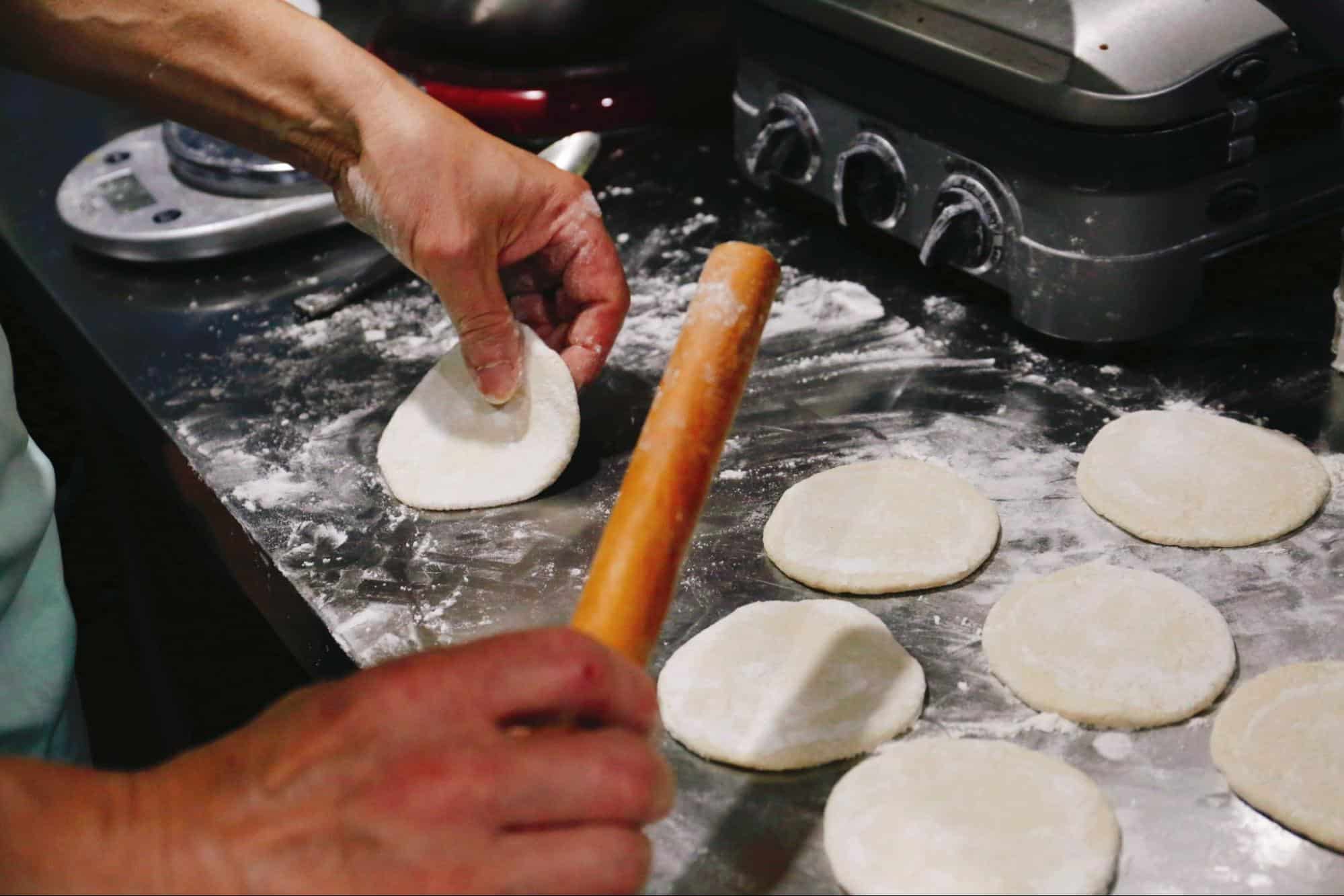
The menu tells a similar story. The beef veggie fried buns are crisp on the outside and tender inside, based on a Shanghai family recipe that Ling and Zhang adjusted until the seasoning worked for both first-time visitors and regulars. Pan-fried dumplings are served with Italian truffle sauce instead of soy. At breakfast or brunch, customers can choose a Danish, croissant or order a Chinese savory crepe, known as jianbing. Each item is designed with the same goal: familiar enough for some, approachable for everyone.
Why Waltham?
Zhang said they chose Waltham not because it promised the most foot traffic, but because it felt like a community.
“In places like Newbury Street in Boston, you mostly get visitors,” he said. “Waltham doesn’t have that kind of heavy foot traffic. But that’s the point. You build connections here. You pick up your kid, run an errand, and you start recognizing customers’ faces.”
For Zhang, the choice had less to do with business calculations than with instinct. Waltham simply felt like the kind of place where a café could belong.
In the early months, many customers were Chinese or Asian families who stopped in for a taste of home. As the café settled in, the crowd began to shift. Now tables hold a mix of neighbors pecking on laptops, parents splitting a bun with their kids, and office workers stopping by for a quick espresso.
“That’s how a café becomes part of a neighborhood,” Zhang said.
Newcomers keep showing up – neighbors curious about the buns, commuters grabbing coffee, friends introducing each other to a spot they’ve just discovered. The talk inside rarely strays far from the everyday: the weather, looming deadlines, where to find parking, but Zhang says the effect is cumulative. Over time, those small exchanges pile up, turning the café into a place people return to not just for food or coffee, but because it feels familiar.
That homespun vibe is what struck Rachel Keegan, a graduate student who moved to Waltham this fall. She said she found the café by accident and returned the next day.
“It doesn’t feel like just another café where you grab a drink and leave,” she said. “Here it feels like people actually know each other. Even as someone new to town, I felt welcomed right away.”
That experience, Ling said, is exactly what she and her husband hoped to build.
“Surprise me today”
Asked to describe The Fika Spot in three words, she chose “inclusive, innovative and practical.”
“The innovation is quiet, small adjustments that make traditional recipes a good fit for first timers,” Ling said. “The practicality is even simpler: being steady, taking things step by step, and showing up every day.”
She said that spirit is modeled by the staff. Lucy Wang, a senior at Bentley University who works part-time at the café, said what struck her most was how quickly she felt at home.
“It feels more like joining a family than a job,” Wang said.
She said that feeling carries into her interactions with customers. Staff often know a regular’s order before they reach the counter.
“Sometimes we’ll see someone walk in and say, ‘Still the same?’ and they’ll laugh and nod,” said Wang.“ Other times a customer will playfully ask, ‘Surprise me today,’ and we’ll pick a pastry or try a new tea for them. Little things like that make it feel personal.”
Over time, that familiarity creates room for flexibility. Regulars sometimes ask for things off the menu, and the kitchen will try if it feels right.
“Once, a longtime customer asked for steak,” Zhang said, laughing. “Of course it’s not something we usually serve. But when people come back again and again, you want them to feel at home. If we can manage it, we try.”
One step at a time
Preserving that atmosphere has not always been easy. In the first months, Ling said, the café faced sharp online comments that were hard to take. Some customers complained about long waits on weekends or that the beef veggie buns sold out before noon. Others questioned whether the buns tasted “authentic” enough.
A few critics faulted the café for serving jianbing (a Chinese breakfast crepe) without a full mung-bean batter, while others expected soy sauce with the dumplings instead of the truffle sauce.
“At the beginning, it really stung. I would read a comment at midnight and then not sleep,” Ling said.
She and Zhang made changes where they thought it necessary. They tightened their griddle timing, adjusted seasoning and offered sauces on the side. More importantly, they let the voices in the café guide them, instead of letting online reviews dictate how they felt.
“You can’t please everyone,” Ling said. “If you do the work, choose good ingredients and get each step right, people taste it, and they return.”
As for growth, Zhang doesn’t rule it out. But if it happens, he said, they will take it slowly.
“We’re not trying to open five more locations,” Zhang said. “The goal is just to keep this place personal, small enough to know people’s faces, and comfortable enough that it still feels like home.”
At its heart, fika is a ritual. At The Fika Spot, he said, the tradition doubles as a daily plan: keep the coffee strong, the buns fresh and greet people by name. The rest takes care of itself.
This story was written in collaboration with the Boston University local journalism program.
Author