
Revamped Adamian Center designed to ‘future-proof’ Bentley students
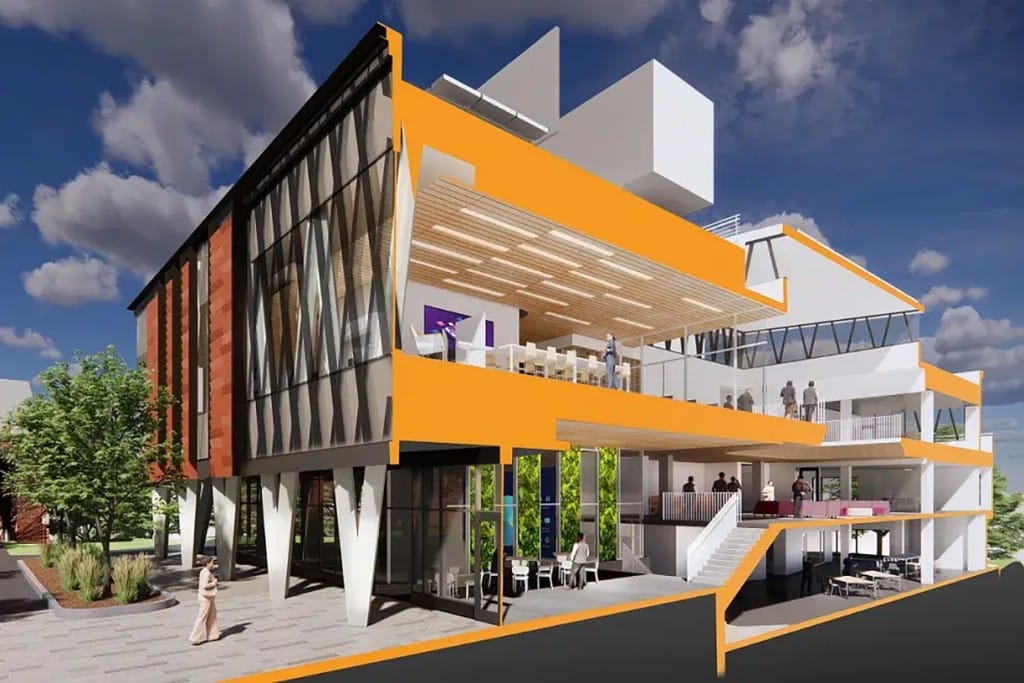
Construction is underway on an $85 million project at Bentley University to completely renovate its Adamian Academic Center to serve as a central hub for technology innovation and entrepreneurship.
The Adamian Center, built in the 1980s, is the university’s largest academic building, and according to Provost and Vice President for Academic Affairs Paul Tesluk, “was a space in need of a complete re-imagination.”
Plans for the center emerged from Bentley’s strategic plan, developed four years ago, which focused on reinventing the curriculum to prepare students to adapt to jobs that don’t yet exist.
“We are pushing our students to think entrepreneurially,” Tesluk said. He and other senior administrators speak about “future-proofing our students” by enabling them to develop the skills and competencies to continuously adapt to rapid technological change.
The transformation of Adamian will be the cornerstone of the university’s Technology, Innovation and Entrepreneurship initiative, according to a university statement. The building is scheduled to open in fall 2027.
A history of being on the cutting-edge
Bentley has long been known as an innovator in the applications of technology to business.
The university began providing laptops to all students in 1985 and established a state-of-the-art Trading Room in 1997, giving students access to real-time financial technologies. In the years since, Bentley has continued to integrate technology, including blockchain, machine learning, artificial intelligence, and virtual and augmented reality into its courses and campus life.
The Adamian renovation will enable the university to continue to innovate on a larger scale, Tesluk said.
Plans for the building differentiate Bentley from many other business-focused universities in that they bring together different functional spaces into one integrated design—in essence, one-stop shopping for developing the kernel of an idea all the way to a finished prototype ready for presentation to a critical audience.
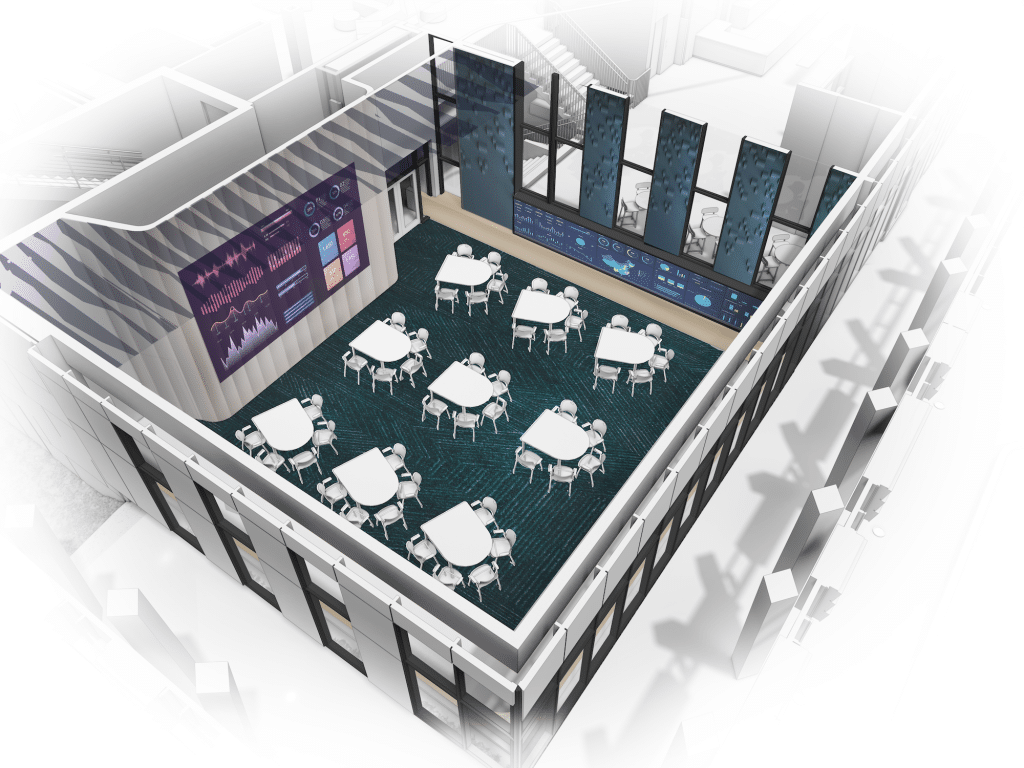
Tesluk cited the example of a finance class working with a financial organization on a new service or product. The process might begin in the Futures Lab, where students will be able to use advanced data visualization and analytics to explore a concept. Another space will facilitate the study of user experiences with technology, while a makerspace will give students tools to develop mock-ups or prototypes.
The building will host an immersive lab space where entire classes can use augmented reality/virtual reality headsets as exploration tools. The heart of the building will be the versatile Falcon Forum, an open space designed to support student entrepreneurs making presentations or engaging in competitions, among other activities.
Bentley emphasizes thinking entrepreneurially with real-world applications, and that requires state-of-the-art facilities and technology, Tesluk noted.
In keeping with the push to apply new technologies, Bentley has a new major in artificial intelligence, but AI is not limited to this specific major. “Part of what we’ve been doing all throughout the curriculum is taking a critical consideration of how we can infuse AI into different aspects,” he said.
The university describes the major as not merely teaching AI as a standalone skill, but also providing critical reflection on its ethical, social and societal implications.
The design of the Adamian Center is the result of a lengthy process involving considerable faculty discussion and trips to other universities with faculty, staff and the project architects, studioDSK.
Students had their say as well. At the instigation of a group of students, the building will have a café managed and run by students, a first for Bentley.
For more information, see the project web page.
Author






Comments (0)
There are no comments on this article.