Waltham composer’s achievements strike a chord with French Ministry of Culture
By JULIE M. COHEN
Waltham Times Contributing Writer
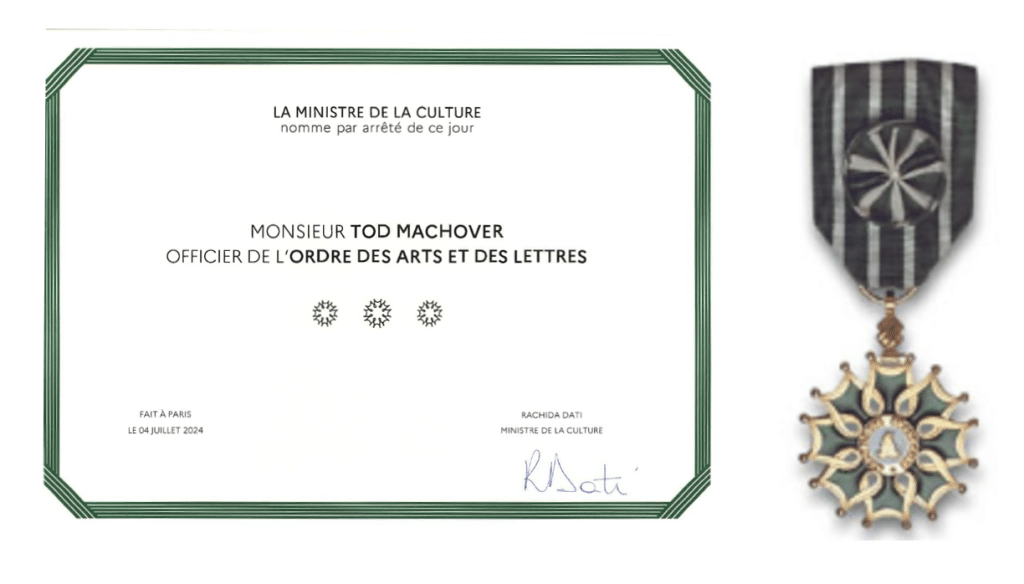
Credit: French Ministry Of Culture.
As a teen who played a wired cello in his rock band Hot Toddy Went West, MIT professor Tod Machover said he could never have guessed he’d one day be honored by the French Ministry of Culture for his impressive contribution to the arts as an adult.
The Waltham resident, 71, recently was awarded the rank of Officer of the Order of Arts and Letters, which “was established in 1957 to celebrate individuals who have made significant contributions to the arts, both in France and globally,” according to the MIT Media Lab where Machover is director of the Opera of the Future group.
“This means a lot to me,” said Machover, who lived and worked in France for several years. In fact, this is not the first time the composer/inventor has been honored by that country, since he was awarded the rank of Chevalier de l’Ordre des Arts et des Lettres previously.
“I certainly didn’t imagine as a teen playing Bach and rock with [a] wired cello that I’d be honored one day by the French Culture Ministry,” said Machover, who is originally from New York. “I always wanted to make a difference in people’s lives through music — even as a teen — but I didn’t imagine then that I’d feel at home in France or at MIT for that matter, or that places and institutions as diverse as that would honor what I had created and shared.”
Connecting disciplines
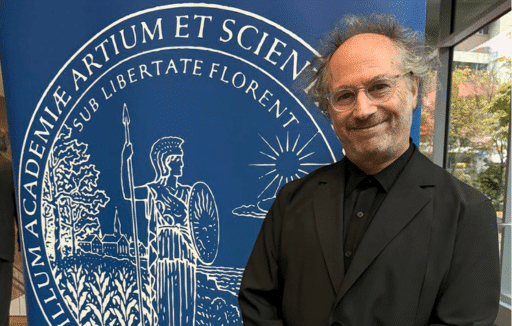
Growing up, Machover recalled, “We always had … technology and music in the house,” since his mother was a pianist and his father, an engineer, was involved with early computer graphics.
Although he played the cello since age 7, after high school he longed to be a composer rather than play with an orchestra. Machover attended The Juilliard School and after earning a few degrees, knew that his true passion was making music with computers.
A breakthrough came when he met famous French composer Pierre Boulez, who Machover said wanted to “make the music of the future.”
Boulez, who knew about Machover’s work, asked him to come to Paris to work at his new creation, IRCAM.
“IRCAM is an acronym that stands for Institut de Recherche et Coordination Acoustique/Musique. Roughly translated, it’s the Institute for Musical and Acoustic Research and Coordination,” according to NPR.
On its website the organization describes itself as “an internationally recognized research center dedicated to creating new technologies for music. The institute offers a unique experimental environment where composers strive to enlarge their musical experience through the concepts expressed in new technologies.”
Machover learned French and in 1978 moved to Paris where he had access to the cutting-edge technology of the time, including room-sized computers, to pursue his dream.
However, in 1985 he received a call from the MIT Media Lab that would change his life again.
According to its website, the Media Lab’s mission is “to create transformative technologies, experiences, and systems that enable people to reimagine and redesign their lives.”
“I knew this media lab was going to be really special,” said Machover. “It’s totally unique in the world.”
Graduate students can earn a master’s or PhD of science in media arts and sciences and learn from about 25 professors who run their own groups in different concentrations.
Machover is director of the Opera of the Future group where he said he has been able to consider “how music can have a powerful effect in the world” and bring different disciplines together.
Students in his program have a strong music background, often have a technology background and are very “open-minded about what music is and could be.”
Cutting-edge inventions
In addition to being a composer and professor, Machover is also an inventor of “Hyperinstruments.”
The Hyperinstrument project “started in 1986 with the goal of designing expanded musical instruments, using technology to give extra power and finesse to virtuosic performers,” according to the MIT Media Lab. “Since 1992, the focus of the hyperinstrument group has expanded in an attempt to build sophisticated interactive musical instruments for non-professional musicians, students, music lovers, and the general public.”
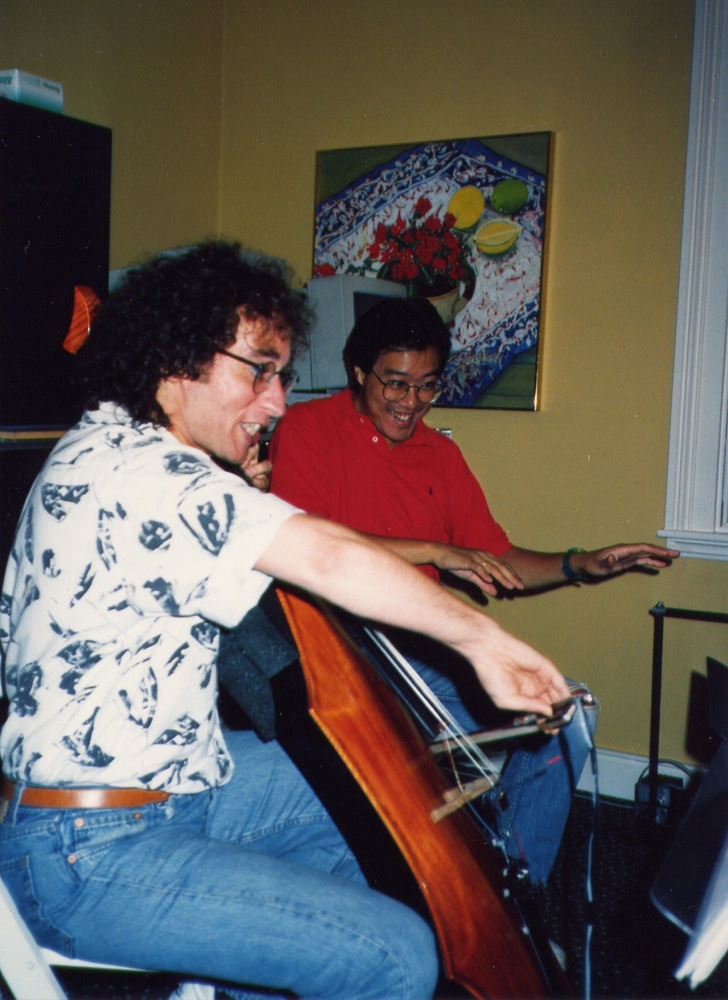
Machover developed one of those instruments — a “Hypercello” — for arguably the most famous cellist in modern history, Yo-Yo Ma.
The multi-award-winning artist had heard of Machover’s work, and the two met in the early 1990s. Ma, who was interested in learning different ways to play the cello, asked Machover to make him a “Hypercello.” The instrument could measure everything about Ma’s playing style, including the amount of vibration and the precise locations of his hands, among other elements.
“I wanted it to become more than just a cello,” said Machover.
He also developed “Hyperscore that uses simple lines and colors to open musical creativity for young people, to numerous sonic strategies for promoting wellbeing and combatting disease, to radical and rewarding applications of musical AI,” according to the American Academy of Arts and Sciences.
Over Machover’s multifaceted career he has created music and instruments and taught others that “music has enormous potential to be beneficial in the world. … There’s different ways to make it grow … and have an impact in life.”
Lifetime achievements
Machover’s achievements have earned him other notable accolades over the years, too.
He was a 2012 Pulitzer Prize finalist for his opera “Death and the Powers.”
Iin 2016 he was named Composer of the Year by Musical America, which wrote in his profile with the award announcement that it “is incredibly easy to be seduced and dazzled by the technology Tod Machover manipulates.”
And just last September he was inducted into the American Academy of Arts and Sciences.
Editor’s note: Tod Machover is the spouse of June Kinoshita, a co-founder of the Waltham News Alliance, publisher of The Waltham Times. Kinoshita was not involved in the reporting or editing of this article.