Surrealist artist Leonora Carrington offers “journey into the imagination” at Waltham’s Rose Art Museum
As Aine McGovern-Uebbing slowly walked around Brandeis University’s Rose Art Museum, she studied the multifaceted artwork of Surrealist Leonora Carrington (1917-2011).
“It’s really resonating,” said McGovern-Uebbing, an artist herself.
Visitor Monica Zgola, who first learned about Carrington at this exhibit, said she and her husband enjoyed the variations and style of the Anglo-Irish creator’s work.
“It’s very thought provoking,” said Zgola.
“The more you look at or into the images, the more you discover, unveil, and understand,” said Gannit Ankori, Henry and Lois Foster Director and Chief Curator of the Rose Art Museum, and Professor of Fine Arts and Women’s, Gender, and Sexuality Studies at Brandeis University.
The Rose show is the first time there has been a solo exhibit in New England of Carrington’s work, according to Ankori. “This presentation offers an extraordinary glimpse into Carrington’s captivating and complex worlds, where exquisite paintings and drawings give form to riveting epistemologies, unbridled imagination, and mystery,” she said. “Her work is powerful, timeless, and transformative.”
Early influences and memories
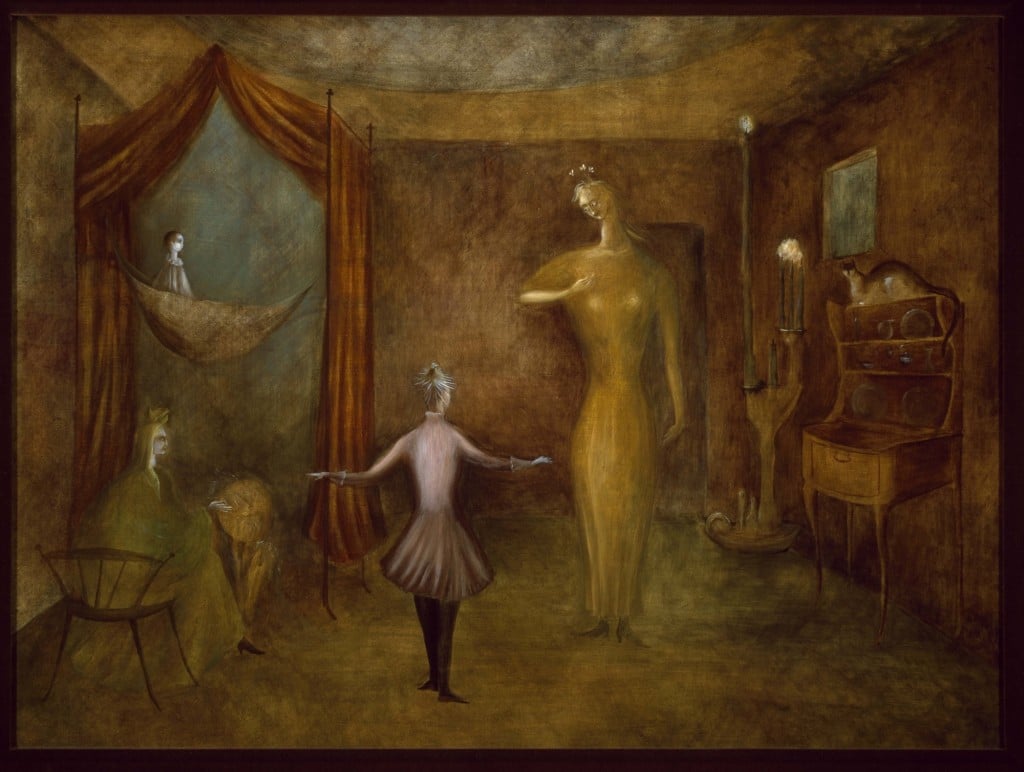
“The first paintings in the show [depict examples of] … the major influences that impacted Carrington during her formative childhood years. The ‘nursery’ scene [“Night Nursery Everything”] links her experience as a mother to her own childhood. The ‘chair’ [“The Chair: Daghda Tuatha de Danann”] directly relates to Irish mythology, which she learned as a toddler from her Irish mother, grandmother, and nanny,” said Ankori.
Another powerful oil painting with influences from Carrington’s youth is called, “Nunscape at Manzanillo,” which “references her negative experiences attending two Catholic schools and being expelled from both by the nuns,” Ankori said. “The nuns considered her a misfit. They did not understand her and tried to change her, crush her spirit, and transform her into a conventional young lady. She rebelled and hated them for limiting her creativity and imagination.”
McGovern-Uebbing also found the foreboding imagery in “Nunscape” reminded her of her own upsetting memories from her time in Catholic school. She recalled that the nuns who taught her would tie her left hand so that she would have to write with her right hand.
Visitor Alex Baldwin noted the painting’s darkness and said although it was quite scary, he liked it. “It’s amazing,” he said, while carefully studying Carrington’s other pieces.
“Always true to herself”
The Surrealist movement, which started in 1924 in Paris, was founded by André Breton and dominated by male artists, said Ankori.
“Many [male Surrealists] had relationships with younger female artists, and they viewed women as muses rather than artists in their own right,” she said. “They thought of women as femme-enfants or childlike creatures, close to nature, intuitive rather than rational.”
Although Carrington had a three-year love affair with artist Max Ernst, who was in his 40s when she was 20, “she was always true to herself,” said Ankori.
“She rebelled against her parents’ societal expectations, her Catholic upbringing, and the prescribed gender roles of the early 20th century,” she said. “Going to France to become an artist took much willpower and guts. She wasn’t going to let the Surrealist men overpower her or dampen her creative ambition.”
Ankori quoted Carrington as saying, “I didn’t have time to be anyone’s muse, I was too busy rebelling against my family and learning to be an artist.”
After living in France, she immigrated to Mexico where she continued developing her art and spent the remainder of her life.
‘Mesmerizing and mysterious art’
According to the Museum of Modern Art in New York, Surrealists believed that the “creativity that came from deep within a person’s subconscious could be more powerful and authentic than any product of conscious thought.”
The Swiss psychotherapist Carl Jung significantly influenced the Surrealist movement. Jung’s concepts of the collective unconscious and archetypes – innate, universal patterns of thought, behavior and emotion that shape human experience and are expressed through symbols and images – inspired artists to explore the subconscious and create dreamlike, irrational art.
The Surrealists were “interested in the occult and esoteric religions and ideas. Carrington was deeply engaged with multiple forms of esoteric knowledge, viewing them through a Jungian prism,” said Ankori. “Her art tracks a steadfast and profound journey towards self-knowledge and a deeper, alternative mode of understanding her complex worlds.”
Ankori described some of the unusual images in Carrington’s works where “creatures materialize within the branches of trees; eyes peer from a hole in the ground; a creature appears behind a curtain; birds show up in the sky as if painted with light,” she said. “Hybrid creatures describe possibilities that are beyond the rational, visible world.”
One of Ankari’s favorite pieces, “Dream Weaver,” which inspired the name of the exhibit, is a pencil drawing that includes intriguing imagery.
“[It] conjures up a riveting scene of a left-handed weaver — a probable symbolic self-portrait of the artist — fabricating a dream, a fantastical animal, and integrating herself into a cocoon that co-joins all creatures,” said Ankari.
In addition to the weaver illustration, an actual tapestry is part of the exhibit: “Untitled (Griffin).”
According to Ankori, Carrington brought weavers into her home in Mexico and worked with them for 10 years.
“She built a large, beautiful loom with them. Then she created the drawings and patterns for the weaving,” said Ankori. “While the weavers crafted the textiles in her home, Carrington supervised them. She included the weaver’s marking in the upper left corner, like a signature.”
The large weaving on display in the exhibition is a colorful and eye-catching two-dimensional mythical creature. It stares at the viewer from its flower-like face with a fanged smile. The tapestry is soft, but the griffin’s talons are sharp.
“I hope visitors enjoy the show’s incredible beauty and meticulously crafted paintings and drawings. I hope they take the time to discover the multiple layers and numerous symbols embedded within each composition,” said Ankori. “I also hope they allow themselves the freedom to embark on the journey that Carrington offers us — a journey into the unconscious, the symbolic, the hidden, the imagination, and that place where magic happens, even within our midst.”
The exhibit, “Leonora Carrington: Dream Weaver,” runs now through June 1, 2025, at Brandeis University’s Rose Art Museum, located at 415 South St., in Waltham. For more information, visit the museum’s website.
Photos courtesy of the Rose Art Museum.