Waltham company aims to recharge Massachusetts
When Anel Bellevue called fellow Bentley University student Mourad Mokrani last May to propose a business partnership, he knew where he wanted to begin: the clean energy sector. As self-styled “practical changemakers,” their intention was to influence a space where they felt business leaders were dragging their feet.
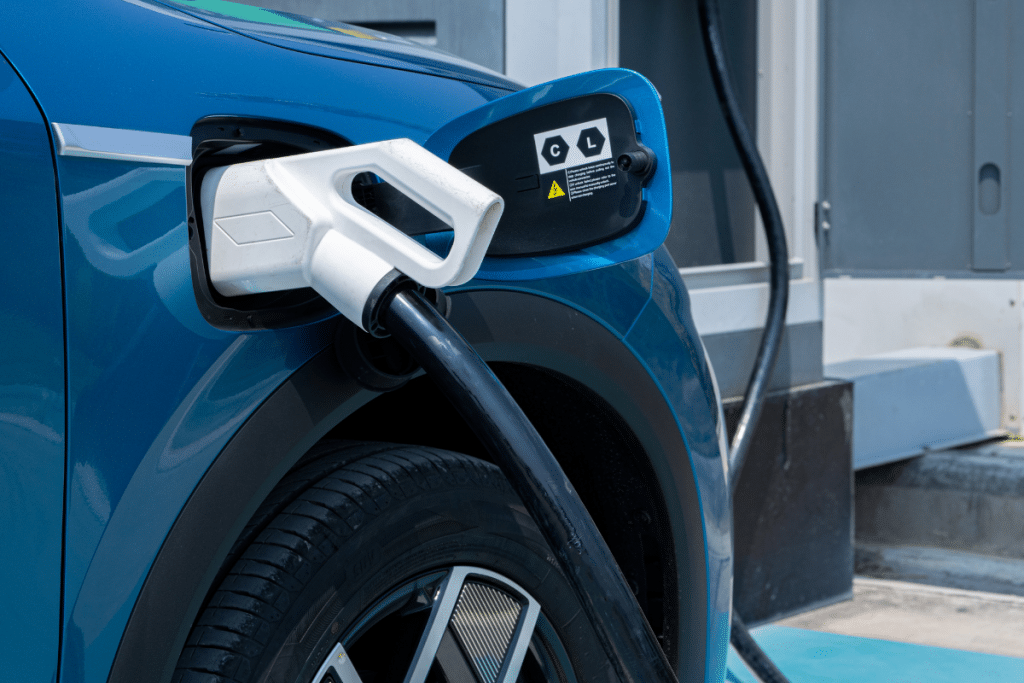
What they decided upon was Re-Volt Charging, a Waltham-based startup focused on installing and managing electric vehicle chargers in commonly-traveled and underserved Massachusetts communities.
Bellevue, soon to graduate from Bentley University with a Master of Business Administration, serves as its CEO. Mokrani, a current undergraduate fellow of Bentley’s Social Innovation Incubator, serves as Re-Volt’s chief financial officer.
The two started looking into EV charging after a business dinner on Moody Street where Bellevue had trouble finding a place to charge his car. This experience was consistent with feedback from other EV drivers in their professional network. Mokrani heard anecdotes about colleagues not being able to find sufficient or sufficiently powerful chargers in areas they were passing through.
The EV industry — along with many other environmental tech sectors — has been on the rise in recent years, partially owing to policies from the former Biden administration. This climb may suffer under the Trump administration’s tariffs and the current Congress, where Sen. John Barrasso,R-Wyo., recently proposed a bill to eliminate federal tax credits for EV purchases.
Still, some states have their own policies promoting EVs. For example, Massachusetts intends to ban the sale of nonelectric light body cars by 2035. To that end, the state oversees multiple programs to incentivize EV purchases, including MOR-EV, a program that gives Massachusetts citizens rebates when buying new or used EVs.
Infrastructure for EVs has not always kept up with sales, however, and there are significant gaps in current charging infrastructure.
“Currently, we’re trying to be where Tesla is not,” Bellevue said. “Tesla is primarily in super affluent neighborhoods where people have an existing infrastructure.”
Bellevue described how companies, municipalities and landlords create a self-fulfilling prophecy by not installing EV chargers in lower-income neighborhoods. Even when residents want and are able to purchase EVs, a lack of chargers may make electric car ownership prohibitive.
For that reason, Bellevue and Mokrani are hoping to install chargers in municipal and multifamily residential lots. Although they haven’t yet secured any public contracts, they’re reaching out to gateway cities like Waltham and Massachusetts communities where there has been less investment in such infrastructure.
The City of Waltham currently offers EV charging in six municipal lots. Colette Casey-Brenner, Waltham’s housing and community development director, said she hasn’t received any complaints about the availability of EV chargers from residents but would be happy to receive feedback.
She said that Waltham is hoping to add additional municipal EV chargers to the city every year. Earlier this year the City Council voted to use a $120,590 federal grant meant for energy efficiency projects to purchase 11 new EV chargers for multiple municipal lots.
Author