‘Men’s Shed’ group restores machinery — and community — in Waltham
Malcolm Burwell last summer worked with the Charles River Museum of Industry & Innovation to form a group of mostly retired men who repair old machinery and equipment. Their goal: finding a new sense of purpose while making social connections and contributing to the museum.
“It was a twinkle in my eye at that stage,” recalled Burwell.
Less than a year later Burwell is turning his vision into reality. The group now comprises six regular weekly participants who attend each Friday afternoon and continues to attract more people.
“I figure we hit a critical mass,” said Burwell, adding that he hopes to have 15 or so participants in the future.
Together they are digging deeply into the museum’s extensive archives and finding an array of equipment to fix, ranging from metalworking machines such as milling and lathe equipment, to old-time film strip projectors, coin sorters and cash registers.
This group is one of many around the world that call themselves a Men’s Shed. While the name conjures up a backyard storage structure, in this case it means a crew of guys who regularly commit to work alongside one another in a relaxed, social environment.
The Men’s Shed gets space and support from the Charles River Museum. In return, the men benefit the museum by working directly on its equipment and machines, which may then be displayed in future exhibits.
“If we’re providing a benefit, then the whole system is much more symmetrical,” explained Burwell.
“They’re getting something out of it; we’re getting something out of it.”
“They have a skill set we don’t have,” said Steve Guerriero, the museum’s director of education. “Their work makes these items actionable, relatable and gives people access to the history.”
Identifying the first participants
Burwell introduced the Men’s Shed to those interested by walking them into the basement storage area, which the museum calls the “way back” because “it goes on and on and on.” (He fondly referred to it as the museum’s “Aladdin’s cave.”)
After giving a tour of the premises, Burwell asked what would be fun to restore or understand. He explained that those with initial project ideas have typically wanted to join the group’s regular meetings.
“This is about the passion around old machines. The ‘way back’ is this fabulous fishing pool where you can take somebody around and go, so do you think you could catch any of these fish?” said Burwell.
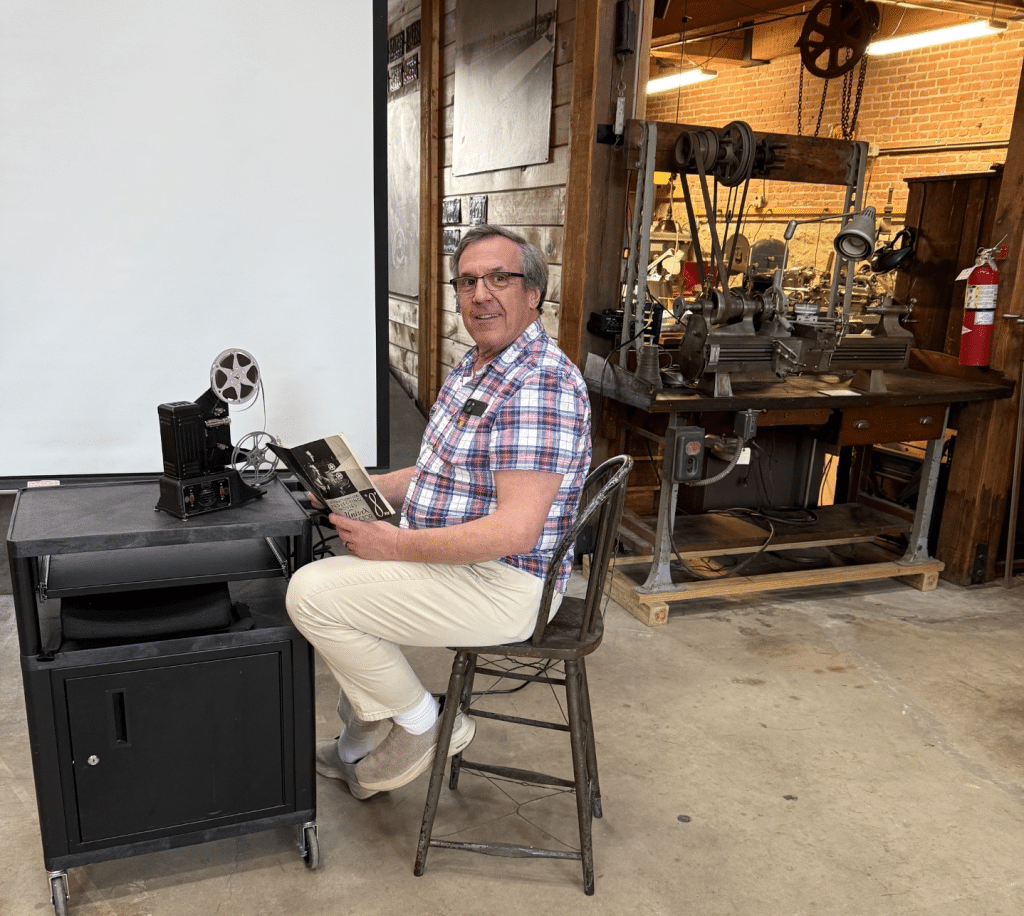
Burwell pointed to Ryan Spoering and Chet Michalak as two early group leaders who were enamored by the possibilities.
“Ryan and Chet, both were balls of energy, and it was very clear they would turn up every week while we tried to figure out what the heck we were,” said Burwell.
Several people have since joined the Men’s Shed, including one earlier this month who picked out a radio receiver as his first project, after first meeting Burwell at a local car show.
“There’s more and more interest, momentum is clearly building,” added Guerriero.
Progress in restoring old-time machines
Because the museum stores a plethora of Industrial Age equipment, there is no shortage of projects to pursue.
“Like all museums, there’s more in storage than we can possibly display at any one time,” explained Guerriero. “It’s in various stages of repair and disrepair.”
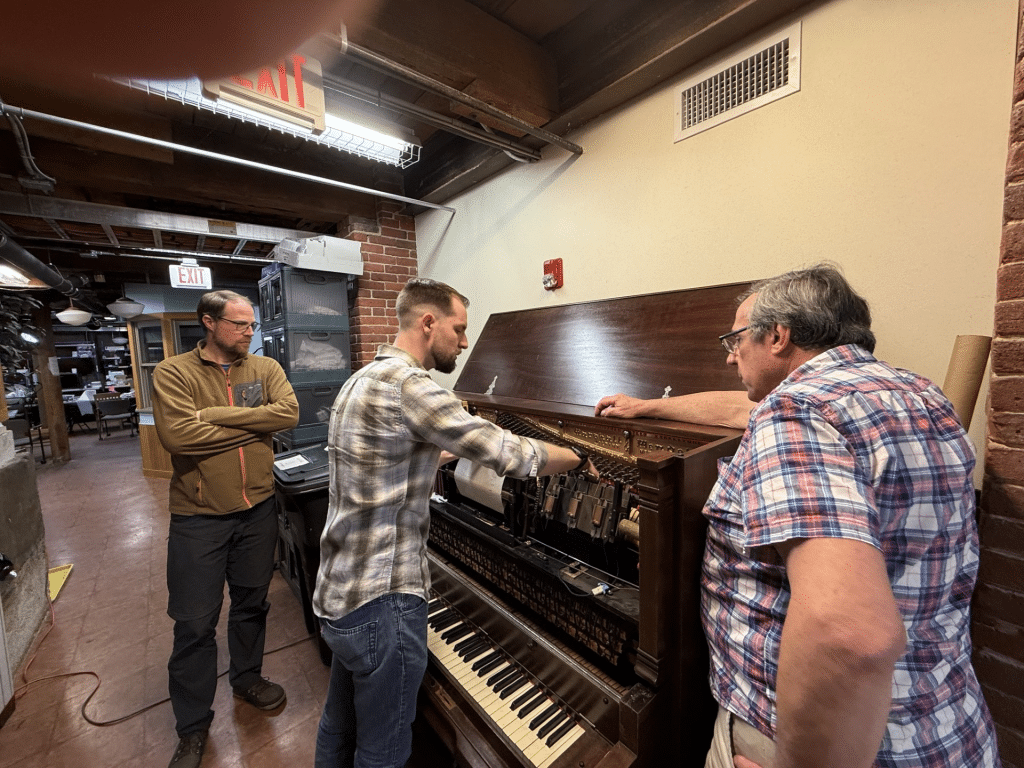
On a recent Friday afternoon a local piano restoration expert joined the other Shed participants. They intently studied the inner workings of an early 20th-century player piano, including its air-powered pumps and hammers for pushing down keys. This type of piano is designed to play music on its own, but that functionality no longer worked.
After group troubleshooting, several participants transitioned to their own projects. Michalak worked on a old 8mm movie projector with film strips rolled up into a couple of large reels. Burwell referred to Michalak as “Mr. Optical,” because he initially worked on a piece of equipment that measured the curve around the back of the eye.
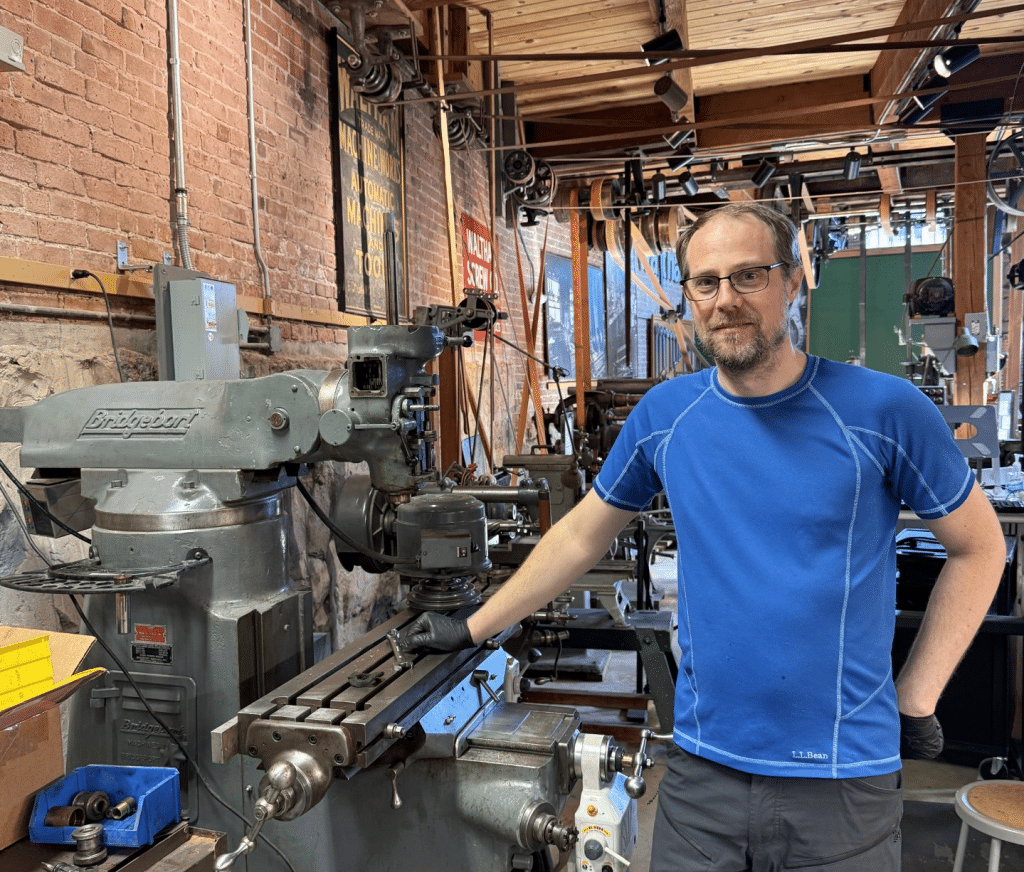
Meanwhile, Shed participant Spoering was in the museum’s machine shop, which included milling equipment made by Bridgeport.
Before starting to make repairs on the Bridgeport, Spoering recalled, “I pulled it apart…the machine was locked up like an old person.” He highlighted the machine’s foundational role in metalworking, stating that “Bridgeports have made the world.”
“We’d have groups from machine companies come and recognize these machines by name and by sight,” said Guerriero. “The Men’s Shed is bringing them back to life.”
Like Spoering, Burwell started repairs by taking apart the equipment. He carefully labeled parts and took pictures so he could later retrace his steps while trying to learn what each part does. He could then test various repairs to see what works.
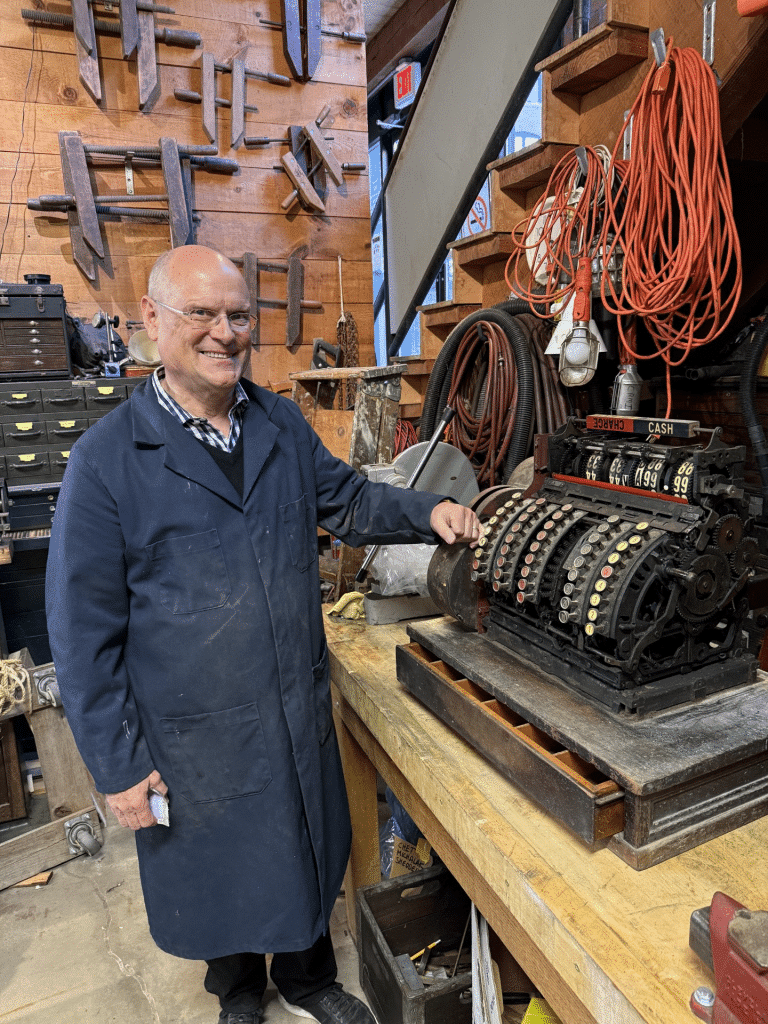
“I chose things that I thought, ‘Those mechanisms are fascinating,’” explained Burwell. “One of the most fascinating is, in an all-mechanical cash register, how does it remember how much money was spent during the day?”
He has left no stone unturned in his efforts, such as tracking down a former vice president of National Cash Register to obtain an instruction manual. After getting several coin-related machines to work, Burwell and the museum are discussing opportunities to incorporate them into a future children’s exhibit.
While there has been much progress, participants are also benefiting from newly formed bonds with one another.
“We get there at 2 o’clock, we stand around and chat for a while. The British call it the ‘How’s your father’ period,” explained Burwell, adding that at the end of their get-together, “it’s not uncommon for us to then stand around for another 15 minutes, even though we’ve all agreed we’re going to go, and talk about something.”
“Ultimately, this museum is a space for community,” said Guerriero. “These are people who didn’t know each other at first, and now they’re good friends.”
For those interested in more details about the Shed or how to take part in this group, contact Burwell at mcburwell@aol.com.
Author