
To control rats, save the raptors
By LINDA GRAETZ, GUEST CORRESPONDENT
The death of a majestic bald eagle during the winter of 2023 sent shockwaves through the environmental community and sparked a local movement that continues today. The eagle, known as MK, was the third member of a family that once lived in Waltham’s Mount Feake Cemetery to die from anticoagulant rodenticide poisoning. This was yet again a tragic reminder of how efforts to control rodent populations can have devastating unintended consequences.

Inspired by environmental advocate and journalist Laura Kiesel’s presentation on the dangers of second-generation anticoagulant rodenticides to wildlife, four concerned Waltham Land Trust members formed Save Waltham Wildlife that February. The group has an ambitious goal: to reduce and eventually eliminate the use of these deadly poisons throughout the city. SWW’s mission has taken on new urgency as Waltham grapples with what many residents simply call “the rat problem.”
Finding a home with the Waltham Land Trust, SWW has adopted strategies for open communication and engagement with city councilors, the mayor and other officials to increase public awareness and implement safer solutions for rat control. Specifically, SWW promotes an understanding of responsible integrated pest management for rat control, which is based on these three principles:
1. Starve. Remove rats’ access to all food and food wrappers on the streets and in open containers as well as around dumpsters and garbage cans. All trash containers should be closed on all sides.
2. Exclude. Seal any holes and openings where rodents might enter your building.
3. Monitor and control. Remove remaining rodents using nonpoisonous methods, of which there are many options. Finally, monitor your efforts and track progress.
A strategy of engaging and communicating
In the spring of 2023 SWW/WLT hosted “The Rat Poison Problem,” a public talk by Laura Kiesel at the Waltham Public Library.
By the fall of that year, the City of Waltham announced it would no longer use traps containing SGARS on city property. During the 2023 municipal elections the WLT hosted a candidates’ forum and asked candidates for their specific rodent-control plans.
While progress may seem slow at times, SWW’s efforts are yielding results.
After pushing the city to invest in fully enclosed smart trash receptacles, the city in January began placing them on Moody Street and other key locations. This was a huge step in addressing the food source problem, as poorly maintained and overflowing trash barrels contribute to the rat problem.
Earlier this year a City Council committee began work on a new dumpster ordinance. When the draft was open for comments, SWW expressed concerns about a few requirements. The committee listened and then streamlined the new dumpster ordinance, which eventually passed on April 14, 2025.
And this spring SWW met with Brandeis University officials to talk to them about the use of anticoagulant rodenticides on campus, which abuts important wildlife habitat. As a result of the meeting, Brandeis officials announced the university will no longer use SGARs on campus.
What’s next?
Much remains to be done. While the city is making progress on trash containment, expanding access to lidded trash barrels for all residents would be a valuable next step.
We SWW members would like the city to promote integrated pest management and discourage use of SGARs throughout Waltham.
And we will continue to educate and activate the public through our webinars and in-person meetings with businesses and nonprofit groups.
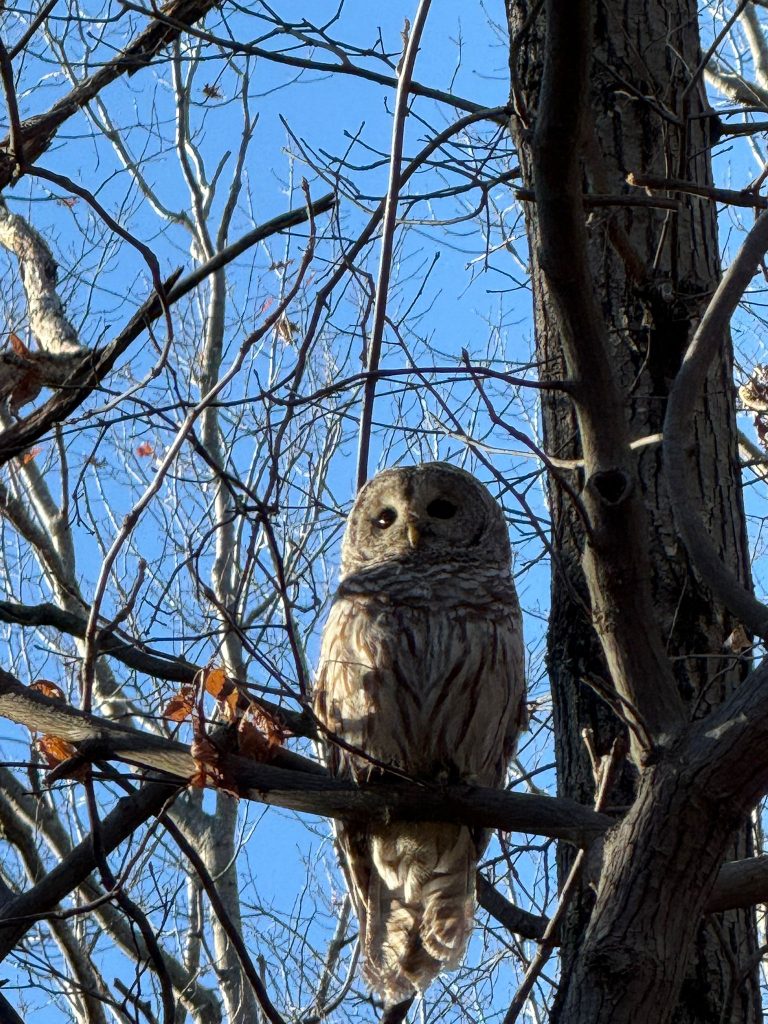
Additionally, SWW, as a member of the Mass Audubon’s Rescue Raptors coalition, joined 40 other coalition members on July 24 at the Statehouse to meet with representatives to advocate for H965/S644, An Act Restricting the Use of Rodenticides in the Environment. We’re proud to say that our state representatives Thomas M. Stanley and John Lawn and our state senator Michael Barrett have joined more than 113 others as co-sponsors of this bill!
Since the death of MK in 2023, more raptors in Waltham have died or have suffered from SGAR poisoning. This is happening all over the state and our country. The loss of these birds, our natural rodent-control predators, on this large of a scale impacts everyone. A poison-free collaborative approach to rodent control benefits not only humans but also our wildlife partners.
What can Waltham residents do to help? Please join our mailing list and become an active volunteer by contacting savewalthamwildlife@gmail.com. Find out more at www.walthamlandtrust.org/save-waltham-wildlife/.
Linda Graetz is a founding member of Save Waltham Wildlife, an initiative of the Waltham Land Trust.
Comments (5)
Comments are closed.


I came home one day last year to find a beautiful red tail hawk dead in our yard, no doubt from eating a poisoned rodent. Such a loss.
I hope Linda Graetz follow up her article with another describing alternative methods to rodent control including, perhaps, links to reviews of easy-to-set traps
We have an occasional mouse problem in our home. I am trying to find a service to eliminate them from the home without the use of poisons. Is there a list of companies who do not use poisons and don’t make the homeowner set/check snap traps? Thanks!
Red-tailed hawk extermination services is up for the job. They don’t have a website, phone number or flashy trucks and vans, but rather wings and rusty red tails. As you guessed they are wild animals, and they will eat thousands of rodents per year. All they ask is you thoroughly check your property for entrances and check your waste baskets and to seal them properly to ensure no rodents enter dwellings and no poison obviously.
Big Belly trash receptacles are also on Main Street and the Waltham Common. We truly appreciate the city installing these and would LOVE to see more placed elsewhere!
Thanks for the update, it’s so important! Pets are poisoned and die, too. A friend’s dog was poisoned twice, once very seriously but luckily did not die.
Many, many thanks to the City of Waltham for its decision not to use SGARs and for beginning to install closed trash receptacles.
A follow up article on non poisonous options and their pros and cons would be so helpful for private citizens and organizations to consider. Having a written outline can help make decisions and spread the word.
Thanks, again!