Gold Fencing Club: From the Olympics to Waltham
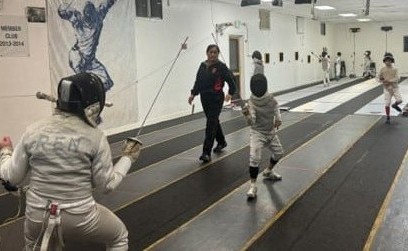
On a noisy Wednesday evening inside a modest fencing gym off a Waltham side street, the metallic click of foils mixes with rapid conversations in English and Chinese, children calling out for missing gloves, and the steady beep of scoring machines between bouts. Parents stand along the wall, watching practice while discussing their midweek schedules.
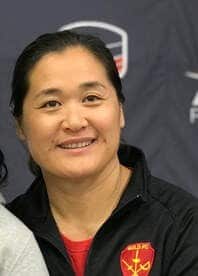
At the center of it all stands Coach Huifeng Wang, calm, firm and unmistakably in command.
“Keep your elbow up! Footwork, focus!” she calls out, her voice carrying across the room.
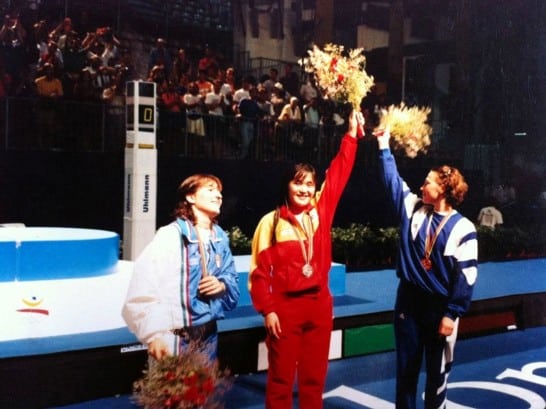
Before she was the coach running drills in a crowded suburban gym, Wang earned a silver medal in women’s foil at the 1992 Barcelona Olympics. Born in 1968 in Tianjin, China, she began fencing at 14 and advanced rapidly, eventually representing China at the 1992 and 1996 Olympics, as well as world championships and Asian Games.
Today, far from global arenas and television cameras, Wang trains young fencers in Waltham — many of them beginners, many from immigrant families, all trying to balance school, sports and growing up.
‘From international arena to the children of Waltham’
Wang’s path to Waltham began with a connection that tracks to the highest levels of Chinese fencing. After retiring from international competition, she moved to the United States in the early 2000s and spent several years in different cities, including a period in Las Vegas, where she coached recreational fencers on a small scale.
Her move to Massachusetts came at the encouragement of Guogang Wen, her former national team coach and one of China’s prominent figures in fencing. Wen, who joined Harvard University’s fencing coaching staff in the early 2000s, had been working with a small group of young fencers in the Boston area but was preparing to step back for health reasons. He asked Wang to continue teaching the students he could no longer train.
“I came just to take a look,” Wang said. “And then I stayed.”
Her early years in Massachusetts were improvised. She taught two evenings a week in a rented multipurpose room at a local Chinese community school, setting up and taking down equipment for each session and occasionally ending practice early when another group needed the space.
As participation grew, she founded Gold Fencing Club in 2012, later moving it to its current location in Waltham. The space reflects her understated approach: no oversized banners or glossy displays, just rows of masks and jackets and a steady rhythm of students practicing side by side.
‘A laid-back approach that builds confidence’
Parents say Wang’s approach feels different from more commercial youth programs, where trial lessons can resemble sales pitches. Nina Cheng, whose 10-year-old son has trained at Gold Fencing Club for more than a year, still remembers her first phone call with Wang.
“I was just asking about class times and what fencing lessons were like,” Cheng said. “And she told me, ‘Just bring him in to try it, let him come feel it, come play.’”
For Cheng, the simplicity of that invitation stood out. Wang focused on how her son responded once he stepped into the room. Cheng said she noticed how attentive Wang was to small, practical details: helping a disorganized student get ready by tightening gear, fixing loose straps or making sure jackets fit properly. Wang also kept snacks on hand “just in case,” and calibrated her coaching style to each child’s temperament.
Cheng said her son, who had tended to stay on the sidelines in group activities, began participating more during practices. “He opened up a lot,” she said. “Fencing helped him build confidence.”
In the Waltham area, fencing remains relatively unknown. Cheng said that when she mentions the club to non-Asian parents at her son’s school, most of them are surprised and say they didn’t know Waltham had a fencing club.
Gold Fencing Club now draws students from Waltham and from neighboring towns such as Lexington and Newton. Many families come through personal recommendations rather than advertising, a pattern that has shaped the club’s steady growth.
Several former students have gone on to fence in USA Fencing championships and later attend universities such as Yale, Brown and Harvard. Wang prepares her students to compete seriously, but in practice, she focuses on the habits that make improvement possible.
During practice, she moves steadily from strip to strip, rechecking grips, tightening masks or demonstrating a movement with practiced ease. Her coaching blends precision with warmth; she occasionally corrects firmly, and other times she uses a quick joke to settle a nervous beginner.
“If fencing helps them become braver or more focused,” she said, “that’s already success.”
‘Kindness and a foil in hand can open a child’s world’
Wang speaks about her Olympic years with the same lightness she brings to her evening classes. Her achievements remain a quiet part of her past, not something she emphasizes in public.
“I’ve had a very fortunate life,” she said. “If I can use what I learned to help kids grow, that feels meaningful.”
As practice winds down, Wang moves through the room with quiet efficiency. She straightens a rack of jackets and answers parents’ questions about registering for upcoming tournaments. A younger student runs over, mask slightly askew, eager to describe the touch he just landed. Wang listens, nods and offers a small smile.
“Good,” she tells him. “Keep going. You can do more.”
When class ends, the room shifts into its familiar post-practice routine. Kids spill off the strips, sweaty and flushed, many insisting they’re “not cold” as they try to leave without their jackets. Wang stops them one by one, gently but firmly urging them to bundle up before heading outside.
After decades at the highest levels of competition, the former Olympian says she has found a quieter, steadier kind of fulfillment, one built on a belief that discipline, kindness and a foil in hand can open a child’s world.
This story was written in collaboration with the Boston University local journalism program.
Author