
Residents demand explanation for Mayor’s new time limit for Waltham Common events
Since Mayor Jeannette A. McCarthy imposed an administrative order last month limiting the length of Waltham Common events to four hours, residents and organizers have questioned the legitimacy of the new rule and whether the mayor’s reasoning holds up.
The mayor’s Jan. 15 notice referenced “noise, neighborhood complaints, wear-and-tear, public safety concerns and the number of applicants asking to use the Common” as reasons to cut down the durations of events on the common. However, concerned citizens have investigated the specifics of these complaints and come up empty-handed.
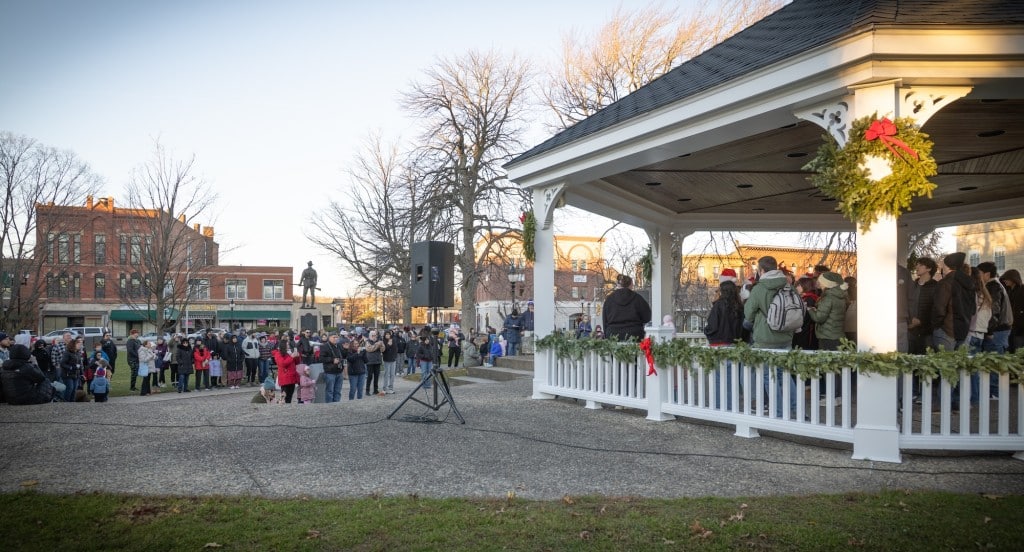
Waltham resident Kate Fontes submitted a public records request to the city’s Law Department for noise complaints, police reports, repair invoices and permit applications from 2023 to 2025 and received more than 3,000 files. However, Fontes was unable to find “citizen complaints, police incident reports, enforcement actions or other documentation substantiating claims of noise, public safety issues or related concerns cited as justification for the policy,” according to her Feb. 2 correspondence with the mayor’s office.
“I am strongly opposed to elected officials unilaterally making decisions about public spaces that affect public use. It is troubling that there was no public input, no grandfathering of existing uses, and that the narrative became ‘this is a done deal’ with no recourse,” Fontes said.
City charter puts the mayor in charge
The Waltham city charter gives the mayor the executive power to make such decisions.
“Oversight of the Common falls within the Mayor’s administrative authority,” said Ward 7 Councilor Paul Katz in a Feb. 24 email to The Times. “The Council does not have a formal role in setting those policies, and we were not (nor were we required to be) consulted prior to the recent decision.”
Executive actions such as this can take effect immediately and do not require prior approval by the City Council. Waltham operates under Plan B of its city charter, laid out by Massachusetts state law. Plan B is often referred to as a “strong mayor” system. In this kind of charter, the mayor is the executive arm, while the city council is the legislative arm – keepers of checks and balances but in situations like these are observers of executive action. The cities of Newton and Boston use the same structure.
As Fontes waits for the mayor or other city officials to produce tangible reasoning for the time limit, she has requested that the City Council place the new rule on a meeting agenda for public discussion. Under Waltham’s city charter, the council can request information from the mayor, pass a nonbinding resolution expressing its view and even attempt legislative action. What it cannot do is veto an administrative action.
Additionally, according to City Council members, the mayor holds administrative authority over the common. Ward 3 Councilor Bill Hanley told The Waltham Times in a Feb. 24 email, “The city charter gives the mayor the right to administer and permit use of the common. I understand some people disagree with that, but it is what we have to work with at this time.”
The mayor’s jurisdiction over permits to use the common wouldn’t be out of the ordinary, but attorney and Waltham resident Jessica Scherer said unilateral control over anything that happens on the common is less routine.
“That strikes me as odd,” she said in a Feb. 26 interview. “It didn’t pass my smell test in terms of what I know about basic separation of powers and checks and balances. Legislatures make law, executives enforce law. Assuming she has unilateral decision making power over the common, the restriction itself is unconstitutional.”
Moreover, Scherer said the time limit rule does not address the issue of noise complaints. As Scherer put it, “There’s also no connection between four hours and ‘wear-and-tear.’” She added that the common is not located in a residential area, and that the noise complaints contained in the public records request were actually in connection with the recent anti-ICE and No Kings protests.
‘Plundered by Time Pirates!!!’
In the meantime, community organizers have felt the blowback from these new restrictions. The Watch City Steampunk Festival has made several statements on its Facebook page regarding the new time limits, telling followers and vendors, “Rest assured that we will look ahead to other options for 2027.”

Melissa Honig, lead organizer for the Steampunk Festival, said in a Feb. 25 email, “We’re also in search of other events happening in Waltham on May 9th that people can attend after our event is over. We’re hoping that these ‘extra hours’ will give people even more reasons to come to Waltham.”
Its Facebook page says something similar, although with Steampunk flair, declaring, “Calamity! Catastrophe! Oh, Citizens of Watch City, our dear Watch City Steampunk Festival has been plundered by Time Pirates!!!”
Hanley said in a Feb. 24 email, “I’m hopeful we can come to a compromise and the city can still provide and fund bathrooms, permitting and trash removal.” Councilor Katz agreed, stating, “I hope that organizations that host events on the common are able to continue doing so in a way that maintains that balance, and that any concerns can be addressed constructively.”
However, unease persists among citizens. “It irks me as an attorney to see any government overstep,” said Scherer. “It’s gonna hurt the city culturally and financially.”
“[The common is] our land, we pay the money to upkeep it, we pay the police officers who patrol it,” she continued. There’s nothing about that space that doesn’t belong to the public. If this were to go to court, the common would be entitled to the highest amount of protection.”
Author

Comments (13)
Comments are closed.

Unfortunately the 10 people that actually vote in the city would unironically crown the Mayor if they could, so I don’t see this going anywhere.
So the Mayor can do this unilaterally because of the type of charter we have? Despite the fact that a huge number of residents seem to be against it?
Sounds like it’s about time to convene a charter review committee…
The quote from Councilor Hanley may give readers the understanding that the Common is specifically mentioned as being under the mayor’s control, although I don’t think that he meant to give that impression. The mayor’s executive powers all come from section 3.2 of the City Charter which states:
“The executive powers of the city shall be vested solely in the mayor and may be exercised by him either personally or through the several officers or boards in the ir respective departments, under his general supervision and control. The mayor shall cause the laws, ordinances and orders from the government of the city to be enforced and shall cause a record of all his official acts to be kept.” The Common is never mentioned in the City Charter. There is also nothing in the Charter to keep the City Council from passing ordinances that makes changes in how the public has access to the Common.
At the Prestige Car Wash on Elm Street, not far from the Common, there are big signs warning “NO MUSIC, per City of Waltham. Violators will be asked to leave.” That suggests that amplified music is an issue in the immediate area. Closing the festival window to four hours, however, does not address what may be a legitimate issue.
The Common belongs to all residents of the City. Traditionally, it’s a place for both cultural and political expression—what we think of as free speech. There can be no doubt that closing the window to four hours can have a chilling effect on that speech, at a precarious time when it is under attack.
I urge the Mayor to relent on this issue; instead, work with the community on strategies to control amplified sound, which in truth can sometimes be deafening.
I’d hate to see the Anti-ICE and No Kings rallies take the heat on this one—they’re generally one-hour standouts mid-day on a Saturday, with activity concentrated on the public sidewalks. And it shouldn’t have to be noted how crucial the free and open exercise of Waltham citizens’ First Amendment rights are to the cultural and political life and health of our city!
It’s the COMMON – a place for everyone to visit, rest, walk, hang out, rally, and enjoy all kinds of cultural events. I live nearby and enjoy being able to walk over and see what’s happening and/or participate.
If folks living nearby don’t like any noise – MOVE – this is the city!! Cities are noisy, busy places and offer all kinds of stores and museums, restaurants and activities within walking distance. Whether I participate or not, I like the fact that folks come from all over to experience what is offered on the COMMON. My family attends Steampunk every year and would be sad if they were forced to find another more accommodating venue. The variety of events makes living here interesting – many are less than 4 hours yet to impose that arbitrary limit negatively affects the couple of longer, fun events enjoyed by so many.
Thank you for investigating. I hope we see a ballot initiative for term limits.
If Waltham wants to be a destination for unique, special events like Steampunk, then this new regulation is an atrocity. Last year was my first time attending Steampunk, and I was blown away by how far people had traveled to participate — literally from all over the country! What a great opportunity to share our industrial history and invite new folks to patronize Waltham businesses.
This action seems short-sighted indeed, and I suspect is directed at recent and future No Kings protests, rather than reflecting actual issues of noise complaints or wear and tear…
If only we could limit the constant noise from vehicles to 4 hours per day. Waltham is lucky to have a large common green space with mature trees. A public park thrives when it’s occupied and falls into neglect when it’s ignored. Perhaps she’d prefer a common like Newton Centre Green: a parking lot.
Thank you for looking into the noise complaints- it never made sense that this was the reasoning. This appears to be a wholly irrational decision by the mayor that negatively impacts really special events that organizers work hard to put on. I wish the mayor would listen to the overwhelming feedback and reconsider her decision
Great reporting!
Thank you for publishing this! I’m grateful to Kate Fontes for driving deeper into the alleged justification for this rule. The mayor’s decision seems arbitrary and i don’t buy the reasoning behind it.
Thank you for this excellent reporting.
Facts matter. Accountability matters.
Keep it up.