
State’s report card ranks Waltham High in bottom 10%
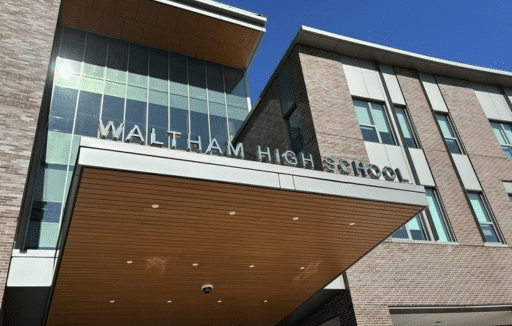
Waltham Public Schools fell short in student performance in a number of categories, despite scoring a three-year high on making progress toward improvements.
That’s the conclusion reached by the state’s Department of Elementary and Secondary education, which is responsible for overseeing the education of children in pre-kindergarten through grade 12 in Massachusetts.
DESE issued its 2025 report card for WPS, which contains wide-ranging data sets and vastly different performance scores for schools in the district.
The report, issued in early February, covers Massachusetts Comprehensive Assessment System performance data, rates of chronic absenteeism, diversity of coursework, spending per student and more.
Multiple years of data in these categories contribute to an accountability rating for each school in a given district, which measures overall school performance. The district as a whole receives a growth percentage, which denotes its “cumulative progress toward improvement targets.”
While WPS as a district has scored a three-year high of 53% progress toward targets, placing it in the “substantial progress” category, some schools lag far behind its overall standard of growth.
WPS comes up noticeably short in comparison to the state average score. The 2025 report card found that only 22.2% of WPS students take a digital literacy class compared to 38.6% statewide. 70.9% of students pass all of their ninth grade courses, which is 10% less than the total of students across Massachusetts.
Challenges at the high school
The biggest outlier in the 2025 report is an accountability percentile score of nine for Waltham High School. That figure places the school in the bottom 10% of all Massachusetts public schools, meaning 91% of schools outperformed it on the state’s measures.
WHS is the only school in the district which DESE has deemed is “requiring assistance or intervention.” This distinction is not entirely dependent on a school’s accountability. For example, Plympton Elementary received a score of 29 and yet was put in the highest growth category, “School of Recognition.” This is because it met the improvement targets laid out by DESE.
WHS, on the other hand, has a growth score of only 17%, meaning it has made very limited progress toward performance goals set by the state. WHS, the city’s sole high school represented in DESE’s report, has risen just 1% from its 2024 placement in the eighth percentile.
The report also tracks how many students go on to postsecondary education, which is defined by the percentage of students who are enrolled in a two- or four-year institution by March 1 of the year following graduation. For the class of 2024, counting all students, Waltham saw 59.2% of its students go on to attend a postsecondary institution, compared to the state’s 63.5%. But among English learners, only 13.3% of WPS students were counted as part of the college-going population, compared to the state’s 30.5%. This figure is down from 17.2% in 2022.
Despite Waltham’s lower performance than Massachusetts as a whole, some performance metrics are on the rise. The ninth grade course-passing rate was up more than 5% from last year, and the dropout rate for grades 9-12 was down from last year’s 14.4%.
Immediate action sought to address rising dropout rates
The 2025 Report Card includes some figures from the 2023-24 school year, such as graduation and dropout rates, because that data takes time to compile. According to a WHS school-wide correspondence from Superintendent Marisa Mendonsa sent March 11, DESE has released the graduation and dropout rates for the 2024-25 school year, and the progress seen the year before has declined.
The graduation rate has fallen 1.5% to 79.3% for WHS, and does not include Valor High School which operates on a flexible, asynchronous schedule to accommodate students with special circumstances outside the classroom.
The dropout rate has also risen to 15.5%, nearly triple the state average of 5.8%.
Mendonsa stated in the email, “While some districts face similar challenges, the data shows Waltham’s dropout rate is among the highest in this comparison group, reinforcing the need for immediate and sustained action. Improving graduation outcomes and ensuring students remain engaged through completion of high school is a top priority for the district.”
She also said the School Committee would discuss possible solutions at an upcoming budget workshop.
Some bright spots
Despite WHS’s jarring accountability score and the newly released high school outcomes, the report card is not all negative. Attendance percentages are high and chronic absenteeism rates are low, in line with the standard across Massachusetts. The detailed accountability report for WHS also showed growth “exceeding targets” for English learners making progress toward attaining English language proficiency.
Additionally, WPS’s other schools are performing well, on the whole making either moderate or substantial progress toward growth markers set by the state. MacArthur Elementary scored the highest in the district with a 58th percentile accountability rating.
However, a ninth percentile accountability score for Waltham High School points to structural issues and brings negative attention to the district. According to DESE, it is among the worst schools in the state of Massachusetts. Mendonsa, in conjunction with the School Committee and Mayor Jeannette A. McCarthy, who serves as the School Committee chair, face the challenge of translating awareness of the results into tangible action.
UPDATED March 13, 1:09 p.m. Due to a reporting error, the initial version incorrectly stated that only 13.3% of WPS students were counted as part of the college-going population. This figure pertains to WPS students who are English learners.
Author

Comments (6)
Comments are closed.


Teachers Union should spend less time protesting courthouse and more time teaching.
These data seem pretty sobering, as is the reported comment about discussing possible solutions at an upcoming budget workshop. How can this very poor performance be new news? What information is available to the community about execution of the 2023-2027 Strategic Plan and the extent to which the Plan ties to the metrics tracked by the State?
I believe there may be an error in the postsecondary education statistics included in this article. The 13.3% referenced in the article is the percentage of English Learners who are enrolled in postsecondary education in March of the year following graduation; the overall rate reported is 59.2%. The link to the report is: https://profiles.doe.mass.edu/nsc/gradsattendingcollege_dist.aspx?orgcode=03080000&orgtypecode=5&fycode=2024
Thank you for pointing out this error. The 13.3% figure was for English learners. We have corrected the story.
When I look at the report data, it appears that the statistic is 59.2% attending college/university, rather than the 13.3% mentioned here. Is there a specific section of the report where the 13% rate is cited?
Thank you for pointing out this error. The 13.3% figure was for English learners. We have corrected the story.