
Town hall on Flock cameras and Waltham Common event time limit draws passionate community voices
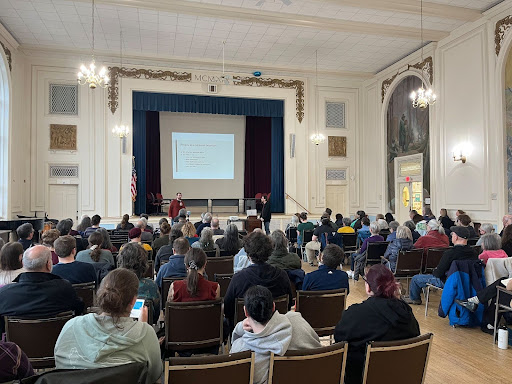
Residents packed Government Center on March 31 for a town hall organized by City Councilor-at-Large Colleen Bradley-MacArthur to discuss the recent installation of Flock Safety cameras throughout the city and Mayor Jeannette A. McCarthy’s recent administrative order setting a four-hour time limit for events held on Waltham Common.
Several community members gave short presentations before the public forum began, including a Waltham High School freshman named Joshua Guerrero who started a petition against the Mayor’s new time limit. Joshua specifically spoke about the impact the time limit will have on the Watch City Steampunk Festival, whose organizers have publicly stated that the Mayor’s order will have a negative effect on their event. “Let’s not put time constraints on the common and keep Waltham fun,” Joshua said.
The crowd also heard a presentation with an accompanying slideshow from Jake, who has lived in Waltham for 11 years and shared his concerns about privacy since the Flock cameras were installed in June 2025. Referring to the information that Flock cameras will collect on residents, he said, “You used to need a warrant for that information, but now you can outsource it to a tech bro.”
Another speaker, Christine Willis, discussed the character of Flock Safety, the company that manufactures the cameras. “The police department has signed an agreement with Flock, but Flock is in control… Flock does not care to follow policies and they can and will break them,” she said.
More than 20 residents spoke to criticize Flock in the public input section of the event. Another petition was organized by concerned citizens, which asked for the Waltham Police Department’s contract with Flock to be dissolved and the cameras removed. Some speakers called for the cameras to be covered up immediately while the city figures out how to regulate them.
Speakers also questioned the City Council’s allowing the contract in the first place. One Angleside resident questioned how the police department was able to sign such a contract without review and pay the $48,000 price tag for the cameras without going through the city budget. “I really feel the council is falling down on the job here,” he said.
Jonathan Paz, a former city councilor and former employee of Flock, echoed the man’s sentiments. “This is very disrespectful that [the Mayor] completely bypassed the public procurement process… That says a lot more about them and what they think about you,” he said.
Clarifying the council’s actions
City councilors Cathyann Harris, Bill Hanley, Randy LeBlanc and Emma Tzioumas attended the event. Bradley-MacArthur and Harris spoke at several points to provide clarification and updates on the legislative review of the cameras.
Both confirmed that the Flock discussion was currently tabled. Additionally, although the city’s Law Department reviewed the contract when it was first signed, Chief of Police Kevin O’Connell has been invited to the next Committee of the Whole meeting on April 6 to discuss possible policy changes going forward.
Harris stated that the council does not have the authority to completely dissolve the contract per residents’ request. “We can’t do anything about it… it’s a two-year contract,” she said. Bradley-MacArthur also confirmed that the funding for the cameras had come from asset forfeiture monies, as opposed to the city budget. Massachusetts state laws stipulate that “All such moneys and proceeds received by any police department [as a result of asset forfeiture] … shall be expended without further appropriation … to provide additional technical equipment or expertise.” Departments can use these funds without approval from the Council.
The councilors also said they found out the cameras had been put up from social media because the contract had been “done all through the police department,” Harris said.
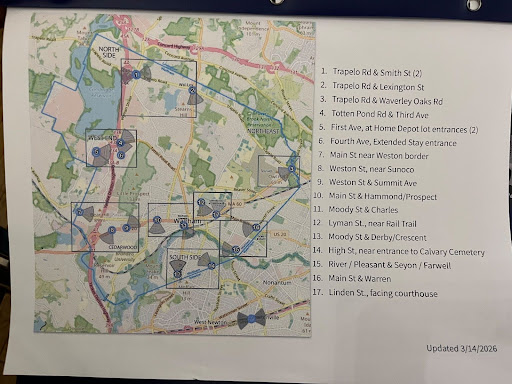
Willis and several of her fellow speakers had prepared a folder of materials to be passed around the room, which included a map with locations of all the Flock cameras currently being used. It also contained a copy of City Solicitor Katherine D. Laughman’s recommendations for a possible new ordinance on surveillance regulations.
Ward 9 Councilor Robert G. Logan had initially asked the Law Department to draft the ordinance, and Laughman’s analysis ultimately recommended “adopting an advisory resolution or internal policy statement expressing its expectations… A non-binding resolution would allow the Council to articulate policy values… without creating separation-of-powers concerns, procurement conflicts, or preemption risks.”
Laughman’s analysis is part of the Ordinances and Rules Committee review phase of any new binding ordinance. After receiving input from the Law Department, Logan requested that the matter be tabled so that the councilors could further review the analysis.
Common decision stokes concerns over top-down government
A smaller number of residents spoke during the public input section about the issue of the Waltham Common event time limit, with opinion skewed similarly critical of city government. One resident of eight years said that as a history teacher, she had taught her students about the bad omen of unilateral decisions by governments.
“I think this is very clearly targeted at us coming together to protest and hold vigils. I am very suspicious about whether this was in response to noise complaints… when we called the mayor to talk about it, we were shut down pretty quickly,” she said.
Waltham’s city charter is a Plan B type, also known as a “strong mayor” system. Diana Young, a resident for 30 years and a member of the League of Women Voters, spoke about the charter and the power it grants the mayor. “Resolutions are nice but they have no binding power on the mayor… Our charter has been in place since 1986 and it could use a refresh. Do we want the mayor to have so much power?” she posed to the crowd. Several other speakers brought up the possibility of democratically changing the structure of Waltham’s government and implored their neighbors to vote in local elections.
Melissa Honig, Lead Organizer of the Steampunk Festival since 2017, also spoke during the public input section, introducing herself to loud applause from the audience. Because the festival is a part of the Downtown Waltham Partnership and supported partly by a grant from the Waltham Cultural Council, Honig said that there were no plans in place to move out of Waltham in 2027.
As for this year’s festival, which will be held on May 9 in begrudging accordance with the time limit, she said, “We didn’t have time to pivot anywhere else. We are wanting to stay, and we want a solution… but this isn’t what we want to see for the future of our event.”
CORRECTION posted April 3, 12:53 p.m. In quoting Jonathan Paz, we implied he was directing his criticism to the City Council, but was directed to the mayor, because only the police department, with the greenlight from the Mayor, can sign the Flock contract.
Author

Comments (3)
Leave a comment
When commenting, please keep in mind we are a small non-profit focused on serving our community. Our commenting policy is simple:
- Common sense civility: we’re all neighbors, but we can disagree.
- Full name required: no anonymous comments.
- Assume the best of your neighbors.


The whole flock ordeal is so sad, and they’re so quick to table it. The city really just sold so much data on its residents and workers just cause the police wanted toys to spy on everyone. It wasn’t enough that they had drones they could fly over people’s property with impunity, they need this now. And the saddest part is that they probably don’t realize that this is all Flock baiting them into selling their city’s data away.
Thank you for reporting on this! Glad to see fellow members of the community standing up for our rights when they’ve been infringed upon and hope some positive change will come out of this
At this meeting I heard several surprising and (if accurate) troubling pieces of information. Among them are:
1. The Waltham Police Department (which in my opinion does a great job) has a separate fund of money (not stated how large) that neither the Mayor nor the Council has any oversight of.
2. That fund has apparently been used to unilaterally install a city wide flock camera surveillance system without the approval or oversight of all or most of our elected representatives.
3. That surveillance system, called a license plate reader, actually collects broad information on our activities within the scope of its cameras.
4. The company has the right to use that data (i.e. our day to day activities) however it wishes to develop its products and to sell those products to whomever it wishes.
5. This is all being done without the permission or often even the knowledge of citizens who are being surveilled.
6. This scenario has been sufficiently concerning to several local towns that they have broken their contracts with the FLOCK company and removed the cameras.
Waltham is a very safe town and I for one am extremely grateful for our police and the work they do to help keep it that way.
But in this instance and because data is now likely a forever commodity (whatever the contracts may stipulate) with considerable potential for harm and intrusion on our rights of privacy, we should expect that any surveillance system employed broadly by our police or our city be made known to its citizens and overseen and approved by our elected representatives at a minimum.
Because this is an ongoing potential harm to our citizens, The City Council and The Mayor should demand that the cameras be disabled and covered until such time as they (our elected representatives) and we (the citizens) can arrive at a reasonable justification for this type of mass surveillance and/or a policy for the management of cameras and their data in our City.