
Law Department suggests non-binding resolution to address concerns over surveillance technology
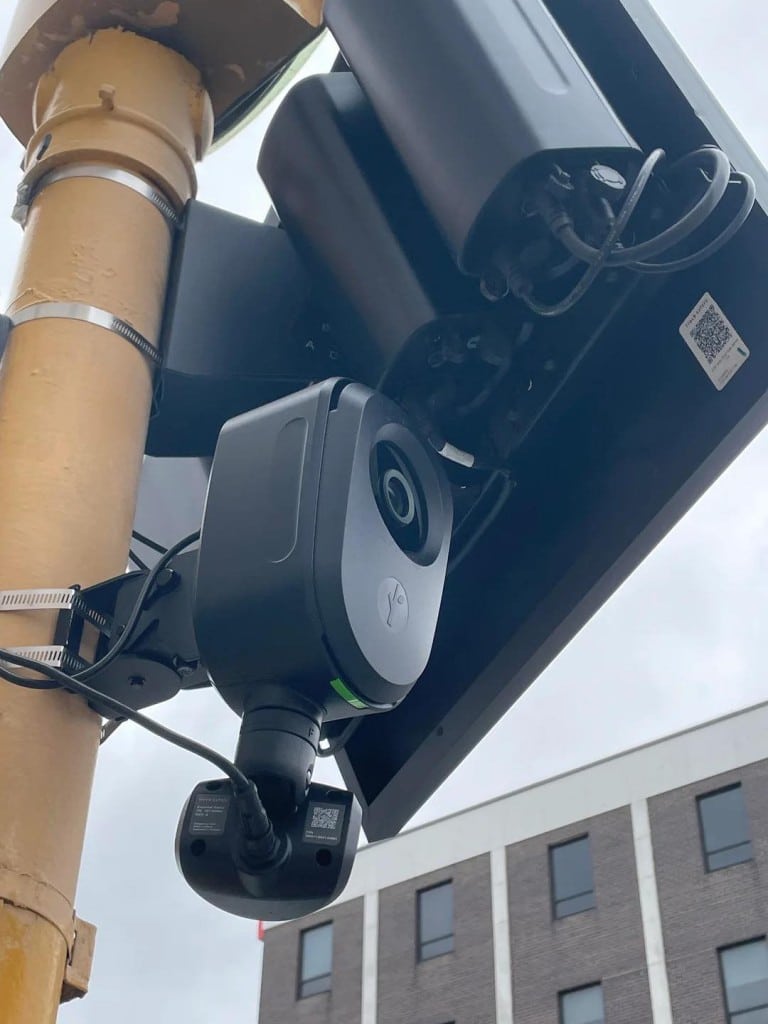
The City Council’s Ordinances and Rules Committee has decided to delay making moves on Waltham’s use of surveillance technology. At its meeting this week, City Solicitor Katherine Laughman reported on what regulation of that technology might look like and how it might affect city departments.
The committee at its Dec. 1 meeting asked the Law Department to draft legislation regulating the use of surveillance technology in response to public outcry about the Waltham Police Department’s use of Flock Safety’s automatic licence plate reader cameras.
At the time, Ward 9 Councilor Robert G. Logan laid out specifics of what he’d like to see in the regulation, including requirements for departments to compile regular reports on their use of surveillance technology and obtain City Council approval for any new technology regulated under the ordinance. These requirements bear some similarity to those of neighboring cities such as Somerville, which Laughman identified as having one of the “most comprehensive” policies in the region.
Laughman told committee members she would recommend the city avoid creating an ordinance regulating surveillance technology and instead consider a non-binding resolution to address the “significant concern from many constituents” about the WPD’s Flock cameras. She said this could allow the council to avoid imposing on city departments “some of the constraints that come from a fully-enforceable ordinance.”
Laughman added that the committee could also make recommendations to the WPD on the department’s own policy on surveillance technology use, which it adopted in November.
She said any legislation around surveillance technology would have to carefully define its own scope, since many technologies that city departments use — including traffic cameras, public health data collection tools, building security systems and web safety controls in schools — technically have the capability to record or analyze personally identifiable information and might therefore be bound by a surveillance technology ordinance.
Any new legislation more restrictive than state law, Laughman said, would require Waltham police officers to comply with additional local laws in order to submit any evidence they gathered from surveillance technology in criminal prosecution cases.
“We also potentially expose ourselves to civil litigation… [when] we impose a higher restriction on ourselves. It provides more opportunities for people to challenge the manner in which we use technology in the city,” she added.
Laughman said that the City Council might exceed its own legal power if it required city departments to get its approval for purchases.
Still, such policies currently exist in some other cities’ surveillance technology ordinances. Laughman summarized the policies of a number of nearby cities and towns including Boston, Brookline, Cambridge, Somerville, Northampton and Worcester. She said their policies broadly fall into two categories: those focus on banning facial recognition technology and those that cover surveillance more broadly.
The former category, she said, would be less likely to create incidental administrative burdens for Waltham’s city departments. Laughman said no neighboring municipalities’ policies had yet been challenged in court, so she did not know whether they would hold up on appeal.
If Waltham wanted to adopt an ordinance regulating surveillance technology, it would need to avoid any explicit conflict with Massachusetts state law. Laughman recommended councilors stay updated on data privacy bills currently going through the state House and Senate, including Massachusetts House Bill 4640 on facial recognition technology, to avoid any potential conflict.
At Logan’s request, the committee tabled the matter so members could have more time to examine the Law Department’s findings.
Author

Comments (2)
Leave a comment
When commenting, please keep in mind we are a small non-profit focused on serving our community. Our commenting policy is simple:
- Common sense civility: we’re all neighbors, but we can disagree.
- Full name required: no anonymous comments.
- Assume the best of your neighbors.




Do people not have an issue with the cameras on the Mass Pike that record and charge per plate use of the Roadway? That information is kept by the state and has anyone asked what is done with that information?
Since it’s an EZPass system, is the information shared with other states that use EZPass also?
OK, so wouldn’t the proper action be to suspend the use of this Flock system/technology in the City until the law department and the council come up with a workable ordinance that addresses citizens constitutionally reasonable concerns as to the ongoing potential harm regarding data collection etc? Surely it makes no sense from a harm control perspective to leave it on while working this out. Right?