
The Explainer: Waltham’s city government
To find the governmental authority that has the most impact on daily life for Waltham residents, don’t look to Washington, D.C., or even to the Statehouse in Boston. Look to City Hall.
When you turn on the water for your morning shower, that’s thanks to the local government. When you take out the trash, drive on city roads, drop your children off at school, need help from police or fire, want to build on your property or get a license for your dog, you are relying on the local government.
“I don’t think everyone really understands how important it is to your daily life,” said Joseph Vizard, Waltham’s city clerk.
One might imagine that elections for Waltham’s governing body, the City Council, would generate a good deal of interest and competition. Yet not one of the candidates running for the nine ward representatives on the council had an opponent this year. Turnout was just under 20% of registered voters.
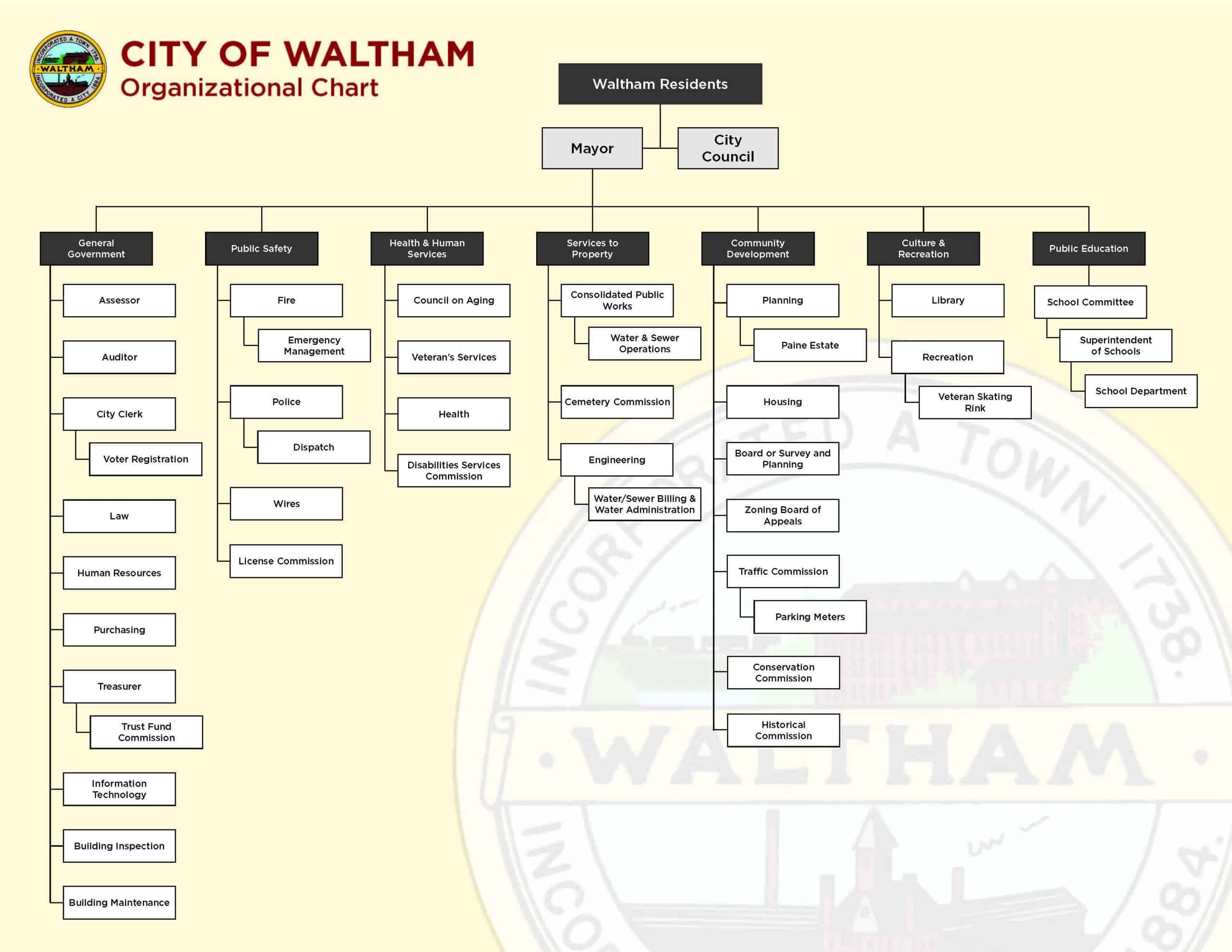
It does not seem like a stretch to conclude that many residents have only a vague idea of how the city functions. What follows is a very brief primer on how Waltham’s city government is set up.
The State of Massachusetts has authority over all its municipalities. The state puts limits on how cities may regulate local elections, levy taxes and borrow money. Fire and building codes are state mandated.
The state leaves many municipal government decisions to towns and cities, including what type of charter to adopt. The state offers six options, and all but one of them require nonpartisan elections, including the one Waltham uses. That’s why candidates for city positions don’t designate a party when campaigning.
Some charters provide for a relatively weak city manager chosen from among members of the town’s legislative body, but Waltham has what’s known as the strong mayor system, where the mayor is elected independently of council members and is the city’s chief executive.
Waltham has preliminary elections to reduce the number of candidates on the ballot in November; however, for the first time in years the number of candidates running did not rise to the level that would have required a preliminary election.
An Early Experiment
Waltham did not always have a strong mayor system.
In 1918 Waltham became the first city in Massachusetts to adopt a charter with a weak mayor/city manager form of government, but a brief taste of that system was apparently enough. In 1923 voters tossed that charter in favor of one that established a strong mayor. With some tweaks along the way, it governs Waltham today.
From 2017 to 2018, the League of Women Voters of Waltham, a nonpartisan political organization that encourages informed and active participation in government, set out to study the current city charter. The committee produced a 36-page overview of the charter, including discussion of its history, state powers and comparisons to other municipalities, said Diana Young, a retired tax attorney in Waltham who served on the league’s committee.
According to the report, Waltham’s charter defines the basic structure of government and delineates the powers of the mayor, City Council and School Committee. It includes additional provisions on elections, citizen petitions and procedures for charter changes.
The charter is also short, 15 pages. The detailed implementation of governance takes place through ordinances, and there are hundreds of pages of them.
The charter establishes the City Council as the legislative body, comprising 15 councilors, nine elected from the city’s wards and six at-large.
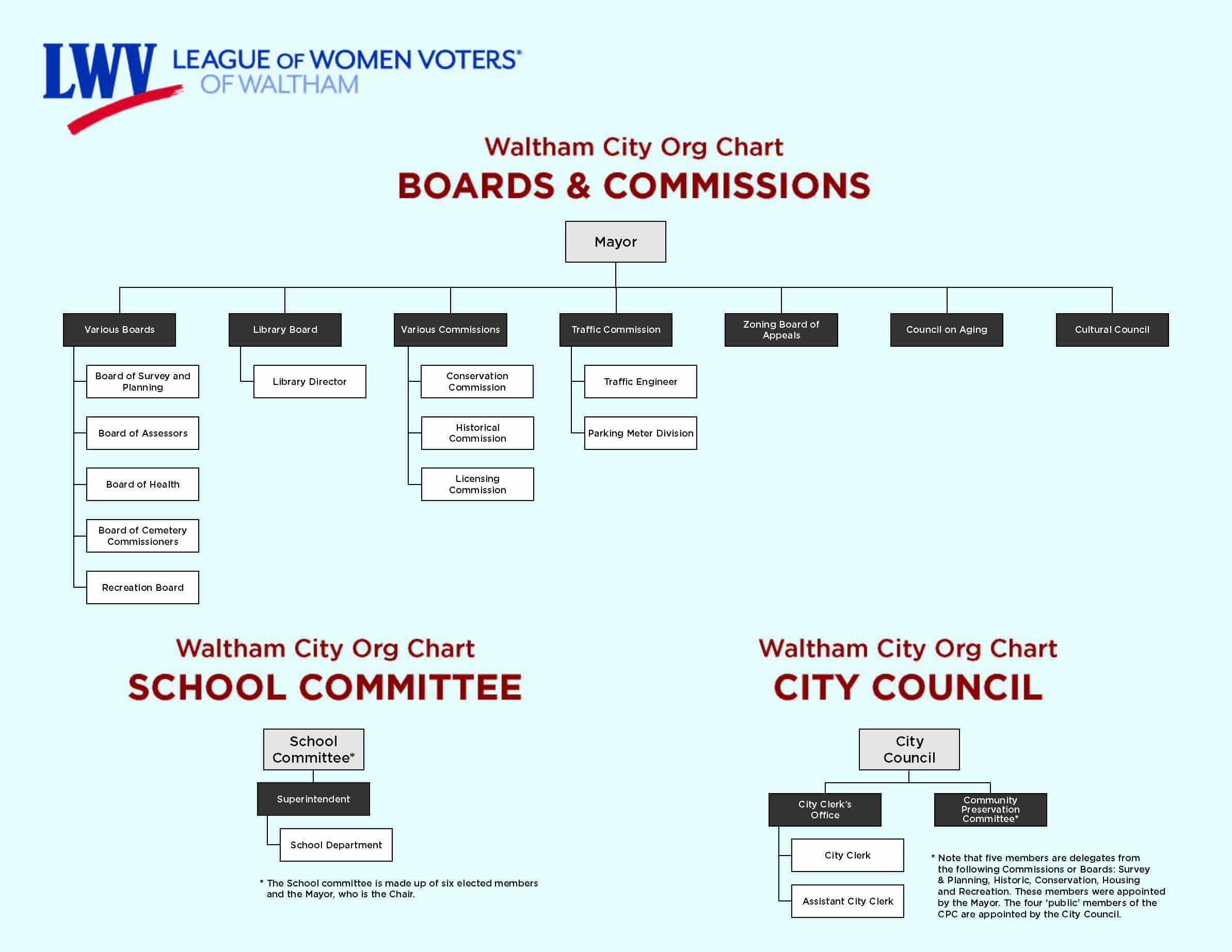
The mayor has a four-year term and no term limits. The mayor appoints all department heads and most municipal boards, subject to council approval. The mayor may veto council actions, though the council may override a veto with a two-thirds vote. The mayor also serves as chair of the School Committee, which has six elected members who serve four-year terms.
The charter also establishes a petition process for citizens to compel a vote on a proposed ordinance. The process requires one-third of eligible voters to vote in order for a petition to be adopted in an election.
“Getting to that one-third is not easy,” said Young. She could recall only one petition on Waltham’s ballot in recent decades. In November 2005 Waltham adopted the Community Preservation Act through petition after the City Council declined to do so (This petition process fell under special legislation rather than the charter provision). The act, which places a surtax on real estate taxes, won by a very small margin, so small – four votes – that a recount was undertaken.
The surcharge provides support for affordable housing, open space recreation and historic preservation. Waltham’s Community Preservation Council has approved use of funds, for example, to purchase a portion of the Fernald property and to fund repairs requested by the Waltham Housing Authority.
The Charter Can Be Revised
The last time the charter was amended, according to the league’s report, was in 1986, when voters further strengthened the mayor’s power by lengthening the mayor’s term from two to four years. (Here is the Home Rule Amendment of the Massachusetts State Constitution on adoption, revisions and amendments to city and town charters.)
Whether the strong mayor system is good, bad or indifferent depends on one’s point of view, but voters could make changes if a charter revision were proposed. Framingham, for example, adopted a new city charter when it changed from a town to a city in 2017. The new charter adopted a strong mayor system but limited the mayor to three consecutive terms of four years, for a total of 12 years.
Waltham’s Charter Revision Committee of 1983-84 recommended establishing term limits, but that recommendation (among others) was rejected by the city council.
Much of the City Council’s business is devoted to spending requests, according to Vizard, who served on the council prior to joining the City Clerk’s Office. The mayor cannot spend money without council approval. The council also acts on requests for licenses (Waltham’s first request for a fortune teller license arose on Vizard’s watch) and on requests for special permits, many of which are related to land use. Councilors may also submit resolutions that do not have the force of law (support for Waltham Pride Day, for example) or propose ordinances.
Additionally, “most economic development is done by cities and towns,” Vizard said.
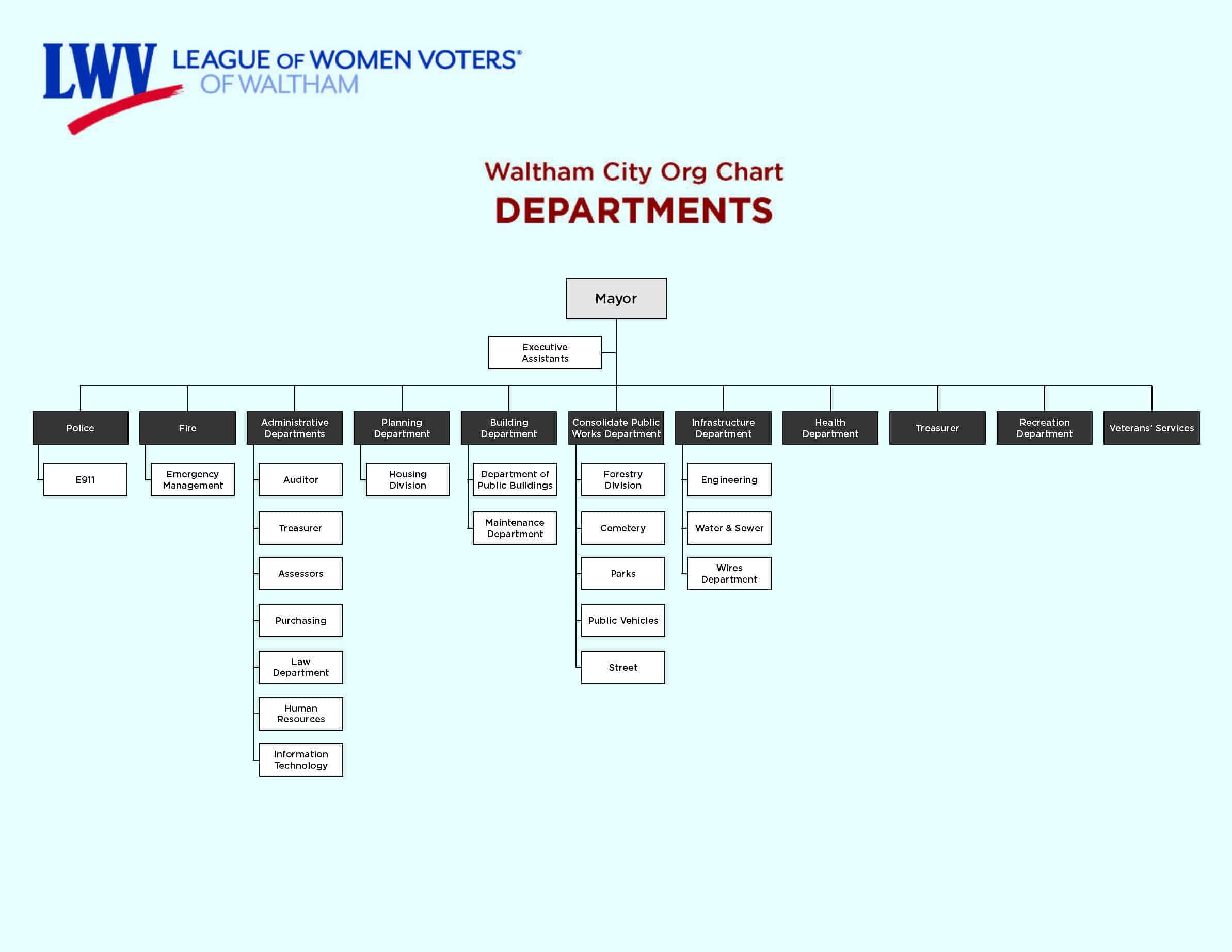
Significant governance issues come before the council from time to time. For instance, in the late 1990s the council passed an education reform measure that invested the school superintendent with hiring responsibilities that had previously lain with the School Committee, he said. Dozens of departments and commissions carry out the day-to-day work of the city, ranging from the Council on Aging to the Zoning Board of Appeals. For information about specific offices, see the city’s website.
Author

Comments (5)
Comments are closed.




Thank you for this excellent work! I hope having a local paper sharing good information like this will help us all know where we can engage more in our local system.
This is great information! Thank you.
Succinct, thorough, and highly informative! Thank you for writing this.
Good informational story. Thank you for taking the time to research and write it.
Thank you for this story!