
Long-term visions for West End traffic start to take shape with Green Street extension
Though some of Waltham’s immediate plans to improve the area have temporarily screeched to a halt, residents of the city’s West End are starting to see a coherent timeline for roadway improvements to relieve traffic in their neighborhoods.
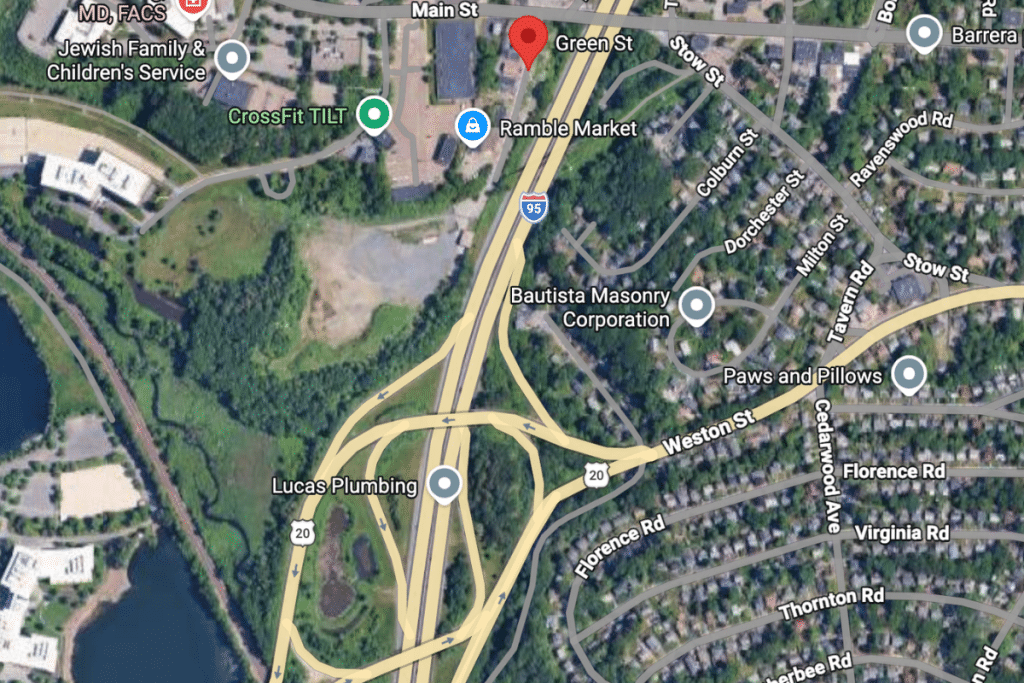
At Thursday’s Traffic Commission meeting, the city heard more details on the upcoming Green Street connector project before it goes out to bid in July. The project involves extending a short road jutting down from Main Street just west of I-95, called Green Street, down to the Weston Street highway exit. It’s expected to be completed sometime in 2028 or 2029.
This project is tied to plans for two real estate companies to build new residential neighborhoods in the area around I-95. The city hopes this new connector road will ease traffic in the West End by providing a direct path between Main Street and the Route 20/Weston Street highway exit without cutting through residential neighborhoods.
Civil engineering firm VHB’s Director of Transportation Planning and Operations Rob Nagi presented schematic designs for the project. Its construction phase will involve widening the existing segment of Green Street to add a shared walking and biking path, rearranging the parking lots of existing businesses to create a new municipal lot and making safety improvements around the Weston Street exit involving new traffic signals and lane restructuring.
The Green Street project will involve installing two new traffic signals, two Rapid Rectangular Flashing Beacons, five new crosswalks, a new stop sign and wiring improvements to coordinate local Main Street traffic signals. It’s estimated to cost $30 million, and real estate company BXP Inc. has agreed to pay any remaining costs after the project goes through its $15 million in state grants. Another local real estate company, 1265 Main Street LLC, has provided a legal easement for some of Green Street’s path.
Future phases of the project
Once Green Street is constructed, the Massachusetts Department of Transportation can start another project on its list: The redesign of the nearby Route 117 bridge where Main Street crosses the highway. This project will be entirely state-funded, and has just begun its design phase; MassDOT aims to start construction by 2030, with a projected completion date in 2031 or 2032.
The redesign of the bridge will open up the Green Street area to further improvements. Nagi said the city will temporarily have to restrict left turns from Main to Green Street until the bridge is widened to allow a left turn lane, at which point pedestrian infrastructure at the intersection can also be improved.
This would make Green Street a more viable path between Main and Weston streets. After the bridge is completed, the city plans to dead-end the residential Stowe Street to discourage vehicles cutting through it for that purpose.
The layout of the Weston Street highway exit will also see changes in the long term. MassDOT plans to move one of Weston Street’s two northbound onramps to I-95 up to Main Street. Nagi said that as traffic in the area may increase with new residential development, MassDot hopes to add additional safety improvements around the traffic circle
The state Department of Conservation and Recreation also has plans to use Green Street to connect the Weston and Waltham arms of the Massachusetts Rail Trail. The DCR has plans to develop the adjoining old railroad bridge as a way for trail users to cross the highway, although Nagi said that project is currently stalled.
Other West End improvements
These changes are still pretty far on the horizon, but the Traffic Commission also discussed more immediate changes to improve traffic around the West End.
In response to the 2024 West End traffic improvement study, the Traffic Commission previously voted to coordinate traffic signals along Main and Prospect streets to improve traffic flow, encouraging vehicles to stick to these major roads.
This week, Traffic Engineer J. Michael Garvin told the commission that Mayor Jeannette A. McCarthy has refused to authorize a bid for the project until the department finishes other previously scheduled improvements around the city.
In the meantime, the Traffic Commission discussed smaller changes it could make to reduce traffic bottlenecks along Prospect Street. It considered options to create turn lanes or limit left turns that hold up traffic, and finally voted to ban left turns onto Highland Street. It also requested the Police Department ramp up parking enforcement along the street to make it easier for cars to make turns.
As part of the city’s ongoing review of traffic lights around the city, Garvin additionally recommended the commission make significant repairs to the Vernon Street traffic signal, whose signal arm — including its emergency vehicle detector, designed to give right-of-way to first responders — was broken and temporarily replaced with a post.
Although Director of Wires Tim Kelly told commissioners he did not currently have the resources to replace a broken signal arm at the intersection, the commission voted to accept Garvin’s recommendations, repairing pedestrian and vehicle signals and replacing the arm when possible.
Author

Comments (2)
Leave a comment
When commenting, please keep in mind we are a small non-profit focused on serving our community. Our commenting policy is simple:
- Common sense civility: we’re all neighbors, but we can disagree.
- Full name required: no anonymous comments.
- Assume the best of your neighbors.


This is great news, but I see several places in this project where crucial bicycle/pedestrian advocacy is needed. The indefinite timeline for the Rt. 117 bridge improvements, stretching out well over three years is far too long to wait for completion of pedestrian/bike access from the Waltham/Wayside trail to the rest of the Mass. Central Rail Trail(MCRT) on the other side of I-95. The article note that DCR plans improvement to the alternate route over an abandonned Railroad bridge, but that the project has been (indefinitely) stalled, likely in part due to the intersecting Green St. project, which will itself remain incomplete until 2028 or so. One of the two projects (Green St/117 bridge or Railroad Bridge improvement) must be expedited to ensure the urgent commuter connection of the MCRT to Waltham, especially during the Rt. 117 bridge construction. And pedestrian/bike advocates should similarly stay alert to opportunities for infrastrure improvement in the Prospect/Highland project, which is essentail to help connect the MCRT/Wayside trail to the Charles River Trail entrance on Prospect St.
A thank you to Ward 7 Councilor Paul Katz for his persistence on traffic issues affecting the West End despite the many roadblocks he has encountered along the way. Over the past several years, he has consistently advocated for the West End Traffic Study, pushed for implementation of its recommendations, and worked with local and state officials to keep the Green Street/Route 117 project moving forward. This article suggests that progress may finally be underway.
There is still a great deal of work to be done, but these issues are receiving attention today because of his sustained effort and advocacy. We are fortunate to have someone who continues to press for improvements and keep these important projects moving forward.