Pedestrian Moody Street plans rerouted around City Hall
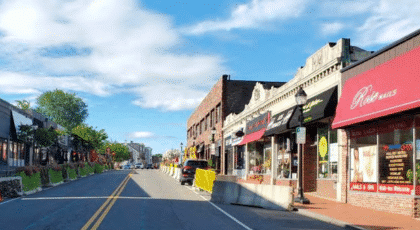
Although outdoor dining and retail started up again on Moody Street on May 23, plans to rework traffic on the street have hit at least a temporary detour.
Earlier this spring, Waltham’s Traffic Commission voted to end discussions of a proposal for turning Moody Street into a pedestrian-focused space.
Mayor Jeannette A. McCarthy said the discussion hasn’t hit a dead end; rather, it’s being taken up by the city’s Planning Department.
Still, the path ahead for the street’s future remains uncertain.
For multiple years the city has weighed turning a large segment of Moody Street into a permanent pedestrian plaza — or at least turning it into a one-way street with larger sidewalks.
The plan received support from some restaurants and some residents throughout the city. But it also received criticism from some retail owners along Moody Street, who feared it would drive business from their shops.
In fact, the city commissioned an independent study in 2023 to look into the feasibility of permanently limiting or closing off car traffic on Moody Street.
The results of that study, by Nitsch Engineering, were published in a report last fall. Nitsch presented three options for limiting traffic on Moody Street between High Street and Pine Street, all of which involved more accommodations for walking and biking and additional greenspaces.
The report proposed plans for making car traffic on Moody Street northbound only, southbound only, or blocking it completely. Ultimately, it recommended preserving car traffic going northbound and about 69% of the street’s on-street parking.
After receiving the study, the Traffic Commission last October put off a vote about whether to adopt the study’s recommendations, requesting further input from the public.
The city held a meeting in November to collect opinions about the future of Moody Street. The Planning Department also conducted a survey about local interest for a fully pedestrianized street, which went out only to residents, property owners and business owners on Moody Street. The responses the city received were split evenly in opinion.
When the case came to the Traffic Commission’s docket again in March, it voted to permanently file the plan. In an email to The Waltham Times, the city’s traffic engineer, Michael Garvin, confirmed that meant it’s no longer under consideration by the commission.
According to Mayor McCarthy, the case is now the Planning Department’s purview.
“The Planning Department is formulating a plan for Moody Street from Main and Moody to the Newton line. When the plan is finished by [the] Planning Department it will be presented publicly,” she wrote in an email to The Waltham Times.
A need for compromise
Ward 9 Councilor Robert G. Logan, who represents parts of Moody Street, said, as far as he knew the Planning Department was looking at improvements to the street and that plans for a pedestrian or one-way Moody Street were now a “moot question.”
“It is not my understanding that there is any intent to revisit the question of closing Moody Street,” said Logan.
The Planning Department did not respond to the Waltham Times’ request for comment before publication.
Logan said that the Traffic Commission’s decision could be ascribed to the fact that the commission saw no definitive preference from the residents it surveyed.
“It was always kind of a split between restaurants and other businesses — retail businesses, service businesses,” he said. “Same thing among my constituents. I had a lot of constituents who would’ve wanted to see it closed, but a lot of my constituents who lived closest to Moody Street weren’t happy with the traffic or the detours.”
Still, some businesses on the street have more nuanced opinions. Madeline Cruz of Waltham Furniture & more said she’d like to retain on-street parking to make her business more accessible, including for people with mobility issues, but ultimately she prefers the city adopt whatever option preserves “safety for [all] persons.”
She said the traffic shutdown during the COVID-19 pandemic meant she saw more families with small children who felt safe walking around Moody Street. She expressed a personal preference for the one-way street plan, which also called for expanded sidewalks while maintaining space for drivers on Moody Street.
Some Moody Street business owners said they hadn’t heard that the Traffic Commission had filed the report and said they hoped to see more progress on the issue.
Erin Barnicle, one of the co-owners of Tempo on Moody Street, said that she’d rather see a pedestrian Moody Street but also had been prepared to work with whatever decision city planners came to, “so long as something is happening.”
“I think everything has to be a compromise, and I’m fine with that,” she said. “I’m not gonna lie and say I didn’t love the pedestrian situation that we had during COVID. … but I also understand the need for traffic and the movement of cars.”
A long history
Moody Street first closed to car traffic as an experiment in fall 2019, transforming it on Saturdays into a pedestrian plaza for the Waltham Farmers’ Market. Longtime Waltham resident and community organizer Marc Rudnick, who co-founded the Waltham Farmers’ Market, said that he and his colleagues worked very closely with the city, and especially the mayor’s office, to make it happen.
Then, during summer 2020, the mayor launched an emergency program for restaurants worried about their future amid the COVID-19 outbreak and Moody Street closed to all car traffic that summer to allow for outdoor dining that stayed compliant with pandemic-era regulations.
The program proved popular enough that some version of it has since been repeated every summer. Many restaurants along Moody Street have since regularly offered outdoor dining during the summer.
And from the first years of the pedestrian shutdowns, some Waltham residents also showed interest in an all-year pedestrian Moody Street.
In the last couple of years, though, the city has been walking back the pandemic closures. In 2023, the street was pedestrian-only on weekends, and last year the city stopped closing down car traffic on Moody Street but still let businesses set up tables on the sidewalk and in parking spaces.
Gabriella Zottola is a manager at Bistro 781 whose family previously owned another restaurant on the street. “I 100% love the closing of the street and being able to expand fuller. Not only because it brings in more [people], but … it makes a safer place,” she said. She said she was disappointed that the outdoor dining this year didn’t limit traffic at all, adding “we’ll take what we can get.”
Rudnick still believes that pedestrianization would be the best thing for Moody Street. He agreed that the Traffic Commission, as a regulatory body, shouldn’t be the organization making such plans in the first place and said he’d like to see someone inside City Hall — or someone outside it, willing to do organizing work — step up to champion the cause.
“Personally, I was hoping the mayor would be the champion but she seems to have been at least temporarily convinced that … the harm to [businesses] is bigger than the good to the community of pedestrianizing,” he said.
He acknowledged that shutting down car traffic might bring trouble for some businesses on the street, but he pointed out that whoever is in charge of the change could address concerns in advance by hiring business consultants.
“Businesses all over the world have learned to benefit from being in a pedestrian area. But they need help to do that,” he said.
He said he also thinks that the pedestrianization of Moody Street is a natural adaptation to the way the area has changed in the last few decades, since the loss of the Grover Cronin’s department store in the 1980s, into a restaurant-focused downtown. He also sees it as part of a greater worldwide trend turning away from car-centric infrastructure.
“The fear of change is behind a lot of why we do and don’t do things in our communities,” he said. “And when we can see changes … in the way people want to live, and don’t respond to them, I think that’s how communities tend to die out.”
Some restaurant owners hold out hope for change in Moody Street’s future.
“I think that the street has a tremendous amount of potential, and hopefully it’s not a dead conversation,” said Barnicle.
It’s a sentiment echoed by Rudnick as well.
“When we have a comprehensive program on how to bring it to Waltham that includes the support of businesses that are affected by it, I think we’d have a good chance of succeeding,” he said.
“Moody Street certainly looks like a street to me that wants to be [pedestrian].”
Author