‘Half a heart’ but a full life
Waltham resident talks about her experience with congenital heart defects
February is American Heart Month.
Most people think of the heart problems that come with age – heart attacks, coronary artery disease, heart failure, stroke – but some people are born with heart defects.
In fact, congenital heart defects are the most common kind of birth defect worldwide.
In the United States, about one in every hundred children is born with a heart defect. According to the American Heart Association, about 2.4 million people in the United States have congenital heart defects, and more than half are adults.
Waltham resident Lauren Bednarz knows these facts well, as she was born with a missing right ventricle, one of the four major compartments of the heart, plus a missing valve (tricuspid atresia) and other cardiac anomalies. Functionally, she has only half of a heart.
Since she was an infant, she has had three cardioversions, two cardiac ablations and three open-heart surgeries, among other medical challenges, and since 2019, 10 hospitalizations.
Now 37 years old, Bednarz is eager to share her message of hope and resilience. “I am proud to show off my scars,” she says. She aims to “live to the fullest despite the challenges” and to inspire others with her upbeat attitude.
In earlier years she played piano, participated in family theater and Girls Scouts, babysat, earned a high school varsity letter in bowling and received a bachelor’s degree in psychology.
A hopeful heart
Today she enjoys living in Waltham with her husband, Chris. Her hobbies include home organizing, couponing, video games and visiting museums.
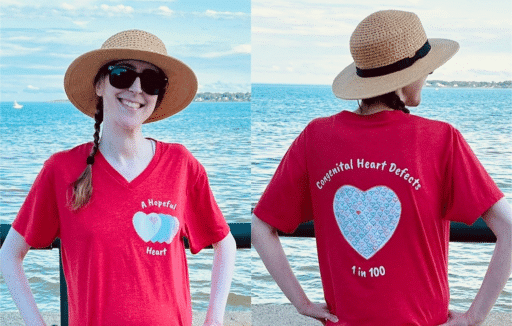
A major focus for her is advocacy for people living with these defects. She has led fundraising walks in Texas and is a co-leader for the newly formed Young Mended Hearts of New England group. She also designs and sells “A Hopeful Heart” clothing to raise public awareness of congenital heart defects.
Born in the Detroit suburbs, Bednarz first seemed to be healthy. But after a few weeks she was pale and weak. Doctors for weeks dismissed her mother’s concerns.
Baby Lauren was eventually brought to a clinic for testing. A physician walked through the waiting room, noticed her bluish skin color and “grunting,” and took her from her mother’s arms. She was in heart failure and was immediately intubated to give her oxygen. Because she was too sick for surgery, she received treatment through her blood vessels (a balloon atrial septostomy) to make sure that her arteries could distribute enough oxygen throughout her body.
At 5 months old she had her first open heart surgery to better configure her heart and blood vessels.
And at age 2 she underwent another open heart surgery, a Fontan procedure, which created a bypass around her heart so that “blue” blood without oxygen returning from the body would flow directly into the pulmonary artery to receive oxygen from the lungs.
In 2021 in Texas, Bednarz underwent a third open heart surgery that lasted 12 hours and involved a Fontan revision, placement of a pacemaker, a procedure to treat atrial fibrillation (an arrhythmia), right atrium reduction and an artery repair.
Feeling at home in Waltham
Bednarz in 2023 began receiving care at Boston Children’s Hospital. She is “super grateful to all the doctors and nurses at Brigham and Women’s and Boston Children’s Hospital’s adult CHD [congenital heart defects] clinic.” (Formally it is the Boston Adult Congenital Heart (BACH) and Pulmonary Hypertension Program.)
The decision to come to the Northeast was an exciting one for both Bednarz and her husband. And from the start, they knew that the “medical move,” especially to Waltham, was the right one, even the day they moved in. Bednarz laughs, “Santa came down the street!” Beyond Waltham’s annual Santa Parade, Bednarz has found Waltham to be a pretty and warm community.
The surgeries that Bednarz received were developed in the 1960s, but they are palliative – they cannot fix the defects. She is in the first generation of children with congenital heart defects to reach adulthood.
Despite the great strides in medical research, adult patients have to contend with many complications, including heart arrhythmias and Fontan-associated liver disease; some people eventually need heart or heart-liver transplants.
Fewer than 10% of adults with congenital heart defects who need further care receive the recommended lifelong medical care with a certified specialist. And the need is great for further research into their needs and medical or psychological issues.
Historically, congenital heart defects have received little research funding although the field is now receiving greater attention, both from the federal government and from nonprofit organizations, including the Children’s Heart Foundation and the CHD Coalition.
Bednarz wants to do her part to raise awareness. “There’s hope,” she says. “We can have beautiful lives despite challenges.”
Editor’s Note: This story has been updated to more accurately detail Bednarz’ medical condition and treatments. An additional correction was made to the caption on Feb 21. The T-shirt was created to raise awareness, not as a fundraising item.
Author