Waltham Housing Coalition hosts inaugural meeting to combat affordable housing shortage
Residents and community leaders discussed strategies for improving Waltham’s housing production at a meeting this weekend.
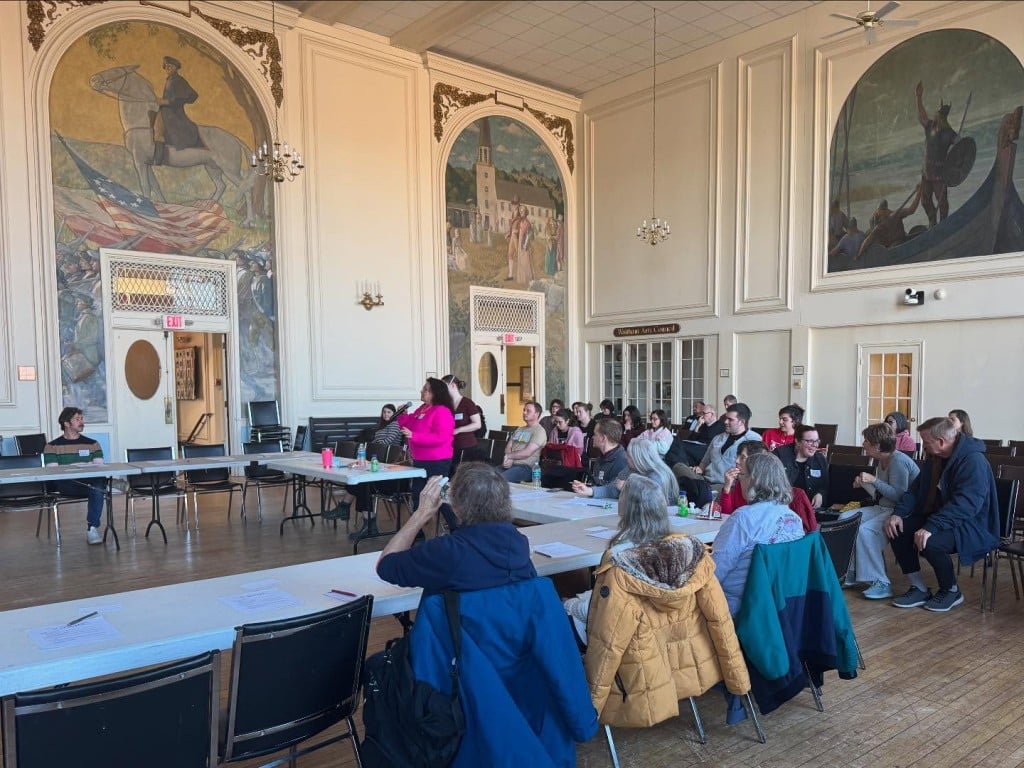
On Sunday afternoon, roughly 40 people gathered in the Government Center auditorium for the first meeting of the Waltham Housing Coalition, a new group that aims to combat opposition to the production of affordable housing by harnessing the combined power of residents and local organizations.
“Most communities lack support for affordable housing and new development,” one of the presentation slides said. But the group wants to counter this by creating “a culture that welcomes housing, including affordable housing.”
The launch event was led in partnership by the Citizens’ Housing and Planning Association (CHAPA)’s Municipal Engagement Initiative and Waltham Inclusive Neighborhoods. Attendees included Waltham residents, leaders from other community organizations, and Waltham elected officials including Councillors Colleen Bradley-MacArthur, Robert Logan and Cathyann Harris.
CHAPA is a statewide nonprofit based in Boston with a mission of encouraging “the production and preservation of housing that is affordable to low- and moderate-income families and individuals.” CHAPA supports coalition-building efforts across the commonwealth.
Monica Keel, CHAPA’s municipal engagement program manager, described the impact of housing security. “Housing is really connected to everything in our lives. It’s connected to where we go to school, if we have access to public transit, even down to the health of the air that we breathe.”
As a graduate student at Brandeis University, Keel interned for CHAPA before beginning work in the Municipal Engagement Program. “I felt that if I could help people in the housing space, then that would have the most impact on their lives in other aspects, so that all of that could be a space for upward mobility,” Keel said.
In an open discussion, participants described barriers to the creation of affordable housing. Some mentioned restrictive zoning and a lack of affordable options . Another participant noted “a lack of political will.”
“You have to be wealthy to live in Cambridge, you have to be wealthy to live in Somerville, and now you have to be wealthy to live in Waltham,” one meeting participant said.
Attendees recounted the arguments of those who oppose the expansion of affordable housing in Waltham, including the worry that increased high-density housing will translate to increased traffic.
Tom Benavides, a representative of Waltham Inclusive Neighborhoods, said a lack of affordable housing in Waltham forces people who work in Waltham to move outward to more affordable neighboring areas. He explained that when more people move out of the area but remain employed in Waltham, more workers need to drive into the city, leading to a greater influx of cars in the daytime and increased traffic.
The Waltham Housing Coalition plans to hold quarterly meetings and invites anyone interested in supporting their mission to join as a member.
State and city officials have taken steps to create more housing, and more affordable housing. In January the Waltham City Council finalized zoning amendments that would allow for higher density near commuter rail stations, a move it took to comply with the state’s MBTA Communities Act.
And last Monday the City Council discussed potential changes to the zoning rules governing the building of accessory dwelling units (ADUs), or dwellings that can be built within an existing building or on the same lot. The City Council’s Ordinances and Rules Committee is slated to review the potential changes at a future meeting.