Why I Am Standing Up for Science
By JENNIFER ROSE
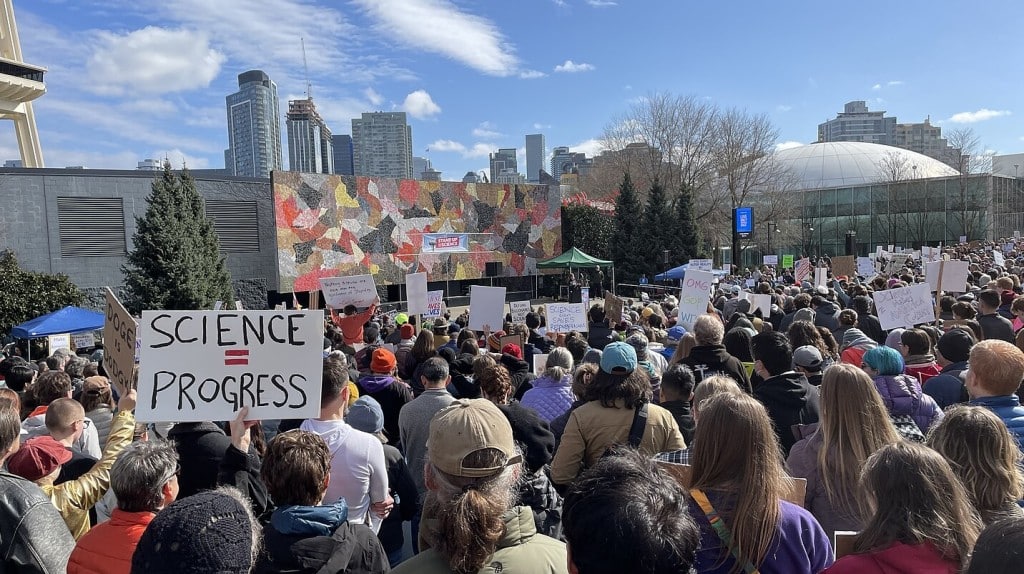
March 7 was designated Stand Up for Science day.
Although I am not a scientist, the day felt very personal for me as a survivor of one type of cancer who recently was diagnosed with another.
It was also personal for me because my late wife was a scientist.
Cecile, a biochemist who taught at Johns Hopkins, did basic research. I once asked her how she could sustain her motivation when she did not have a goal like “curing cancer” (applied research). She said that understanding how certain biochemical processes worked was equally important and sufficient motivation for her, even if she didn’t know how that knowledge might ultimately be put to use.
Even when she herself was diagnosed with cancer, she remained committed to basic research. In her lifetime, it was clear that her research had implications for Huntington’s disease and Lewy body dementia. At the most recent annual lecture held this fall in her memory, I learned that her basic research is now contributing to cancer treatments.
Preceding that lecture, there was a panel featuring department graduates who spoke with current students about different paths they might take as scientists: careers in academia, government, industry. The room was full of young people contemplating how best to utilize their knowledge and skills, based both on available opportunities and personal preferences.
Since that time, there have been huge cutbacks to science funding — including training grants — that will clearly affect them. One of the crippling cutbacks has been a reduction in the reimbursement of indirect costs (such as costs associated with lab space, safety measures and support staff). The average indirect cost rate for National Institutes of Health (NIH) grants is around 28%, though some institutions receive more than 60%. The Trump administration’s new maximum is 15%. Although administration officials say this will save $4 billion, one study estimates the overall economic impact to be a $6.1 billion decrease in the country’s gross domestic product along with a $4.6 billion reduction in labor income.
Massachusetts, with a total of 5,396 NIH grants, stands to lose $535 million this fiscal year. (Brandeis, with 77 grants, will lose $6 million.) This will severely impact many institutions, cutting down on the pipeline of trained scientists and crucial research. In fact, UMass Chan Medical School has already rescinded admissions for one of its biomedical science doctorate programs, among other cutbacks.
My wife not only received funding from NIH, she also served as a peer reviewer of grant proposals. I saw how many hours she spent reading through those proposals, then attending meetings to discuss and make funding recommendations. I know the kind of scrutiny each proposal received and the kind of accountability demanded from recipients. The current administration’s claims of waste and fraud are unfounded.
Furthermore, NIH grants generate a large return on their investment. According to one analysis, in FY24 NIH research grants generated $2.56 of economic activity for every $1 of funding. (Military spending, by contrast, generates a return of only $0.60 to $1.20 for every dollar.)
When Cecile was diagnosed with a subtype of kidney cancer that had no known effective treatments, she participated in clinical trials funded by NIH, not only in the hopes of curing her own disease but in furthering scientific discovery to help benefit others. Those kinds of trials are now at risk.
Of course, science is not only about health. It’s weather reports, better crop production, cleaner air, energy efficiency, GPS, the ability to connect on a computer screen with a loved one thousands of miles away, among many other things we have come to take for granted. We must stand up for all aspects of science.
As Benjamin Franklin noted, an ounce of prevention is worth a pound of cure. Science can offer us both. But we must utilize prevention when it is available to us.
As of mid-March, there were more than 300 cases of measles in the U.S. and there have already been two entirely preventable deaths — the first here in more than a decade. Both victims, including a 6-year-old, were unvaccinated. One infected person can transmit measles to 12 to 18 unvaccinated people (compared, for example, to COVID-19’s estimated transmissibility of 1.4 to 7 people). When the Secretary of the U.S. Department of Health and Human Services denies the efficacy of vaccines, we must stand with the overwhelming scientific evidence that they do work and do not cause autism.
When the administration’s blueprint, Project 2025, calls for the repeal of climate change initiatives, we must stand with experts worldwide who have shown beyond a doubt that climate change is real.
When the president decimates USAID, we must stand with the scientists who say the human costs each year could include as many as 166,000 additional deaths from malaria; 200,000 children paralyzed with polio; more than 28,000 new cases of such infectious diseases as Ebola and Marburg; uncontrolled outbreaks of mpox and bird flu; and a 30% increase in drug-resistant tuberculosis.
As we have seen with COVID, disease does not recognize borders. Nor does climate change. Disease and climate change lead to human suffering, poverty, destabilization, dislocation and other catastrophic consequences. We ignore science at our own peril.
Saying the world is flat does not make it so, even if the government tries to remove all evidence to the contrary. Denying, defunding and decimating science has no human, scientific or financial benefit. We must stand up for science.
What can you do?
- Share the reasons you support science with friends and family who may not realize the negative effects the administration’s actions are having.
- Sign the Science for the Public Good Open Letter to the 119th Congress.
- Contact the president; Sen. Elizabeth Warren; Sen. Ed Markey; Rep. Katherine Clark; Senate Commerce, Science, and Transportation Committee Chair Ted Cruz; and House Science, Space, and Technology Committee Chair Brian Babin to demand that they remove the 15% cap on indirect funding for NIH-funded grants; reinstate all unlawfully terminated scientists and administrators at federal agencies overseeing scientific research, including the NSF, NIH, CDC, EPA, NOAA, NWS, NPS, NASA, FWS and FDA; restore all scientific data, reports and resources on federal websites; prohibit all forms of political censorship in scientific research; and preserve equitable and inclusive access to STEM (science, technology, engineering and mathematics) by maintaining federal programs that broaden participation in STEM training and careers.
- Support science advocacy organizations such as the Union of Concerned Scientists and American Association for the Advancement of Science.
Share anonymous news tips
You can leave a news tip anonymously, but if you would like us to follow up with you, please include your contact information