Waltham Cultural Council breaks down Waltham’s arts and culture funding
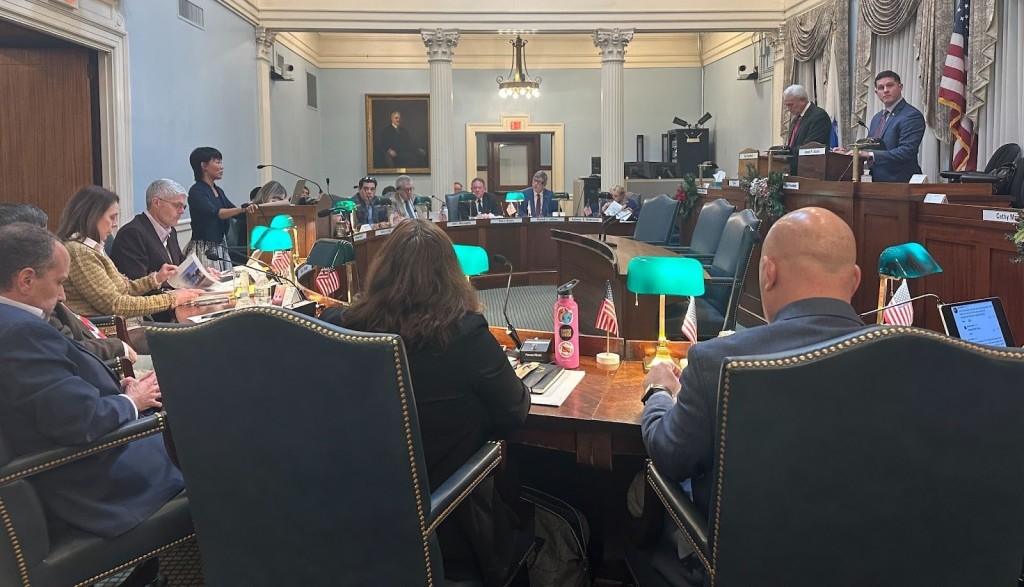
The Waltham Cultural Council visited the City Council’s Committee of the Whole Monday night to explain the work that goes into funding cultural events and the arts in Waltham.
The WCC is Waltham’s chapter of the statewide Massachusetts Cultural Council, a state initiative to fund arts and culture at a local level. On the municipal level, boards such as the WCC review applications from artists and organizations hoping to host events or complete projects of local relevance and then distribute funding in the form of grants.
Scroll through the Waltham Cultural Council‘s presentation and data slides.
WCC President Eileen Peng told councilors that the board members who review these grants are all volunteers and that they represent communities from across Waltham. “We come from diverse backgrounds. We’re parents, professionals, retirees. Some of [us] are local artists and musicians. Some members have lived in Waltham for multiple generations, and some are recent transplants,” she said.
Volunteers are encouraged to stay on the WCC for at least one three-year term and can serve a maximum of six years. Interested parties can request an application form from Mayor Jeannette A. McCarthy, who appoints members to the board.
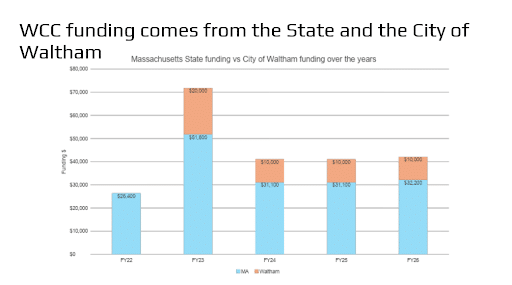
For the last three years the WCC has distributed approximately $40,000 of funding annually: just over $30,000 from the state and an additional $10,000 which the city contributes as a part of its planning budget. Peng said her team doesn’t know how much money they’ll have to spend until the MCC posts the information in August. As an example, she said local councils received a post-pandemic funding spike in fiscal 2023.
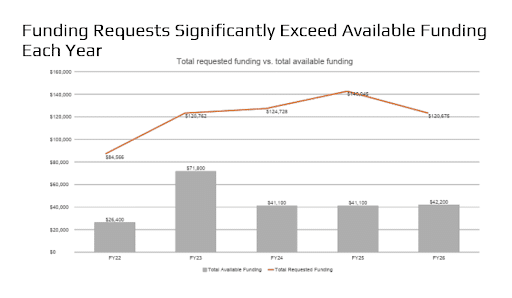
Peng added that the WCC can only provide a fraction of the funding requested every year. Last year it received over $140,000 in grant requests across 72 projects. Although its average grant request last year asked for $2,000, the WCC provided an average of $900 per project. Peng said her team tries to calculate the minimum amount of funding they can provide each project for it to become viable.
Sometimes if a project requires too much funding to take off, the WCC has to cut it from the list entirely. Peng pointed out that volunteers have to strike a difficult balance when raising awareness: They want potential applicants to know they’re there to provide resources, but they worry about getting “too famous” because they don’t have the funding to support more projects.
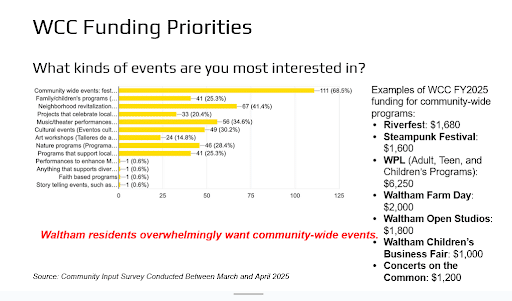
Every two years the WCC also distributes a survey to gather community input about the types of projects to support. Peng shared that in the last survey the WCC distributed in the spring, responders overwhelmingly voiced a desire for community-wide, family-oriented events such as Waltham Public Library’s programming for children and teens, Waltham Farm Day and Waltham Open Studios.
Peng suggested that this reflects a “strong desire for social connection” and an “improved quality of life” through the arts.
The survey also asked about certain subpopulations the WCC should prioritize. Respondents indicated that they wanted WCC projects to prioritize youth and families, followed by low-income and immigrant populations.
City councilors asked Peng questions about potential collaboration with organizations such as the Waltham Chamber of Commerce to assess tourism impacts from arts and cultural events and whether the WCC collaborated with the Senior Center and Radio Uganda to get the word out about its grantees’ events. Ward 3 Councilor Bill Hanley asked for more details on how WCC volunteers provide non-monetary assistance to grantees, such as by connecting them with other community partners and artists to promote their events.
Councilors thanked WCC volunteers for their hard work, some expressing they wished the city — which started contributing to the WCC after the pandemic — could provide more funding. “If it’s allowed by the state finance laws, then I’d certainly support additional funding for [the WCC],” added Ward 9 Councilor Robert G. Logan.
Disclosure: The Waltham Times received a 2025 WCC grant to fund its arts coverage.
Share anonymous news tips
You can leave a news tip anonymously, but if you would like us to follow up with you, please include your contact information
Authors