
The people of Waltham deserve safer streets
By Kenny Artigues, Wellington Street
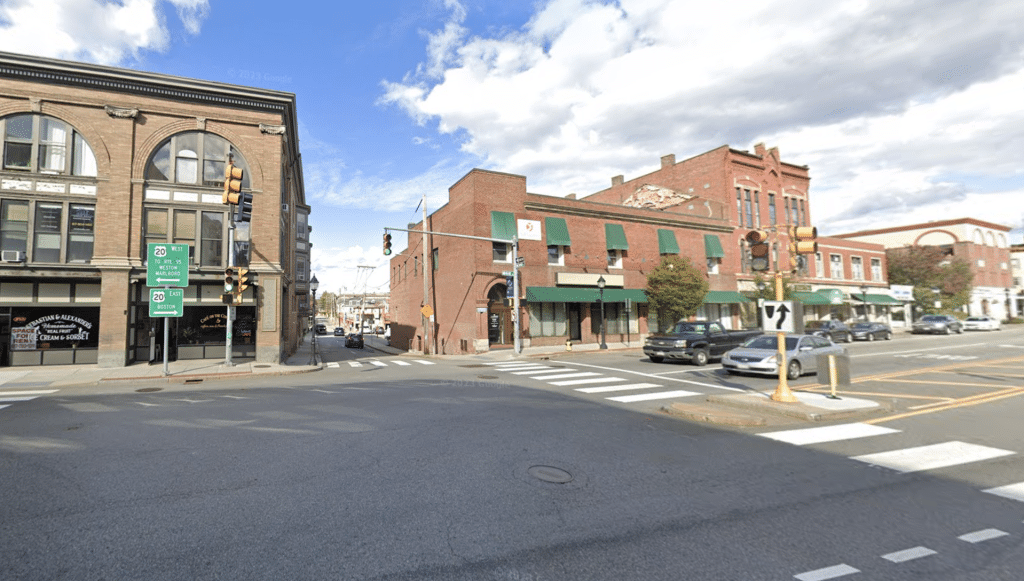
The Waltham Times published an article on Jan. 4 reviewing crash data from MassDOT. One thing not covered in that article was where Waltham sits in relation to other Massachusetts cities with regards to the safety of our streets. According to MassDOT’s Interactive Crash Cluster Map, several intersections along the busiest parts of Main Street and Moody Street are in the top 5% statewide for accidents involving cyclists and pedestrians. For anyone who lives in the area, this likely won’t be a surprise. But the statistics just confirm what can easily be experienced by trying to navigate the Main/Moody area on foot: It’s often unpleasant and nerve wracking.
I feel this way when I walk with my two young children, whether on foot or using a stroller. Getting to the library or the grocery store, both less than half a mile away, involves an unreasonable amount of hurdles and risk. The Main Street crossings nearest us require getting past four lanes of fast traffic that often won’t stop unless one is standing in the middle of the road. Even the more narrow Main Street crossings near the center of town can be hair raising and provide absolutely no protection.
Most Main Street intersections provide crossing signals with barely enough time to make it across before the countdown hits zero, especially if one is encumbered by a stroller or a wheelchair. Part of what makes these intersections (and the one at Main/Prospect/Hammond in particular) so unfriendly are the wide, sweeping curbs. These not only increase the distance one must cross to safely beat the light but also make it easy for cars turning on or off Main Street to barely slow down.
I have to be extremely vigilant about crossing with my kids, even when we have the walk light, because it’s so common for cars to turn “right on red” while hardly touching the brakes (because they don’t have to!).
On residential streets like mine cars regularly speed past us at 40-plus mph on a road wide enough to feel like a highway, even though the speed limit is 25. Like many residents, my family doesn’t have a driveway. Getting between our car and our home is frankly dangerous. After more than one near-miss, we’ve had to seriously reconsider whether this is a place where we can raise a family.
Toward a pedestrian-friendly city
Despite the fact that Waltham is a lovely city with amenities and destinations in close proximity — exactly the kind of place that should be walkable — getting around on foot often feels like an obstacle course.
It does not have to be this way.
Conversations about road safety typically get sidetracked with red herrings about “bad drivers.” The truth is that drivers will drive in whatever way roads allow. If the roads are wide and look like runways, people will speed. If crosswalks are hard to see and not protected, pedestrians will be at risk. If curbs make sharp turns easy, drivers will do just that, slowing down only as much as the road requires. We can’t fix human nature, but we can ask for road designs that guide behavior in safer directions.
The good news is that solutions exist, they don’t have to be expensive and they have been proven to work in cities across the country. Narrower lanes and curb extensions naturally slow traffic. Protected crosswalks and leading pedestrian intervals give people on foot a safety buffer. Even simple changes such as high-visibility crosswalk markings and better signal timing can make a meaningful difference.
Other Massachusetts communities are making these changes. Somerville has been systematically redesigning intersections to prioritize pedestrian safety. Cambridge has implemented neighborhood traffic calming measures. North Reading recently gave Main Street (on a state highway just like ours) a “road diet” to improve walkability. These aren’t radical experiments. They’re evidence-based improvements that make streets safer for everyone, including drivers. I’m not suggesting that Waltham ban cars or turn Main Street into a pedestrian mall. I’m simply asking: Should the roads we pay for be designed primarily to shave seconds off car journeys for people passing through our city, or should they be designed to improve the lives and safety of the people who live here?
I want to encourage anyone who has had similar experiences navigating Waltham on foot to reach out to the City Council and Traffic Commission. Change is possible, but only if we make it clear that safer, more walkable streets are a priority for residents.
Comments (11)
Comments are closed.

Kenny I agree with you. One of the best ‘free bees’ in Waltham is its walkability. My sister and other family members and myself are avid walkers. It does have a few ‘bumps’, though that could be addressed by the city or even the state. From Dale St downhill to Guinan St. It’s like a speedway even though there’s a pedestrian blinking light between the football field and the playground. Years ago a teacher was hit by a car crossing the street from Plympton School and I believe at a crosswalk there at Plympton St. This is the first one I can think of. (Now with the snowstorm, I saw kids walking in the center of Bacon St. to and from school.) Multiple Main Street intersections are too short on timing for their crosswalks. There are now lots of new apartments in an already dense area and people will have cars. It’s going to be annoying to drivers but I believe that pedestrians still have the right of way and should not have to be in fear of their lives crossing anywhere. Waltham, whether they know it or not, has the ‘New England town center’ configuration that people envy and community planners use when developing new communities. Walkability should be promoted and preserved. The rail trail is almost finished, 20+ years in the making ….I hope I live long enough to be able to see it finished and maybe even use it from end to end.
I appreciate the thoughtful discussion in this article, and I would only add that outside of the downtown area we have a long way to go ensuring that all roads (or at least all roads with painted lines) have sidewalks on both sides of the street (let alone other ADA compliant or pedestrian-friendly considerations).
If the anonymous “guest writer” (or anyone else in Waltham for that matter) is interested in discussing this topic further, I would be excited to help advocate for improving walkability in Waltham. (You can get in touch with me on my website http://www.sean.diamonds.)
Thanks for your comment. The guest writer of this column is Kenny Artigues, a Wellington St. resident.
Thank you for this article. We moved my mother 6 years ago to Waltham to be closer to us, and she chose an apartment near the Waltham Common for its walkability. She no longer drives but she enjoys her independence walking around: CVS for medications, Hannaford for groceries, Waltham Library for books, Moody Street for restaurants etc without needing someone to drive her. She now walks slowly with a rolling walker, but she enjoys her walks which keeps her healthy! However, when asked about her biggest fear? It is crossing the streets, in particular, Main Street and Moody Street.
As Guest Writer points out, the pedestrian signal is barely long enough for an able-bodied person to cross. Anyone who walks slower (with a stroller, walker, or with a disability), it is highly stressful for them to cross the street before the light turns red. And this is not counting cars who Turn Right on Red, even when there is a sign prohibiting it. My mom knows better not to cross Main Street at any non-signaled crosswalk — her friend, also a senior, was hit by an SUV a few years ago when crossing Main Street with her granddaughter in a crosswalk just outside the Waltham Public Library. Luckily the granddaughter was unhurt but my mom’s friend suffered a hip fracture, needing her to undergo surgery and being wheelchair-bound for weeks and then going to rehab for months. Her neighbors in the senior housing building pitched in to help her with childcare, while I helped her with getting groceries and driving her to doctors’ appointments.
My son, a student at Kennedy Middle School, enjoys riding his bike 2 miles to school. His route involves the Mass Central Rail Trail, and sidewalks on Bacon and Lexington Streets. He knows not to ride on the roadways even where there is an interrupted bike lane (a painted line on the road) on Lexington Street (35mph limit) because of how fast the cars drive there. On Bacon Street where speed limit is 25mph, cars frequently go above 35mph because how straight the street is, especially the section near Plympton Elementary School, Drake Playground and Leary Field. This is an area where there are often children around, not just during school hours. However, even after a car plowed into the playground fence almost 2 years ago, no traffic calming measures are ever installed there (except at the MRCT crossing further to the south).
As Guest Writer concludes in their article, what worths more? Shaving a few seconds off a driver’s trip, or making the city safer for its residents and vulnerable road users?
This question says it all:
“Should the roads we pay for be designed primarily to shave seconds off car journeys for people [non-Waltham citizens] passing through our city, or should they be designed to improve the lives and safety of the people who live here?”
The role of local government is to meet the needs of the local citizenry and to work towards the betterment of the common good.
Unfortunately, many of Waltham’s elected and unelected officials are completely out of touch with the reality that we live in a city of 65,000 people less than 10 miles from Boston. None of the unelected members of the traffic commission live in densely populated urban neighborhoods like the South Side. These members live in Cedarwood, Warrendale and North Waltham, which are suburban neighborhoods built around the automobile. Some of these members grew up in Waltham and want to keep things the way they’ve been for the last 50 years. The traffic engineer lives in Chelmsford, a suburban town that requires driving to most destinations. The traffic commission does not fulfill the needs of Waltham residents who walk, bike, or use public transit as a form of daily transportation. This especially becomes evident in the winter months, where the Mayor has specifically said she doesn’t support bike infrastructure because “we live in a climate that has a winter” and the fire station on Prospect Street doesn’t even shovel their sidewalk. When I asked Mayor McCarthy at a neighborhood meeting why we can’t plow the Mass Central Rail Trail or the Riverwalk, I was quickly interrupted and told there is nothing we can do; it’s DCR’s job.
This is an excellent article! But it’s part of a larger discussion with regard to civics. Bad behavior isn’t just a driver issue; it’s also a pedestrian issue. Dropping trash wherever you please isn’t cool. Taking off your muffler to exceed 90 decibels isn’t cool either. Let’s enforce the noise and trash bylaws too. Let’s grab this opportunity to have Waltham Pride!
just adding a point to consider:
While walkability is highly desirable, it might be produent to consider a tight balance. Part of the reason the author desires to walk to the various amenities, is that the amenities are there! Restaurants, shops and other amenities require a certain amount of people traffic (foot and otherwise) to be able to justify the continued investment of operating in those locations.
It would be a great result if there was a way to make the environment very walkable, yet allow crowds from a large area to frequent and support the institutions and ensure their continued presence.
A possible path is to consider a master plan, where there are some arteries allowing for efficient car-traffic , while maintaining ample space for pedestrians.
Over emphasizing pedestrian traffic might kill off the desire to walk to those destinations….
Thanks for submitting this! As a parent who has successfully converted his kids into ‘walk-firsters’ (is there another term for someone who prefers to walk over riding in a car?), I’d personally like to see areas where children interact with the street (i.e. libraries and schools) get immediate priority for curb bumpouts and raised intersections. I thought there was talk of this happening at Plympton at least.
Excellent article. Unfortunately Mayor McCarthy and the unelected Traffic Commission are stuck in the 1950s mentality of cars being the only way to get around. Anyone else who doesn’t drive is of too low a social standing to matter to them. Ask city leadership (or the constituents who keep electing a geriatric city government) when the last time any of them took a trip outside of their homes via anything other than a car. Any traffic calming measures will result in the Fire Department crying that their massive vehicles will be delayed by 0.4 seconds which will kill millions. Waltham is a sleeper of a city and will prosper once the antiquated mindset that rules this city is sent to pasture.
Excellent article with very good suggestions on steps the city can take to improve our road safety. Thank you!