
Watch Factory Lofts withdraws controversial case to rework affordability terms
Plans for a proposed 140-unit expansion to the Watch Factory Lofts have been withdrawn from the city.
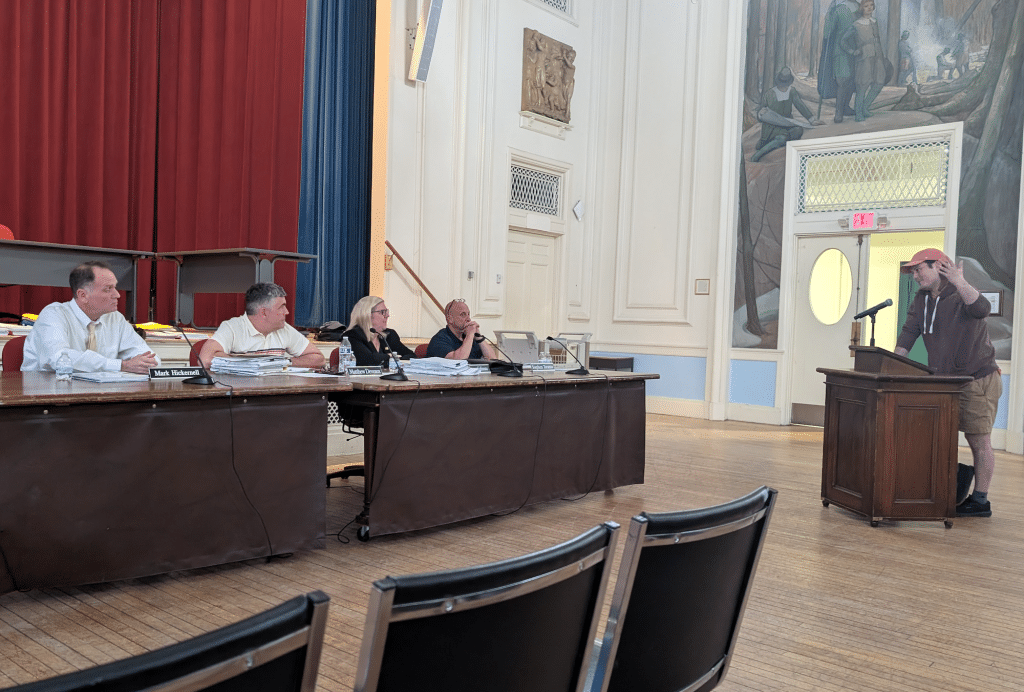
Project attorney Michael Connors requested leave to withdraw the case without prejudice in light of changes to the city’s housing affordability ordinance, a move that came after an hour-plus of discussion at Tuesday’s Zoning Board of Appeals meeting.
Connors requested leave to withdraw the case without prejudice in light of changes to the city’s housing affordability ordinance.
The ZBA unanimously agreed to let site owner Berkeley Investments withdraw its case for the time being.
Berkeley Investments had proposed building the units at a site it owns that is currently a parking lot, which it determined is significantly underused.
The case has attracted significant attention over the past few months, both from those who oppose the development for its potential effects on the neighborhood and fear the precedent it could set for other developers, and those who support it as a way to help offset high housing costs in Waltham and housing affordability problems around Greater Boston.
This hearing drew around 40 individuals, and the board had received a slew of letters to review before the meeting, with 57 opposing the project and 20 supporting it. The project’s immediate neighborhood was well represented in the correspondence, with approximately half of letter-writers opposed to the project and a quarter of those supporting it hailing from Crescent Street, Adams Street or nearby crossroads.
Speakers both for and against the development mentioned they disliked Berkeley’s choice, up to this point, to opt out of providing units that meet the city’s affordable housing threshold. Instead, the company had planned to make a contribution to the city’s Municipal Affordable Housing Trust Fund.
The city recently decided to amend its affordability requirements on the grounds that its previous affordable housing threshold was high enough to disincentivize building new housing. Connors implied that this may change the developer’s plans for incorporating affordable units.
This expansion was first proposed to the neighborhood in 2024, and the plans had been working their way through city committees for the past few months. Most recently Berkeley asked the ZBA for variances to zoning rules regarding parking, building height and the distance between the building, Crescent Street and the Charles River.
Public input
Eight audience members at Tuesday’s ZBA meeting spoke against the project. Most were South Side residents citing concerns about density and traffic, reporting that parking is already tight and traffic on Crescent Street is often packed and difficult to navigate, especially during rush hours.
“In the nine years I’ve been living there I’ve seen many, many almost-accidents,” warned Robbins Street resident Marni Abramowitz. “By adding 140 units across the street … it’s just adding to that volume, and it’s inevitable.”
She added, “I do agree that we need more housing in the city, and we need more affordable housing. But that particular location is not the place for it.”
Some speakers clashed on Berkeley’s parking studies, which indicated around 60% of its parking spaces sat empty during peak hours and residents used at most 8% of spaces at the lot where the proposed building would go. One neighbor said she passes the lots regularly and finds them mostly empty, but two others contended that they’ve seen the parking lots close to full.
Another theme among the project’s detractors was that the variances were too significant and not justified enough for the ZBA to grant them. Under Massachusetts General Law Chapter 40A, the board can grant a petitioner permission to ignore parts of the city’s zoning code provided they can prove their lot is unique in some way, whether because of its shape or composition, that would mean conforming to the code would represent a significant hardship.
“They’re asking you to approve a project that does not fit within the zoning framework adopted by the City Council and to grant a level of relief that effectively rewrites the rules for this property,” said resident Gail Drakos. “Reduced profits are not a hardship. The desire for larger projects is not a hardship.”
Resident and Waltham Inclusive Neighborhoods policy coordinator Tom Benavides argued the requested variances weren’t much different than the existing Watch Factory building and that some of the neighborhood’s zoning ordinances don’t reflect existing buildings.
“I definitely agree this belongs in front of City Council … and for that reason I really hope you approve these variances,” Benavides added. “This isn’t a [Chapter] 40B. You aren’t permitting the project.”
Five other speakers spoke in favor of the development. Most emphasized a need for housing in Waltham to mitigate the area’s housing shortage, arguing that even without affordable units, adding new housing to the area would create more supply and lower rents for residents.
Some contested complaints about traffic and overdevelopment, arguing other factors such as a lack of walkability in Waltham contributed more significantly to local traffic.
“The character of this neighborhood [going] back 120, 150 years is dense multifamily housing … building housing here is just returning its use to what it was,” said resident Saul Blumenthal. “This is not open space. It is two slabs of concrete abutting the river. It is almost comically laughable to hear people in this room lamenting the loss of the view of a parking structure.”
Additionally, the ZBA
- Approved variances to construct a drive-thru ATM at the Bank of America branch at 880 Main St. Project representative Jim Souza said the branch was replacing its current ATM after a truck drove into its canopy; the new ATM will be separate from the building and have a higher canopy.
- Voted 4-1 to approve a 323-unit residential development at 245–265 Winter St.
- Approved a one-year extension for variances to build a garage at 222 Bacon St. The ZBA granted these variances in 2024; the owner’s lawyer, Phil McCourt, said the project was nearly ready, but the owner had run into delays on some of its permits and wouldn’t quite meet the original construction deadline.
Author

Comments (1)
Leave a comment
When commenting, please keep in mind we are a small non-profit focused on serving our community. Our commenting policy is simple:
- Common sense civility: we’re all neighbors, but we can disagree.
- Full name required: no anonymous comments.
- Assume the best of your neighbors.


As one of the commenters at this meeting I found it a little frustrating that some of the opponents took a very excessive time to comment, with two of them talking more than 10 minutes each. I hope the ZBA starts to enforce a reasonable time limit for individual comments in future meetings.