
Waltham was home to enslaved people
Waltham resident Marjanneke Wright is on a mission to document the lives of Black Waltham residents who were enslaved. Now retired from a career as a reference librarian at Wayland Public Library, Wright has been digging through some of the city’s oldest records to find evidence of people who lived here before the founding of the nation. With the help of Wayne McCarthy of the Waltham Historical Society, she is creating a digital archive so future scholars and others will have access to them.
“This work is dedicated to the individuals whose names were long omitted from our town’s official narrative: Kent, Jetty, Bristow, Prince, Lucy and others, both named and unnamed,” she said. “The history of enslavement in Waltham is not just a collection of data — it is a story of human lives long obscured.”
With the help of city clerk Joe Vizard, Wright has been able to access the city’s vault to examine old, fragile records. “Touching these documents felt like touching history itself,” she said. “Within these pages as well as in other records, I identified over 20 enslavers and, more importantly, over 20 names of enslaved individuals.
One of the enslavers has a name familiar even today: Jonathan Brewer. He operated a tavern on the grounds of what is now the Gore Estate. In the 1770s, his establishment served as a hub of activity, where local labor, municipal administration and the impending American Revolution intersected. It was at Brewer’s Tavern that a bar maid, possibly an enslaved person, overheard two British spies.
In 1774, Brewer placed an advertisement in the local newspaper seeking the return of a man named Boston. He is described as “About 25 years of age, about five and a half feet high, walks stooping, speaks quick. Had on when he went away a dark-coloured Serge Coat and Drawboy Jacket, a Pair of Buff Colour’d Sheepskin Breeches, one Pair of Yarn Stockings, and a Pair of Pumps.”
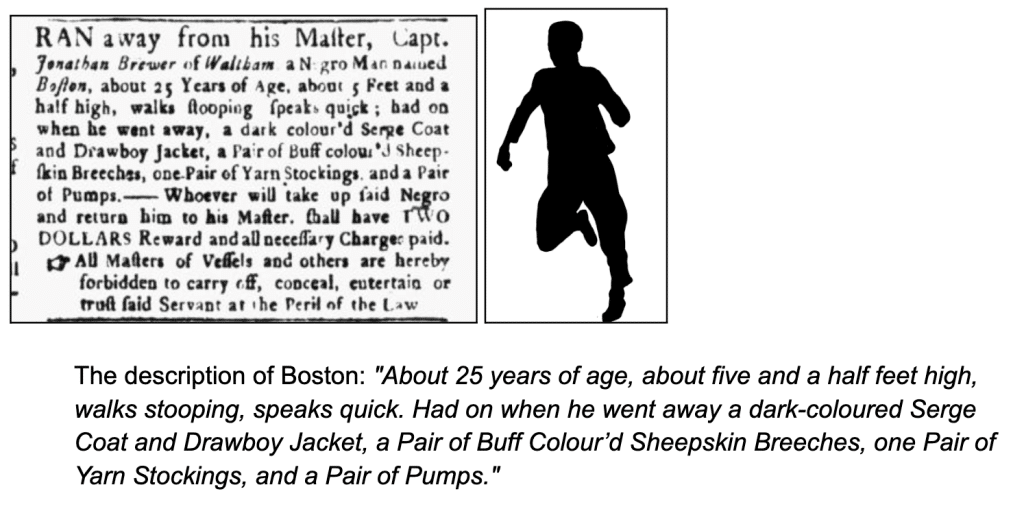
Brewer offered a $2 reward for Boston’s return, concluding with a stern legal threat: “All Masters of vessels and others are hereby forbidden to carry off, conceal, entertain or trust said servant at the peril of the law.”
There were people in Waltham who opposed slavery. A year earlier, town representative Jonas Dix read a letter at a town meeting “setting forth the Barbarous unChristian and inhuman Practice of stealing and subjecting the poor Africans to perpetual Slavery.” The issue was debated and the town “submitted the same to their Representative to act thereon as he shall judge proper.”
Despite the town meeting’s criticism of slavery, Brewer apparently had no qualms about advertising for the capture and return of Boston.
Author

Comments (1)
Leave a comment
When commenting, please keep in mind we are a small non-profit focused on serving our community. Our commenting policy is simple:
- Common sense civility: we’re all neighbors, but we can disagree.
- Full name required: no anonymous comments.
- Assume the best of your neighbors.




Thank you for this article!