
At Bentley’s student philanthropy center, students learn by serving their community
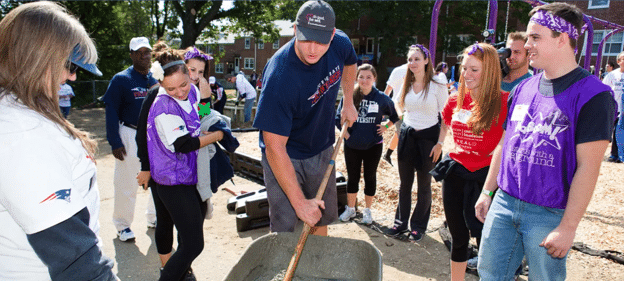
The Bentley Service-Learning and Civic Engagement Center runs on a simple premise: Community engagement should be graded, structured and student-led — not treated as a side project or extracurricular activity. Entering its 35th year of operation this fall, the center’s work will engage about a quarter of Bentley’s 4,500 undergraduates, making it one of the largest programs of its kind in the country.
Founded in 1991 as the Bentley Service Learning Project, the center has changed its name twice, eventually adopting its current title to reflect a broader civic mission alongside academics. It was one of the earlier adopters of “service-learning” back when the concept, and the vocabulary for it, were still being invented.
“Thirty-five years ago, service-learning wasn’t really a thing as a pedagogy or as a concept at other universities,” said Jonathan White, the center’s executive director and a faculty member in Bentley’s sociology department.
White said his predecessor and the center’s founder, Edward Zlotkowski, is considered a pioneer of the service-learning philosophy, which became a national movement. Zlotkowski later wrote a book called “Students as Colleagues”, which informs how the center operates. White co-directs with Brian Shea, an alum of the center himself, but Bentley students are the backbone of the center’s leadership structure.
About 150 students serve as program managers and are paid to run training, facilitate community partnerships and coach students in their service placements. “Jonathan and I, we’re not going to Whittemore Elementary School to facilitate a reading program for fourth graders,” Shea said. “We’re not going to the Waltham Senior Center to lead an intergenerational program. … Those are all student-led.”
Getting paid is important, Shea added, for reasons beyond the obvious. “It’s helpful simply to break the notion that the only thing you can get paid for is something that doesn’t align with your values,” he said. “I think it is good for especially students at a business school to understand that community work is valuable, and it is valued.”
Above the program managers sit student directors — a group of four selected students who sit in on staff meetings alongside the directors, helping make decisions about how the center runs. They work roughly 20 hours a week on top of full course loads and represent the center publicly, including through presentations to Bentley’s Board of Trustees. Selecting them is a weekslong process thatincludes extensive student input.
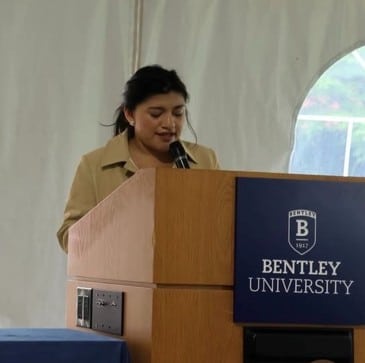
Despite its large size, that level of care translates directly to the quality of students’ experience with the center. Helen Yac Xiquin, who was a lead program manager before she graduated this spring, first encountered BSLCE before she had even committed to Bentley. While touring campus on admitted students day, she passed a BSLCE table and, on impulse, wrote down a program she dreamed of starting: helping immigrant populations prepare for their citizenship tests. Years later, while working at the center, Shea handed her a small slip of paper — the exact note she’d written at 18. “It was a total full-circle moment for me,” she said.
By then, she was already doing the work she had once only imagined, spending all four of her years at Bentley with the Whittemore English-Spanish exchange program, where she helped immigrant parents build confidence speaking English.
While she helped parents learn English, Helen said, they also helped her strengthen her Spanish skills — exemplifying the balance that the directors hold in such high regard. Shea said students are encouraged to think of it as working with the community, rather than for the community.
In line with the service-learning philosophy, the educational aspect of students’ work is reflected in tangible academic credit. Bentley faculty members can offer an additional optional credit tied to community-based work. Students who opt in don’t just volunteer for an afternoon; they take on roughly 30 hours of structured work, including prep and reflection.
That legitimization matters more than it may seem, the directors said. “When it comes to midterms, even if the students’ priority is to work with the community, they’re going to skip that and study for their test,” White said. “Here, it’s grade-incentivized. The school has decided that it’s equally important.”
Roughly 1,200 students take part in the credited model each year — a level of participation that is highly sought after among Bentley’s peers. The BSLCE pioneered the additional-credit model, and White says he still fields calls from other universities asking how to replicate it. “I wish more people would consider implementing it. … Often the barrier is trying to get it into the systems of their school.
At Bentley, the model falls under academic affairs rather than student affairs — an unusual placement that, White said, reflects how deeply the university has invested in service learning.
The directors note that none of this happened all at once. The additional-credit option arrived in the late 1990s, allowing the program to scale. Program manager roles came later, and the student director model has continued to expand. Even outside partnerships keep growing; White said the College Board has approached Bentley about building service-learning components into Advanced Placement courses nationwide.
What hasn’t changed is the underlying premise that community-based work holds value not only for the community, but for the student doing it. Alexander Sassaman, lead program manager for the Sages and Seekers program with Waltham Connections for Healthy Aging, said the center’s work dramatically changed the way he views Waltham. “It is easy for the university to feel like its own world,” he said. “For some, this can isolate students from the Waltham community. The Service-Learning Program at Bentley provides a way to bridge this gap. I feel more connected than ever to the Waltham community and have even run into a Sage from my program in Cafe on the Common.”
For now, White says he’s less interested in dwelling on the center’s past achievements than in what it does next. As the new freshmen arrive, the bigger goal is making sure programming keeps evolving, as always, pulled forward by the students running it.
Author





Comments (0)
There are no comments on this article.