
Five Diet and Nutrition Goals You Can Do Right Now
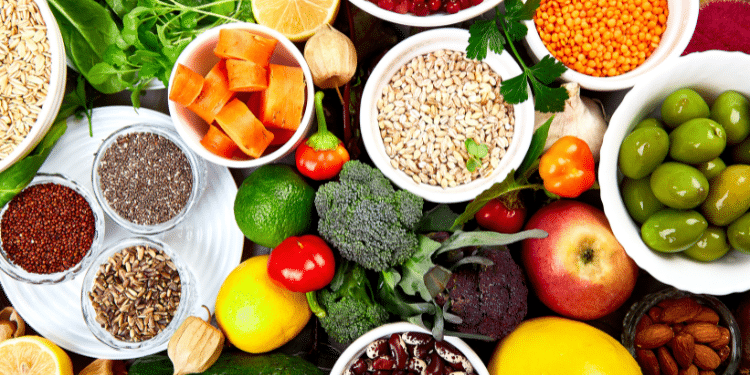
Many of us think about what we can do to improve our nutrition and health — and sometimes feel guilty about what we’re eating. Improving your nutrition can be done with simple changes, not a complete overhaul of your eating habits.
People eat what they like and like what they eat. If you try to make major changes you are likely to end up failing and going back to the way you were eating before. If you were feeling bad about the way you were eating, this can make those feelings much worse.
Here are five ways to improve your diet and your health right now.
1) Add, don’t subtract. Think less about what you shouldn’t eat than what you can add to your eating patterns. For example, if you add one or 2 servings of fruits and vegetables to your pattern every day (or every week!), that tends to crowd out other foods that may not have the same nutrient density. Make your goals for change modest and achievable.
2) Consider having one or two meals each week that feature vegetarian sources of protein. The term “plant-based” is very popular right now and means simply that food comes from plants and not animals. Examples are a bean or lentil and vegetable soup or stew or chili with beans (not meat) or a stir fry with lots of fresh veggies and tofu.
3) Eat mostly whole grains. Examples include whole oats, whole wheat, brown rice and quinoa. Read the labels on packaged foods such as bread and breakfast cereal looking for the word “whole”, which should be first or second in the list. This means that the grain includes the bran, germ and endosperm of the plant. Grains such as wheat are processed to remove these parts of the grain to make them “white”. For example, if the label just says “wheat”, that means it’s made with white flour. Processed grains such as white flour are not inherently bad, they are just lacking in important nutrients contained in whole grains.
4) Make your meals colorful. When you plan your meals, think about the colors of the foods you’re going to eat. If your plate is beige, brown and white, add some colorful veggies like green leafy, bright orange, red, green or yellow. That could be a salad with tomato, red peppers, and romaine lettuce or kale. Don’t want salad? Try steamed carrots, green beans, squash or spinach. Have colorful fruit for dessert, such as melon, berries or peaches.
5) Avoid promising yourself you won’t eat your favorite foods. “Avoid” does not mean “never”. Before you eat something you think you shouldn’t, think about how much you really want or crave it and how much of it you need to feel satisfied. Remember that no one has a “perfect” diet, and you won’t either. Feeling guilt about eating something is a waste of energy.
These are goals to which you can aspire. Not meeting a goal is not a reason to feel guilty. You may need to adjust the goals to make them more doable. Such goals should be SMART: Specific, Measurable, Achievable, Realistic and Time-bound. In other words, a change that is clear and is something you can really do. Then be proud of your achievement!
Resources for eating well in Waltham
• The Waltham Farmer’s Market. Every Saturday through Oct. 31, 2026, 9:30 a.m. to 2 p.m. This is a great place to buy fresh, local produce, fish, cheese, honey, baked goods, pet food and prepared foods. The market accepts SNAP.
• My favorite supermarkets in Waltham are Market Basket on Market Place Drive and Hannaford on Main Street. Both stores carry a beautiful array of fresh produce, baked goods, fresh meat, poultry and fish, plus general grocery items.
AUTHOR: Ellen Glovsky, PhD, is a retired Registered Dietitian who has lived in Waltham for 32 years. Her career spanned 55 years and included a private practice specializing in eating disorder treatment. She was on the faculty of Northeastern University and Boston University. Dr. Glovsky also had a consulting practice in which she provided training in counseling skills for other health care providers.
Author







Comments (0)
There are no comments on this article.