
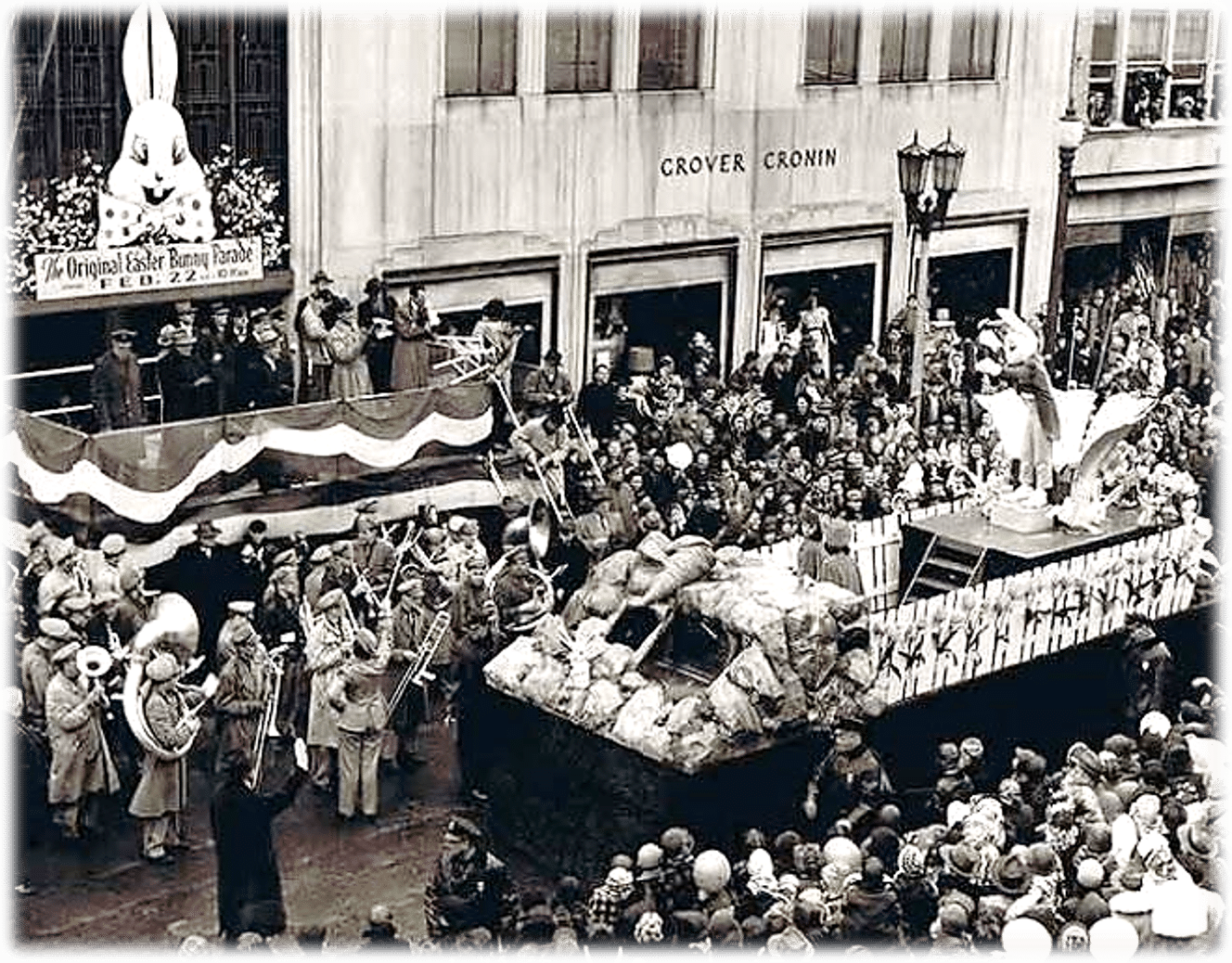
In 1954, 75,000 people came to see the Easter Bunny, in Waltham, a city of about 50,000 at the time.
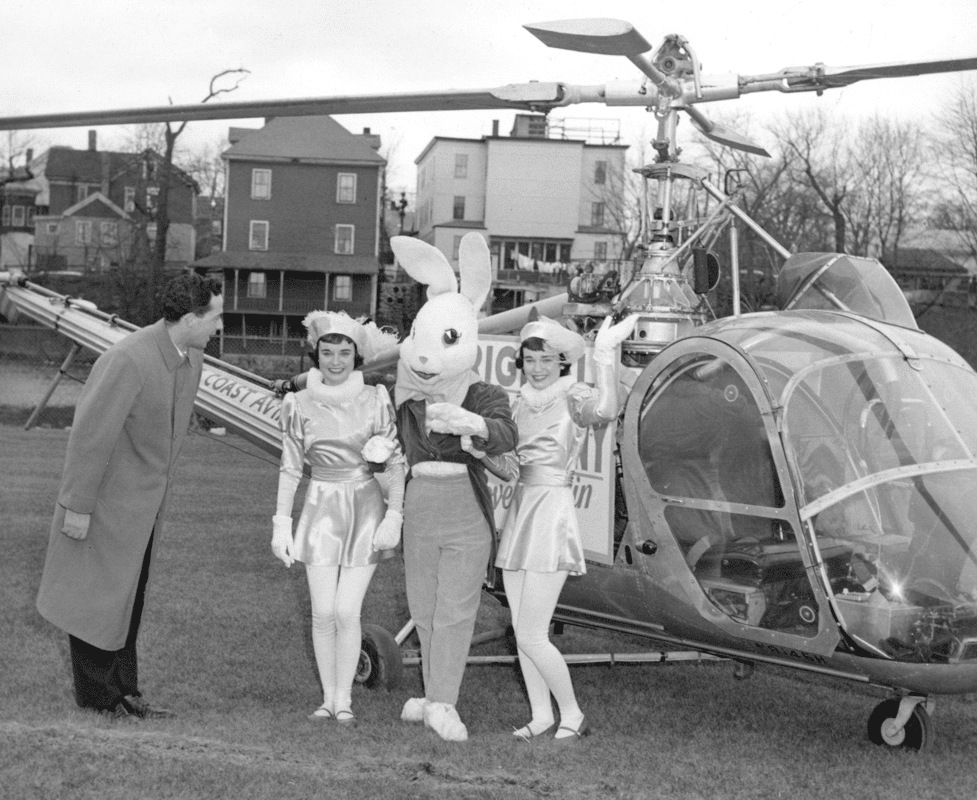
From the Reece Corp. parking lot (now Nova Biomedical), where the bunny arrived by helicopter, down Prospect, then east on Main, up Moody Street and across the bridge, crowds lined the streets. By the time the bunny rolled up to the reviewing stand in front of Grover Cronin’s department store, thousands packed the street. For a generation of Waltham children, the parade and the store that sponsored it were as big as anything in Boston.
“People eventually just thought it was the city of Waltham” putting on the parades, local historian Jack Cox told a sold-out audience at the Lyman Estate on Thursday, Sept. 24. “It was Grover Cronin’s.” The Waltham Historical Society organized the program about the legendary store.
The talk drew on archives the Cronin family recently donated to the society. Photos, ads and issues of the employee newsletter showed a merchant who always dreamed up ways to bring customers downtown and treated his employees like family.
Jeremiah Cronin opened a small tea shop in 1885 in Watertown. A year later, he moved it to Waltham. His son Grover took it over in 1912 at the age of 24 and built it into a pioneering department store on Moody Street.
National celebrities and spectacles
Grover Cronin had a gift for spectacle. He brought in celebrities such as the legendary bandleader Benny Goodman and boxer Jack Dempsey. A photo shows Cronin’s son Paul squaring off with the former heavyweight champion. “There is no record in the company archives as to who won that match,” Cox noted wryly.
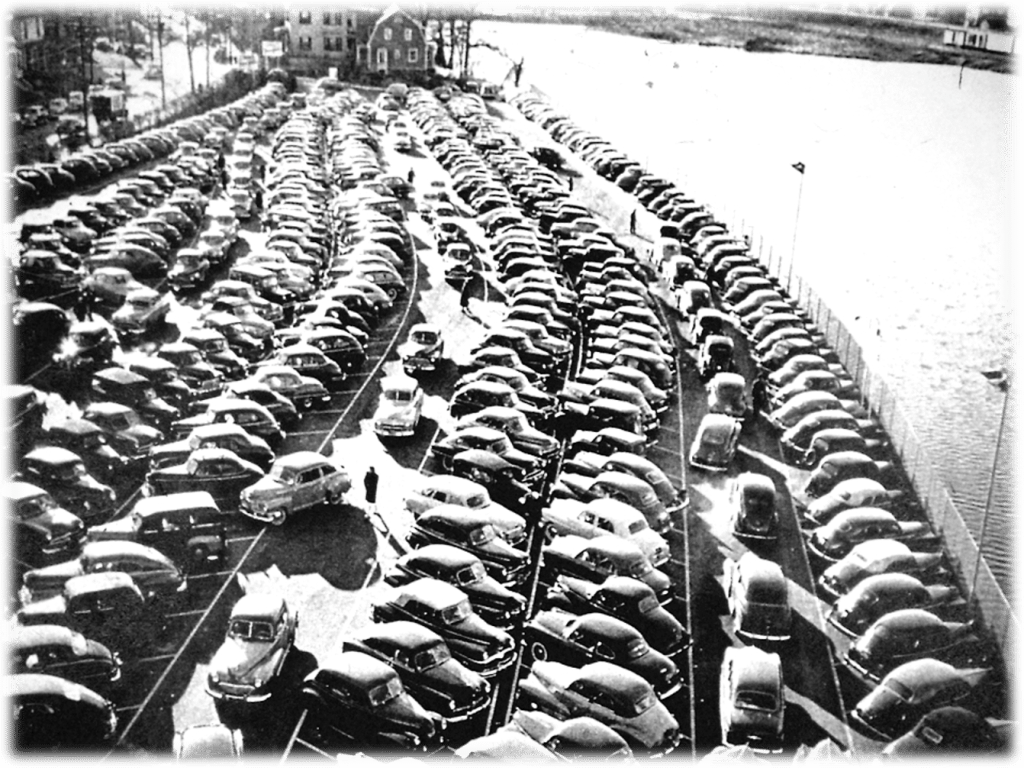
Cronin was also a visionary. In 1920, when few Americans owned cars, he foresaw the need for a place to park them and began buying land for what became a 300-car lot behind the store.
In 1948, when most Americans didn’t own a television, Cronin put TV sets in his front windows. Crowds packed Moody Street to watch Joe Louis knock out Jersey Joe Walcott in the 11th round on those small screens.
Christmas brought its own show. An evergreen garland stretched the length of Moody Street, while Santa was lifted by a crane onto the roof and sent down a chimney. Each year, 8,000 to 10,000 children visited Santaland. Not all were thrilled. One photo shows a sobbing boy who grew up to be Tom Grinnell, a longtime Waltham High history teacher.
The store’s nativity scene, which was displayed each year in the corner window, now sits restored in a museum room in the basement of Waltham City Hall.
Some of the store’s work was never publicized. Each Easter, Cronin’s sent the Easter Bunny with gifts to children’s hospitals across Eastern Massachusetts. In a 1952 photo, a row of boys in wheelchairs smiles at the bunny. They were likely polio patients; the photo was taken three years before the Salk vaccine.
A caring boss and respected business leader
“I want you, each and every one, to know that your welfare has always been in my mind and heart,” Cronin wrote to employees in 1948.
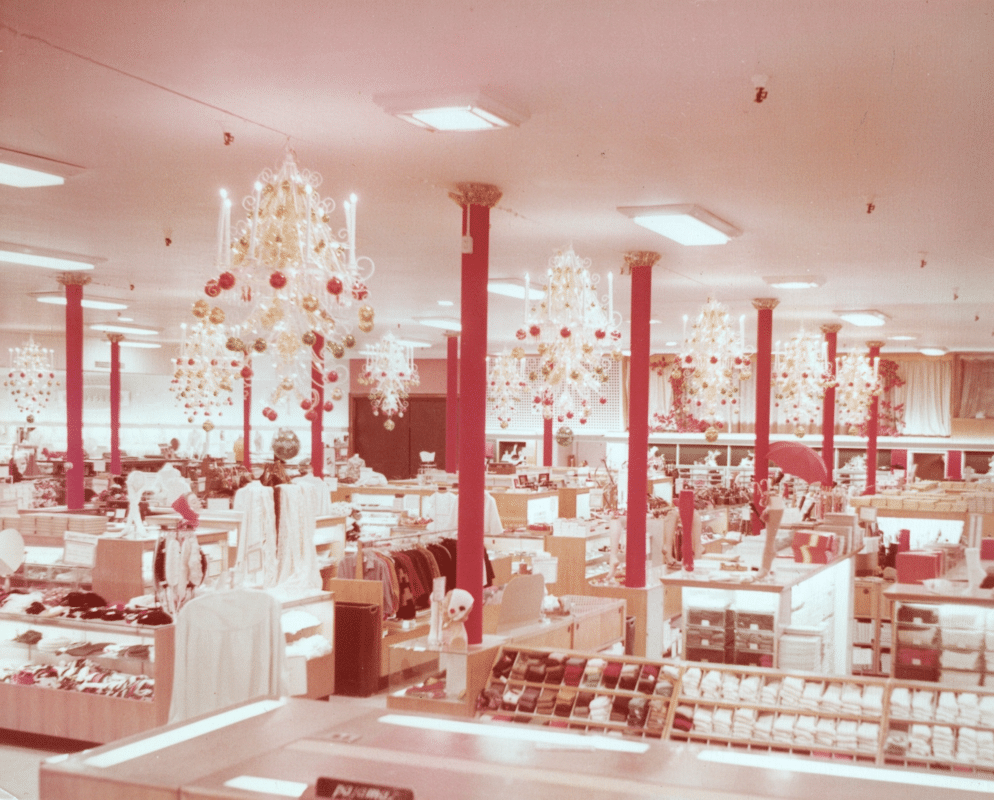
He backed that up. Full-time workers had health insurance with nothing taken from their pay. After three years, they were vested in a pension at no cost, and some former employees still get those checks, according to grandson Phil Cronin. The company had basketball, softball and bowling teams, a choir and a Quarter Century Club for long-time employees like Harold “Pops” Mungen, who started in 1919, did “everything from putting coal in the furnace” to selling, and retired at 88. When Cronin died in 1953, Mungen said he lost his best friend.
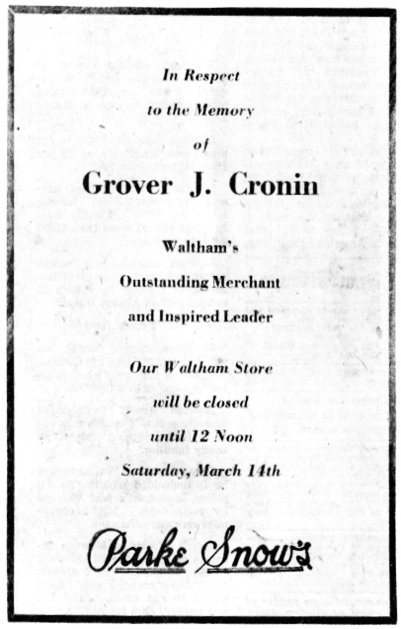
On the morning of Cronin’s funeral, stores up and down Moody Street closed for the day to honor him. Parke Snow, the rival department store downtown, called him “Waltham’s outstanding citizen and inspired leader” in a newspaper notice.
Cronin’s widow, Helen, ran the store. Their son Paul took over, and another son, Robert, later became its last president. Cronin’s marked its 100th anniversary in 1985. By then, malls in Chestnut Hill, Burlington and Watertown were pulling shoppers away, and the other clothing stores on Moody Street were closing. Cronin’s shut its doors in 1989.
“When I drive past Grover Cronin’s, I think of the store,” Cox said, “and seeing my aunt in there, my grandmother in there. My father worked there part time at Christmas.”
Cox asked how many in the audience had worked at Cronin’s. A half dozen hands went up. For many Waltham residents, the Cronin’s story is part of their lived history.
The family’s work in Waltham continues. The Grover Cronin Memorial Foundation has given scholarships to Waltham High graduates for more than 70 years and still donates to local charities.
“The legacy of the store and my grandfather, Grover, really lives on,” Phil Cronin said.
Author

Comments (2)
Leave a comment
When commenting, please keep in mind we are a small non-profit focused on serving our community. Our commenting policy is simple:
- Common sense civility: we’re all neighbors, but we can disagree.
- Full name required: no anonymous comments.
- Assume the best of your neighbors.



A lovely article. Jennifer Rose was the person instrumental in having the art deco facade of Grover Cronin’s preserved when the building was converted to residential living and storefronts.
Thank you for opening my eyes to some history of my new hometown, June!