
Budget breakdown: Final school budget funds new administrators and rising special ed costs
The final FY27 budget book for Waltham Public Schools, approved during the School Committee’s July 9 meeting, closed the loop on a contentious budget season that saw strategic disagreements between Superintendent Marisa Mendonsa and Mayor Jeannette A. McCarthy.
A central variance between the two visions for the future of the district was the inclusion of new administrative positions both in the central office and at Waltham High School. Mendonsa saw the positions as essential to putting WHS back on the right track, while McCarthy thought the money would be best spent on more classroom teachers.
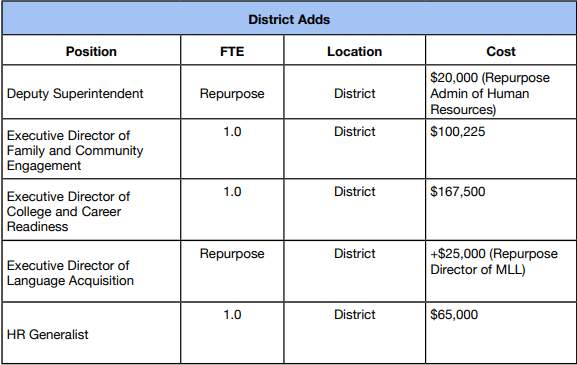
The book resolves that variance and shows that it will indeed be Mendonsa’s strategy that carries forward into next fiscal year. The cost center covering the district’s central administrative offices rose from $2.4 million to $3.4 million — a 40% increase. The document’s line-item notes attribute it to a “reorganization of Central Office positions” and list a new deputy superintendent, an executive director of language acquisition, an executive director of college and career readiness and a human resources generalist (which replaces an administrator of human resources).
It also eliminates a director of English language learning role, replacing it with an executive director of language acquisition. It’s unclear if this role will be occupied by the previous director. As of press time, the district’s website still lists Marianne Duffy as the assistant director of English language learning, but no director or executive director.
Though City Council ended up approving McCarthy’s final budget book, which totaled $132,847,897, it does not have the authority to approve specific line items. It simply appropriates a lump sum to a department, and that department decides how to divvy up the funds. In this case, the School Committee had room to fund extra positions that didn’t appear in McCarthy’s budget, and it did.
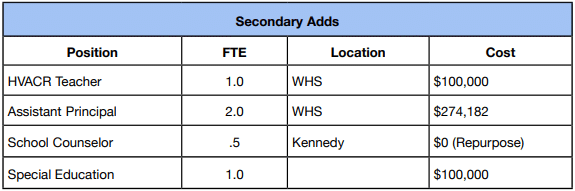
Also in keeping with Mendonsa’s growth strategy, Waltham High School will get two new assistant principals — bringing the total to six — who will work with the recently hired principal William Conard.
Mendonsa said her plan is partly rooted in bringing Waltham up to speed with other districts and their admin ratios. “Our admin ratio, if you compared us to … the communities around us, Framingham, Natick, etc., we are at the bottom in terms of the ratio between teacher to administrator,” she told the City Council at a June budget hearing.
She elaborated on her reasoning at a June 10 School Committee meeting. “When I propose assistant principals … it’s because I believe they are the most important investments we can make,” she said. “When the ratio between teachers and administrators is too high, the support is spread too thin.”
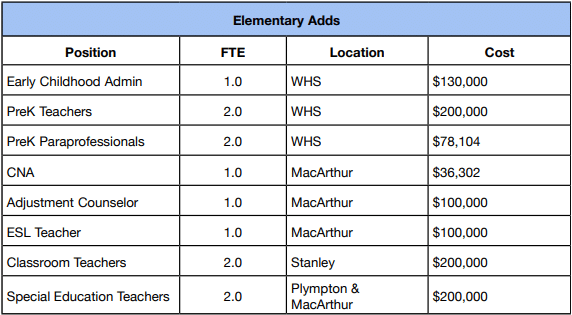
In total, 19.5 new positions were added across administrative and classroom roles, totaling $1,996,313.
Changes in other areas
While the back-and-forth over administrative positions dominated meetings, two other cost centers raised by more than the entire reorganization combined. Special education, a historically expensive area for districts across the state, rose by $2.85 million, or 10.3%, from FY26 — the largest single dollar amount anywhere in the budget.
Much of that is $924,000 in salary increases for special ed paraprofessionals, who support classroom teachers. Some $887,058 is allocated for special ed teacher salary increases. But the largest percentage increase from last year’s budget is in out-of-district collaborative placements. Waltham is obliged to pay for tuition at specialized schools when it cannot serve a student’s needs, including transportation to and from that school. These placement costs are up 109% from last year, from $1.42 million to just under $3 million.
Transportation is also up 25% from last year to $1.67 million.
The district has received feedback on improving its in-house offerings and better serving the needs of students within its own programs.
That increase didn’t move the bottom line as much as it should have, though, because the state’s circuit breaker reimbursement rose right along with it by 80%, up to $5.6 million. Because out-of-district placements are so costly, the circuit breaker provides financial assistance, and has done so since implementation at the state level in 2004. Once a student’s costs exceed a certain threshold, the state covers 75% of the student’s tuition and transportation. Waltham’s per-pupil costs rose, and thus so did the circuit breaker.
A few line items rose faster by percentage, though making up smaller portions of the budget. Spending on information technology equipment is up 82.5%, from $43,000 to $168,000, tied to a technology refresh cycle that administrators alluded to throughout the budget process.
On the other side of the ledger, English language learner services dropped 6.4%, or $412,000, tied to the cuts of four-and-a-half full-time teacher salaries and two full-time paraprofessional salaries. Mendonsa has said these changes were motivated by a drop in the English learner population in the district.
The total amount for FY27 of $132,847,897 represents a 7.1% increase over FY26, consistent with the figure approved by the City Council in June. Clerical errors and inconsistencies between budget books halted the School Committee’s final approval until July 9, but the School Department can now move forward into the school year with a clear roadmap.
Author







Comments (0)
There are no comments on this article.