Waltham man’s abduction in Uganda sparks demonstration at State House
Charles “Muvawala” Bukenya was found alive with signs of torture
BY VIVIAN AINOMUGISHA AND BAILEY SCOTT
Waltham Times Contributing Writers
About a dozen members of a Ugandan political group demonstrated from Copley Square to the State House in red berets on Friday, following the abduction of a key figure in their organization.
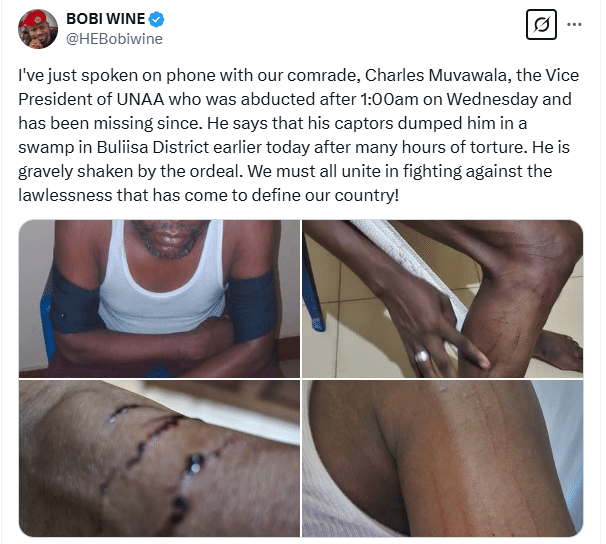
Charles “Muvawala” Bukenya — a Waltham resident — was abducted in Nakulabye, Uganda, shortly after 1 a.m. Wednesday on his way to withdraw money from an ATM, according to Ugandan news media. He was found alive Friday, according to photos posted on social media. His captors, who have not been identified, dropped him off at a swamp, brutally beaten and scarred.
“He went on vacation and disappeared,” said Maureen Kalemba, president of the Uganda Boston Community Association. “Before we knew it we were seeing pictures of him bruised and tortured. We don’t know what happened to him.”
Muvawala plays a key role in the Massachusetts Ugandan community as the vice president of the Ugandan North American Association and a member of the National Unity Party (NUP). He traveled to Uganda last month to visit family, according to people at the rally.
NUP members believe his association with the party was the reason behind his abduction.
“They stopped him to put fear into people like us, in the diaspora, maybe to stop us from going there [Uganda],” said Robert Kabuye, an NUP member.
Local pro-democracy activists seek change in Ugandan government
NUP is a Ugandan political party led by Robert Kyagulanyi Ssentamu. Kyagulanyi, also known by his stage name “Bobi Wine,” is a Ugandan singer, musician, actor, activist and politician. He created the slogan “People power, our power,” which led to the formation of the People Power Movement.
Since its formation in 2017, the People Power Movement has stood for democracy, human rights and reform. The NUP is the political arm of the People Power Movement.
The movement has fought to remove the National Resistance Movement (NRM), led by President Yoweri Kaguta Museveni, from power. Museveni has been in office since 1986.
The NUP was defeated by the NRM in the 2021 election, leaving Museveni in power until the next election in 2026.
To some Ugandans, that is far too long for any one person to stay in office.
“I’m turning 41 soon, and guess what? This president that we’re talking about has been in power for the last 40 years,” said Marvin Bbale, Massachusetts NUP chapter leader. “My generation is literally gone, you can imagine.”
“But this is the new generation,” he said. “We believe in peace. We believe in freedom for all. We believe in democracy. We believe in human rights. We believe in justice.”
NRM’s opposition associates the party with dictatorship, violence and election fraud. Despite six elections since 1986, no one has succeeded in replacing Museveni.
“Looking at things that are happening back home, there’s a lot of injustice,” Bbale said. “Each time we go into elections, you see the kidnapping and the killing.”
Demonstrators want U.S. to stop aiding Uganda
Others in the Ugandan community say that going back to Uganda has now become a risk.
“We do not have a guarantee that when you go home, you come back alive, or you won’t be kidnapped, or you won’t go missing, or your property won’t also go missing,” said Maureen Asiimwe, also known as Afande Momo, chairperson of the Uganda Boston Community Association.
“I know that when I go home, I may not come back alive, or that something may happen to me, so I decide to stay,” she said. “It’s a decision I have to make on my own for the security of my kids, my parents and my family.”
“But do I have to do that when that is my nation? That’s where I hail from?” she added. “No. So that is what we are coming and standing for.”
Asiimwe said that despite the law saying that they are free to go to Uganda, and that Uganda is free and safe, it doesn’t feel that way at all.
“The example which they have just shown to Charles Bukenya shows us that we are not free, and that is why I’m here today in this protest,” she said.
Being part of this movement comes at a great cost for many, including 33-year-old Habib Male, who no longer travels to Uganda after experiencing repeated acts of brutality.
“I’m a survivor of kidnapping. I’ve been arrested four times in Uganda,” Male said. “I’ve been detained and tortured two times.”
In captivity Male was beaten by batons and hit with a weapon.
He grew up in a household affected by domestic violence and was inspired by figures like Kyagulanyi to become a human rights activist. His passion has driven him to continue resisting oppression.
“The people that inspire me have never given up,” Male said. “I don’t see a reason to give up.”
At the end of the demonstration, Bbale and other group members presented a petition to Senate President Karen E. Spilka and House Speaker Ronald J. Mariano. Their goal is to advocate for the United States to stop sending aid to the Ugandan government, citing the harm it has caused its people.
“We’re scheduled for more meetings,” Bbale said. “We’re going to be coming up, and we’ll get to amplify our message, to stop funding the Ugandan government, our message that Ugandan voices need to be heard.”
This story is part of a partnership between the Waltham Times and the Boston University Department of Journalism.