‘Waltham Murders’ probes a shocking crime
By WILLIAM HOLDER
Waltham Times Contributing Writer
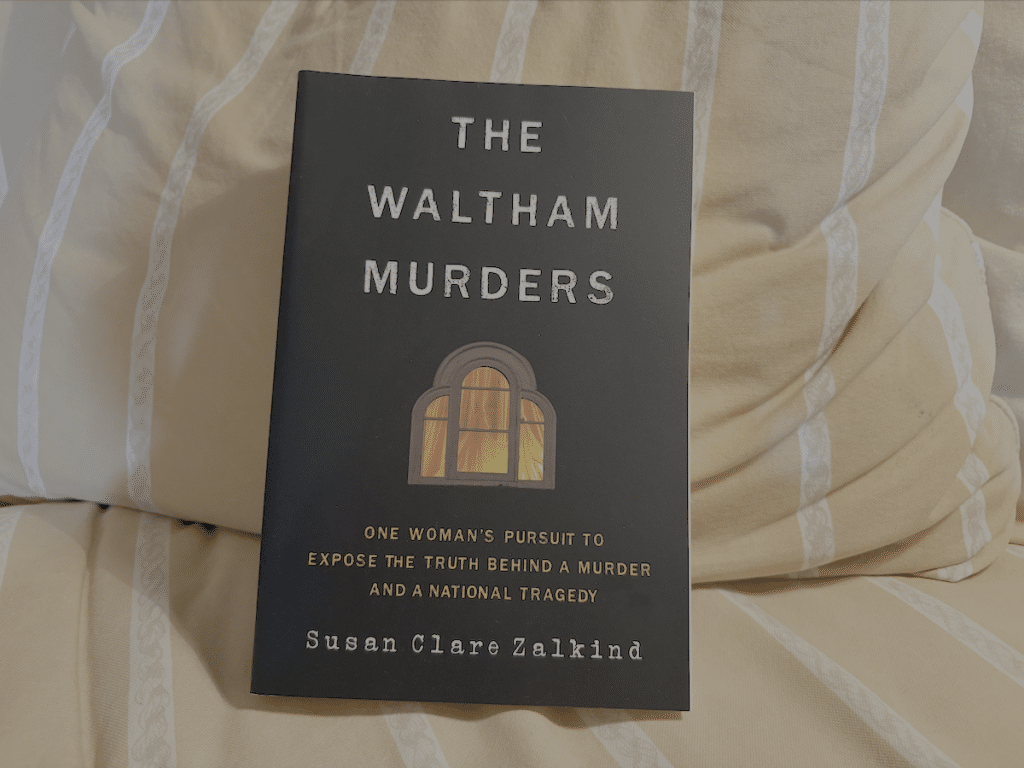
In her recently published book, “The Waltham Murders,” investigative journalist Susan Clare Zalkind lays out a meticulously researched argument for the identity of killers who committed a brutal triple homicide in the city in 2011, and she says there is more to be learned about the case.
Zalkind, who grew up in Newton and now lives outside of Boston, spent 10 years interviewing numerous people, accumulating mountains of facts, obtaining a multitude of court and other public documents, and battling law enforcement authorities who have consistently held that details of the case could not be released while the investigation remains open.
“I feel I accomplished what I set out to accomplish,” she said. “I was very careful in reporting on this story to make the narrative fit the facts, not create a sensational story line just to sell a book.”
She continued: “The book is a search for the truth and a commitment to its telling. My intent was to compile a record of account for readers today and in generations to come. This is why I am most grateful for the enthusiastic reception of this work by libraries, especially the Waltham Public Library.”
She noted that the Minuteman Library network has 88 copies in circulation, 22 of which are at the Waltham Public Library.
Motivation to tell the story
“The Waltham Murders” (Little A, New York, 2024) is partly a gripping true-crime story, but it’s also a first-person memoir of her search for answers in which she lays bare her motivation at the outset — one of the victims, Erik Weissman, was a friend of hers.
Much about the case has been reported in major media outlets. Zalkind herself wrote and produced a 2022 Hulu docuseries about the homicides, “The Murders Before the Marathon.” She wrote a lengthy story for Boston magazine in 2014, reported on the case for radio program and podcast “This American Life,” and was interviewed by TV show host Rachel Maddow.
The murders
The slayings occurred on Sept. 11, 2011, 10 years to the day after the 9/11 terrorist attacks. Weissman and his friends Brendan Mess and Raphael Teken, all known to sell marijuana, were found dead in an apartment at 12 Harding Ave. Their throats had been slashed, leaving a bloody and horrifying scene.
Early on, friends of the victims suggested that Tamerlan Tsarnaev be questioned by police. Tsarnaev worked out at the same gym as Mess and had been seen with the trio at Mess’s apartment.
Tsarnaev would become known nationwide in 2013 as one of the Boston Marathon bombers, and he was killed shortly after the bombing. Two unanswered questions that have hung over the investigation of the Waltham slayings is whether the bombing could have been prevented if authorities had focused attention on Tsarnaev — and why they didn’t.
Asserting guilt
Zalkind traces a detailed and complex web of circumstantial evidence that points to Tsarnaev and his accomplice, Ibragim Todashev, as the murderers. She has no doubt that the two are the perpetrators.
“Tamerlan Tsarnaev and Ibragim Todashev are guilty of the 2011 triple homicide,” Zalkind wrote in her book. “This is not an accusation I make lightly. If there were holes in this theory then I would be duty bound, by my own conscience if nothing else, to reveal them to you.”
At the heart of her story is a partial confession by Todashev, who admitted to his involvement in the murders as he was being interviewed in Florida by the FBI and other law enforcement officials in May 2013. According to a partially unredacted report of this interview and other records obtained by Zalkind, the pair had intended to rob the victims of $40,000 in drug money. Tsarnaev threatened the trio with a gun and pistol-whipped at least one. The assailants bound the victims with tape.
Todashev reportedly said that he had no idea that Tsarnaev intended to kill the victims and walked out of the apartment while Tsarnaev slashed their throats. The killers removed the tape and other material that might have provided DNA or fingerprints.
The interview with Todashev took a bizarre turn when he tried to attack his questioners, according to Zalkind’s sources, and was then shot to death by an FBI agent. As a result, both of the individuals named by Zalkind as perpetrators in the Waltham murders died violently, never to be brought to justice through the legal system.
The timing of the murders on Sept. 11 was no accident, in Zalkind’s view, and she explores Tsarnaev’s radicalization that began well before the marathon bombings.
A critique of the investigation
In the absence of a trial record, she says her work will enable future researchers to pick up the trail should they wish to re-examine the case.
Are there others involved in the crime either directly or indirectly who might be charged someday? According to the Middlesex District Attorney’s (DA) office, the investigation remains open and active. Zalkind said she has pressed the DA’s office to say whether any leads are currently being pursued.
A theme that runs throughout the book is her criticism of law enforcement authorities for their handling of the case. She raises numerous questions about why leads were apparently not followed up and why information has been withheld. She says authorities have sidestepped accountability, and much about the case remains opaque.
Meghan Kelly, spokesperson for the Middlesex DA’s office, says the active investigation into the triple homicide includes “recently interviewing a material witness and identifying a new potential source of physical evidence.” Any claim that the office is covering up deficiencies in an investigation conducted by the prior administration are without merit, she said, and the office will investigate all avenues before issuing any statements that could impede future prosecutions.
She also defended the record of the DA’s office in solving cold cases. Since establishing the cold case unit in 2019, the office has resolved nine cold cases, several of which are older than the Waltham slayings.
Zalkind is highly critical of the lack of a major crimes unit in Massachusetts. Murder investigations, she said, become localized into the 12 different district attorney units and are susceptible to political influence. Problematic murder investigations are not limited to the Waltham slayings, she added, citing the ongoing Karen Read case as a prominent example.
“As an independent journalist, there is only so much I can do,” she said. “I don’t think the story is over.”
We are a reader-supported nonprofit newspaper. If you value our reporting, please support The Waltham Times through a tax-deductible gift.
Author