
Residents share grievances about the impacts of 200 Trapelo Road
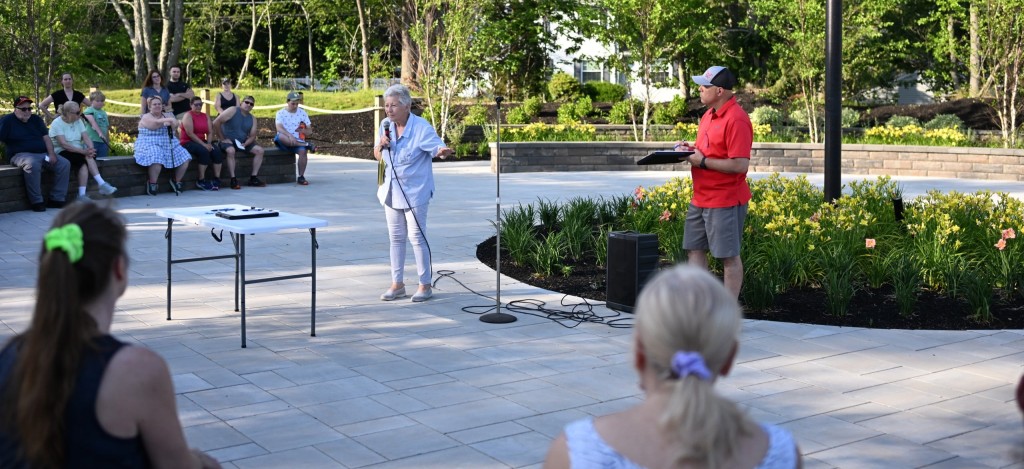
Tensions swelled Wednesday as neighbors of the new playground at 200 Trapelo Road vented their frustrations to city officials.
“I’m sorry — I really am — for the aggravation that you’ve been through,” said Waltham Mayor Jeannette A. McCarthy to a small crowd gathered at the park’s memorial area.
The popularity of 200 Trapelo Road has exploded since its opening on May 17, fueled by social media posts and the park’s unique amenities for individuals with disabilities.
Ward 3 Councilor Bill Hanley told the crowd that the park has been taking in as many as 100 vehicles per hour on the weekend.
However, the park’s popularity has come at a cost.
Popularity is a double-edged sword
Visitors have been parking on nearby streets when the site’s parking lot is full, leading to frustration from neighbors.
One resident, who lives on Marlborough Road, said visitors were parking on both sides of the street during the week of the park’s opening, preventing her from getting out of her driveway.
Another attendee who works at the nearby office park on Waverley Oaks Road said employees of the office park’s businesses are unable to get down Trapelo Road to come to work due to traffic caused by the park.
McCarthy told attendees that trespassing in the area continues to be a problem.
The park sits on the site of the former Walter E. Fernald Developmental Center, a school for children with developmental disabilities. The sprawling complex, which sat abandoned for more than a decade, has been a hot spot for trespassing over the years. The park’s opening has not deterred trespassers, as McCarthy explained that the fence around the property’s still-abandoned areas was found cut in five different places.
McCarthy said she gave a directive to Waltham Police Chief Kevin O’Connell to institute a no-tolerance policy for trespassing at the site, saying people found trespassing should not just be let go.
Proposed and temporary solutions
Hanley and McCarthy told attendees that solutions have been put in place to deter trespassing and overflow street parking on surrounding roadways.
Hanley said the Department of Public Works has been providing cones for residents in the area to prevent visitors from parking along nearby streets, but Hanley admitted that some visitors have been moving the cones and ignoring them.
Signs have been put up on the surrounding roadways, stating that the streets are not to be used as parking for 200 Trapelo Road. But Hanley and Michael Garvin, the city’s senior traffic engineer, explained that the signs are unenforceable because the streets are public ways.
On June 5 the Parks-Recreation Board made weekend parking at 200 Trapelo Road available through reservation only via an online portal. Multiple residents said this has reduced street parking on the weekends.
Another resident suggested that the city could form an agreement with the nearby National Archives Building at 380 Trapelo Road, explaining that the city could ask park visitors to park at the building and have a bus shuttle them to 200 Trapelo Road.
Parking problems and a debate
The central issue, both city officials and attendees agreed, is a notable lack of on-site parking spaces: 200 Trapelo Road only has 100 spaces.
Moreover, the park is still not finished.
According to McCarthy, four more phases of development are yet to be completed as the city plans to build an amphitheater, athletic fields and other amenities. A total of 550 parking spaces are planned for the site. As the city completes these phases, more parking spaces will be added, McCarthy said.
But there are still lingering problems, as the sometimes tense tone of Wednesday’s meeting indicated.
One resident said she felt the city put a sizable effort into planning the park but didn’t put much thought into what the park’s potential impact on surrounding residents would be.
Another neighbor expressed distaste at the park’s placement at Fernald, saying it was “an insult to everything that happened here.” Fernald’s history includes human rights abuses. The neighbor also claimed that the city was participating in its erasure.
“No one here is trying to deny history,” McCarthy responded. The park, she said, is meant to honor both “the good and bad parts” of Fernald. She explained that a portion of the Howe Library building on the site, originally constructed in 1917, will include a memorial to those who were victimized.
Author

Comments (3)
Comments are closed.


That will just make it worse. More people will park on the adjacent streets as some are already doing.
To whom should questions and suggestions be presented, such as the suggestion of solar panels being placed over parking areas and possibly offering priority stickers to Waltham residence?
The city should just take a page from the well trod ground of economics and just charge for parking to manage accessibility for all. A target of 80% utilization would allow those who feel a need to drive to this place to find a spot, while likely not imposing a burdensome cost on anyone. An hourly charge would encourage visitors to leave rather than linger on.
See for example ‘The High Cost of Free Parking’ for a fuller discussion on the harms of free parking on our communities. Really the problem here though started with the city’s choice of this location, which is largely separated from the rest of our neighborhoods.