Waltham Democratic City Committee panel discusses local news decline, misinformation and role of social media
By Isabella Lapriore
The Waltham Democratic City Committee hosted a panel discussion exploring factors shaping the current environment of journalism on Sept. 30 at the Clark Government Center, at 119 School St.
This is the third panel in a series that Andrew Fintzel, WDCC chairman, said the committee launched in 2021 to foster open dialogue on current important issues.
The panelists, Joan Donovan, Dan Kennedy and June Kinoshita, all shared experiences and advice on questions about current public concerns surrounding journalism from a local scale to nationwide.
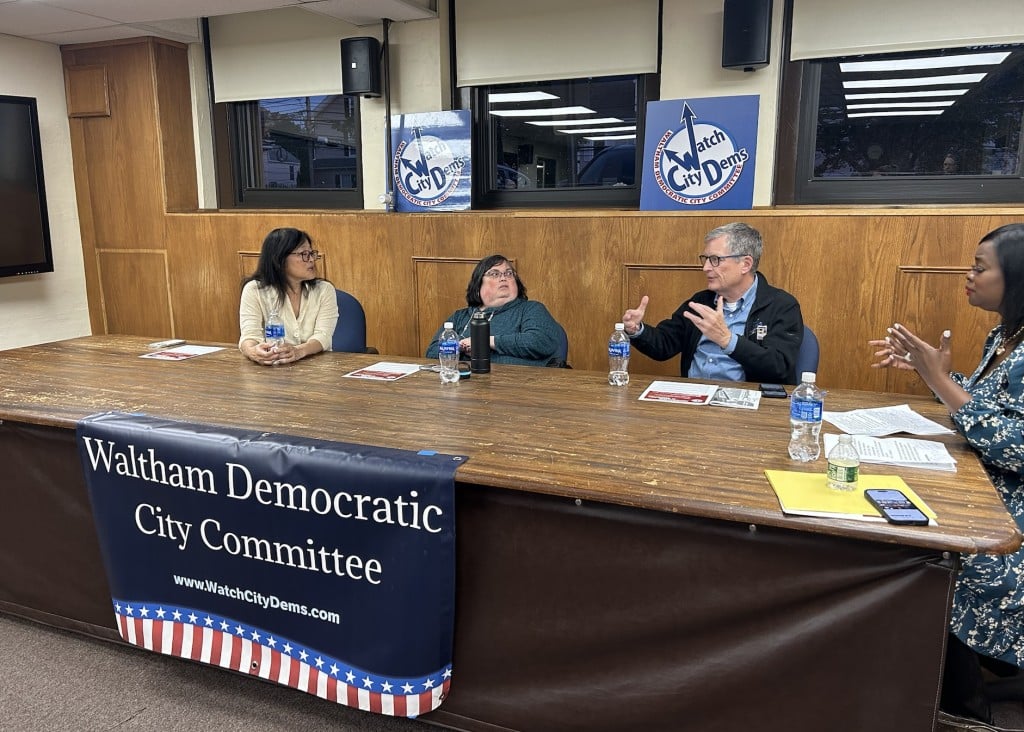
“Journalism in Jeopardy,” moderated by Tina Martin McDuffie, an associate professor of the practice of journalism at Boston University, was a chance to open dialogue, according to Fintzel.
“Each individual person is bringing their own perspective and that’s what is really so important in this dialogue,” Fintzel said.
News deserts
The problem of news deserts, a term used to describe areas with a lack of reliable news, according to Kennedy, is only getting worse.
Newspapers, he said, are disappearing as a result of corporate chains and hedge fund owners.
“You see, the problem is thousands of closures and hundreds of startups,” said Kennedy. “The economic model for doing this is very dicey these days.”
The Medill Local News Initiative at Northwestern University reported the closure of 127 newspapers in 2023 in an October 2024 study.
It’s becoming harder and harder to find local coverage, according to Donovan. Social media has played a role in disrupting media ecosystems and generating a lack of reputable information.
“You’re being fed news of the day that these algorithms anchor and think are important, but really what they are is novel and outrageous information,” she said.
Timely, accurate, area-specific knowledge, Donovan said, is a quality of local news.
Social media and misinformation
Social media, according to Donovan, distorts reality.
She referenced coverage surrounding the trial of Karen Read as an example of this distortion, emphasizing the importance of getting local information.
“When you look for reputable news sources and breakdowns of what was actually happening, you really didn’t get anything from the point of view of journalism where people were covering it until it became very sensational online,” Donovan said.
In order to combat misinformation with local news, Kennedy said, nonprofit publications like The Waltham Times need to regenerate interest and reeducate the public.
Kinoshita, co-founder of The Waltham Times, said the outlet is pushing utilization of more social media to reach new audiences of readers and maintain its existing audience base.
Any social media user though, Kinoshita said, can negatively impact coverage as well.
“You look at someone and they have three followers, but they’re saying something kind of incendiary and getting thousands of people to engage with them,” she said.
Public media defunding
Earlier this year, the decision to pass the Defund Government-Sponsored Propaganda Act eliminated $1.1 billion in funding for the Corporation for Public Broadcasting.
While NPR reported it receives approximately 1% of its funding from the government, approximately 30% of its total funding comes from fees paid by member stations, according to a February 2025 finance FAQ.
The cut eliminated all federal support for NPR, PBS and their member stations, a move Kennedy said has impacted the media landscape.
“It was asymmetrical in its effect … rural areas, urban communities of color, they’re the ones who were more dependent on government funding,” he said.
Anyone with a cell phone has the tools of journalism through technology and can help put more truth into circulation and help supplement these losses, according to Donovan.
“I think it’s incumbent upon all of us to start to think about what happens when we turn the social media off of our preferences and highlighting our own lives and into a tool for letting people know what’s going on and understand what’s happening in your community,” Donovan said.
After moderating an open audience discussion of topics like news commentators, media algorithms and content paywalls, McDuffie concluded the panel by addressing attendees.
“Thank you all for coming and support your local news outlets,” McDuffie said.
Author