At-large council candidates discuss politics with League of Women Voters
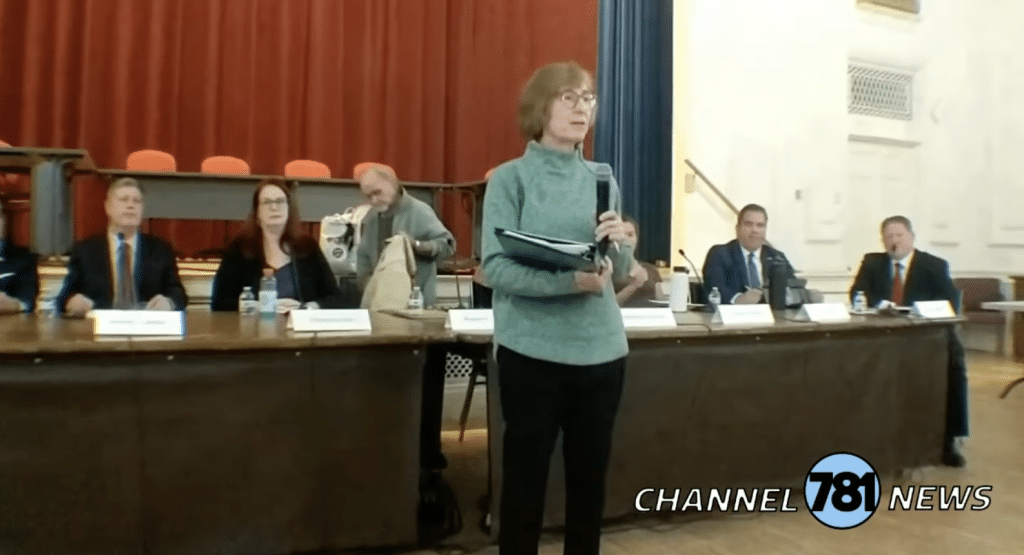
The League of Women Voters of Waltham hosted all nine candidates for at-large seats on the City Council at an Oct. 22 event, where the organization invited the candidates to discuss their political positions with voters.
The night followed a straightforward format: Candidates were asked to introduce themselves, answer three questions pulled from a question bank developed by the LWVW and The Waltham Times, and deliver a few closing statements.
Here are summaries of each candidate’s statements, in the order they spoke at the event:
Colleen Bradley-MacArthur
Bradley-MacArthur, an incumbent, said she values resident feedback, especially “at a time when so many people feel ignored — or, worse, threatened — by their government.” She said if elected she would focus on transportation issues, including public transit and pedestrian safety; better facilities for first responders; and diverse housing options. She said she strongly supports the public library update, and added that Waltham needs to better collaborate with partners like Community Development Corporations (CDCs) in the future.
On Waltham’s master development plan: She applauded the suggestions Waltham residents brought forward in the 2022 ward-by-ward master plan brainstorming meetings and said the Master Planning Special Committee should start meeting again to try to implement them.
On making the Board of Survey and Planning into a planning board: She said she opposed granting the current BSP the powers of a planning board, because it is not directly accountable to voters. She said the city should have a more robust Planning Department that includes a certified planner and an economic and community development officer to help improve Moody Street and similar areas.
On the ongoing zoning code review: Bradley-MacArthur said Waltham is in dire need of more housing. She added that the city needs a diverse housing stock, emphasizing that many young people will not be able to afford to purchase single-family houses.
What’s her favorite thing about Waltham? Hardy Pond.
Carlos A. Vidal
Vidal, an incumbent, talked about his personal history in Waltham and journey to politics, where he became “the first person of colour elected to public office in Waltham.” He said his work, including as the chair of the City Council’s Licenses and Franchises Committee, has supported affordable housing, schools, small businesses and first responders. He said in his closing statements that questions at the event should have focused more directly on the City Council’s role reviewing the city budget.
On protecting current open and recreational space: He said any protections for open space have to be made in collaboration between the council and the mayor, adding that Waltham’s open space is uniquely abundant and he is dedicated to protecting it.
On Waltham’s master development plan: He said that the Master Planning Special Committee, of which he is a member, should continue to meet to resolve its docket items. Still, he said some of the ideas residents presented at the 2022 neighborhood meetings would not work or receive the full support of the neighborhoods in which they were proposed.
On outreach to include low-income and immigrant residents in housing decisions: Vidal said that many immigrant and low-income families may be too busy working to attend in-person neighborhood meetings. He suggested holding meetings online for more accessibility or posting multilingual notices at community spots such as bodegas.
What’s his favorite thing about Waltham? Open space.
Randall J. LeBlanc
LeBlanc, an incumbent, talked about his experience raising a family in Waltham and expressed affection for its spirit and community events. He talked about his previous work on City Council, including as chair of the Public Works and Public Safety Committee, and the ways that running his own small business has prepared him for the budgeting and planning work with City Council. He said he wants to keep focusing on infrastructure improvements to the city and brought up the current city zoning review as a main result of the 2022 Waltham master plan meetings.
On affordability issues pricing out Waltham residents: He spotlighted the housing affordability vouchers he helped create on the Community Preservation Committee and suggested the city should dedicate more funding to subsidizing first-time homebuyers.
On making sure Waltham’s renters feel a part of the community: He talked about how community events in Waltham such as the recent Homecoming Parade build local pride. He added that he’d continue outreach on civic engagement to the city at large to get more renters civically engaged.
On how Waltham can prepare for the local impacts of climate change: LeBlanc talked about the current City Council’s record supporting green and open space and said the city could help the South Side maintain tree cover by purchasing “pocket parks.” He added that Waltham has used federal grant money to improve its stormwater infrastructure to protect against flooding.
What’s his favorite thing about Waltham? Culinary diversity.
Christina Curtin
Curtin talked about her life growing up in Waltham and her experience in insurance-sector public service, saying that her experience has taught her how to be a “professional listener.” She said if elected she’d apply the listening and problem-solving skills she has acquired to her work in City Hall and further pointed to her experience on the city’s Ambulance Committee and advising Waltham High School’s health assisting program.
On making the Board of Survey and Planning into a planning board: She said having a separate planning board would help the city go through its project docket more rapidly and efficiently and allow BSP members more context and dedicated attention to make big-picture decisions.
On her concerns about public schools, municipal services and public safety: She said constituents have frequently told her they were concerned about traffic safety, and she wants to make sure the city made common-sense traffic improvements not limited by rigid rules. She talked about giving the school system resources to expand the capacity of its career and technical education programs, which she described as state-of-the-art.
On protecting current open and recreational space: Curtin talked about the importance of maintaining park space as a public social space for neighbors to build community that they wouldn’t have otherwise.
What’s her favorite thing about Waltham? The people.
Richard Hynes
Hynes spent most of his introduction time playing a recording of “The Star-Spangled Banner” for the gathered crowd. He also talked about his education, his personal journey to sobriety and displayed to the crowd a book he had written about his reflections on running for City Council. In his closing statements he talked about the long road to achieving women’s suffrage.
On what the city can do to make city funds that fund publicly-accessible grants transparent: He said he’d encourage citizens to apply for the grants they were eligible to receive but said he ultimately didn’t have much sway in city government decisions. He talked in nonspecific terms about how many city issues are interconnected.
On how Waltham can prepare for the local impacts of climate change: He spotlighted the recent Riverwalk renovation in collaboration with the state Department of Conservation and Recreation and said the city’s Department of Public Works was insufficiently available in the winter.
On his concerns about public schools, municipal services and public safety: He said every resident was “obligated to be safe at all times” and advocated for abolishing high school football to protect students against head injuries.
Kathy McMenimen
McMenimen, an incumbent, talked about her long track record as a Waltham representative on City Council and in the Waltham Housing Authority; her teaching experience and long list of other community and leadership positions; and the perspectives she brings to council discussions, including as chair of the Long-Term Debt and Capital Planning Committee. She said her priorities would be fiscal transparency, responsibility and land use. In her closing statements she said the council and mayor had failed to agree on a master plan for the city in 1980 but hopes they can make one going forward.
On what the city can do to make city funds that fund publicly-accessible grants transparent: She said that since Waltham established the traffic mitigation fund in the 1980s to fund infrastructure projects without additional burden to taxpayers, she estimated developers had paid approximately $3 million into it. She said the Community Preservation Committee provides funding information on its website, and she encouraged people to learn about other funds by accessing the city’s full budget at its OpenGov page.
On the lack of conservation staff in Waltham, even after the City Council voted to fund a full-time position that never appeared in the city’s budget: She said that the mayor sets budget proposals, and City Council can’t add to them — which means they couldn’t add the funding for the full-time conservation agent they approved. Still, she said, the Conservation Commission is a powerful board, and residents may be too intimidated to apply for currently open volunteer positions on the commission.
On expanding affordable and median-income housing in Waltham: McMenimen said she plays an important role as a stopgap on City Council to avoid developers overdeveloping Waltham for business “to the detriment of housing.” She argued against “upzoning” recommendations she said were upcoming from the Massachusetts Municipal Association that would allow more housing and increased residential density, saying that housing initiatives such as allowing accessory development units by right would create too much density in neighborhoods like Lakeview.
What’s her favorite thing about Waltham? The people.
Emma Tzioumis
Tzioumis talked about how her unique expertise as a public health professional would guide her policy decisions, allowing her to parse large amounts of data and information, collect feedback, address structural problems at the root of issues affecting Waltham residents, and identify how to act in the public interest. She talked about the importance of working to better understand other city departments before budget season.
On collaborating with community development corporations for affordable housing: She said she wasn’t familiar with CDC collaboration projects, so she would want to first read up on them, look at examples of collaborations with them in neighboring communities, and ask residents for feedback on any concrete plans.
On transparency in Waltham’s government: She said that Waltham needs to rebuild trust with its residents because it doesn’t make information sufficiently accessible. She pointed out that federal guidelines require Waltham to update its website to be compliant with the American Disabilities Act by next April. She suggested the city could also engage closed captioning services for its city meetings and translate city notices into multiple languages.
On communication with constituents: Tzioumis said that if elected she would continue sending out an email newsletter and would consider running drop-in coffee sessions. She said she couldn’t and wouldn’t impose requirements on other councilors’ communication but advocated for the city to create a central communications department.
What’s her favorite thing about Waltham? The people.
Tim King
King talked about the importance of communication and getting information from voters about their priorities, thanking residents who he’d already talked to in his campaign. He discussed his experience as a community organizer from his time as a labor attorney, police officer and Massachusetts Department of Transportation board member; his love for and connection to the community; and his history of local volunteering. He emphasized that the city needed a long-term and big-picture plan for its future.
On public transit in North Waltham: King said that he had discussed extending the MBTA’s 73 bus line down Trapelo Road with his colleagues on the MBTA Board of Directors in 2023. He said the MBTA at that time wouldn’t extend the line because ridership data didn’t show a need for it, but he had suggested the city take advantage of “last mile” program grants to fund shuttle buses to MBTA stations.
On bringing business to Moody Street: He said businesses are having trouble beyond Waltham, but the city should consider convening a committee to plan for Moody Street’s future as a part of a comprehensive and ongoing plan for the city as a whole.
On collaborating with CDCs for affordable housing: King said that he would listen to any proposals and information from organizations with expertise addressing housing issues, including CDCs, adding that Waltham could look to other communities for further solutions.
What’s his favorite thing about Waltham? The sense of community.
Paul J. Brasco
Brasco, an incumbent, thanked the audience for attending, saying civic participation and public discussions are important to keep councilors accountable. He talked about his work as chair of the Economic and Community Development Committee and on the council at large, as well as balancing planning and immediate needs for public safety, infrastructure and education. He added that he was in favor of creating a Waltham master plan and a planning board and adding trees along main city streets.
On whether he would remove parking requirements that may limit development: He said that he would support reducing parking requirements, because of the way they reduce green spaces and drive up housing construction costs.
On amending the 1986 City Charter: He said he would approve amending the city charter, which he described as similar to a city master plan, on topics where it is currently outdated and where there’s a consensus in the city to change it.
On bringing business to Moody Street: Brasco said the city could use Community Development Block Grant funding to create tax incentives and reduce zoning regulations to encourage more businesses to move in.
What’s his favorite thing about Waltham? The people.
Author