Holocaust survivor visits Bentley Hillel to deliver powerful story of survival and grief
In honor of the annual day of Holocaust remembrance, Yom HaShoah, Bentley University Hillel hosted Jack Trompetter, a survivor of Nazi-occupied Europe, to tell his family’s story of persecution, recovery and pitch black humor during one of history’s darkest chapters.
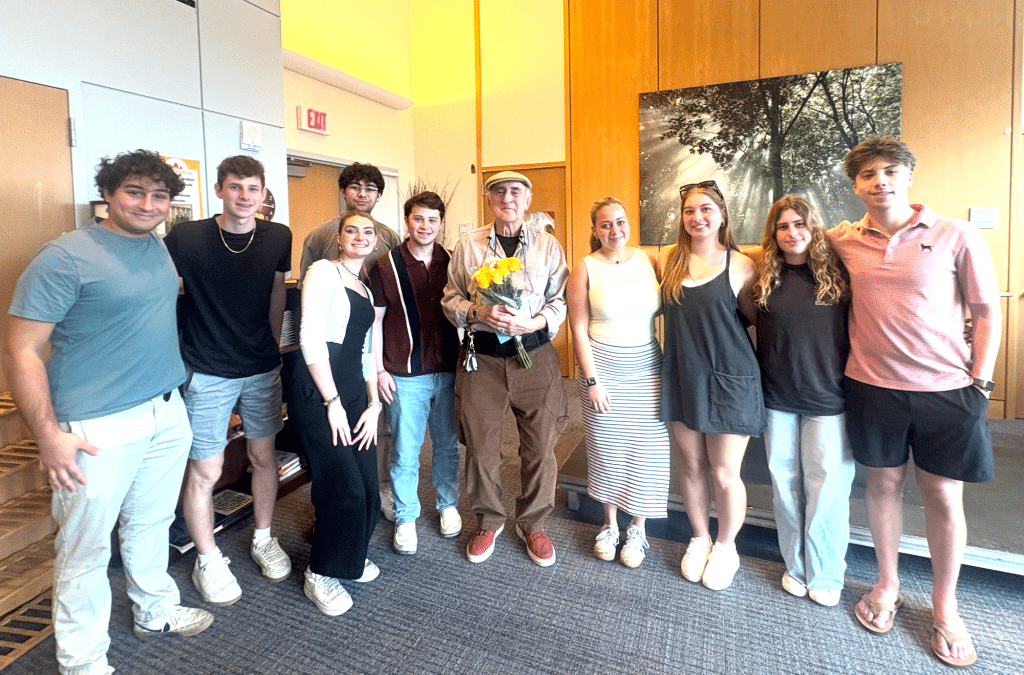
Trompetter was born in 1942 in a Holland already run by the Nazi Party. His mother and father were working class — a seamstress and a restaurant worker — but politically active in the labor movement. By the time he was born, Jews had been removed from public professions, banned from public swimming pools and made to wear the Star of David everywhere they went. Aryan certificates, which proved no Jewish ancestry up through one’s great-great-great grandparents, were required for those in the public sector.
At that time, Trompetter said, Jews in Holland reacted to their slow, methodical persecution with compliance. “The Jewish community thought, obey the rules, pay your taxes, cross at the green, be a good neighbor, everything would be okay.”
This was because those Jews who were sent to concentration camps at first were told they were going for work. A Jewish council, or Judenrat, was assembled by the Nazi government to relay messages and orders to the community. They came up with a vague location — “east” — and told Jews they would be resettled there for labor.
The community believed them. “Back then, people did not know. If you were someone who said to the Jewish community, there are concentration camps where they will murder you, you would think they were crazy. People couldn’t conceive of this.” So, they packed their suitcases with warm clothing and waited to be sent “east.”
Trompetter’s family survived, although not together. His parents hid with a young couple in Tilburg for two and a half years, and after receiving a smuggled note from a family member about the dangers of the city, chose to hide him with a Catholic farming family in central Holland from the age of 3 months to nearly 3 years.
Of the 25,000 Dutch Jews who went into hiding, he noted, a little more than half were betrayed by friends and neighbors, sometimes for just a pound of sugar in return. “I’ve come to understand my family’s past is very much about luck and the help of other people,” he said.
A framework of ignorance
When asked about antisemitism today and how it compares to his family’s history, Trompetter refused to discuss the problem separately from racism in general. He believes they are part of the same framework of ignorance, which is cured by actually getting to know someone you have prejudice against.
“You can be sure that many of those people who are antisemitic never had anything to do with a Jewish person. It’s not like a Jewish person wronged them in some way. It’s an idea they have in their head.” The same, he said, is true of racism against anyone. “Babies are not racist. Babies are not antisemites. You learn it.”
He referred to a phenomenon he called the terrible power of ideas, using Germany as an illustration. Engineers used their expertise to design gas chambers, and doctors worked out the logistics of human experimentation. Their education and intellectual achievements were no match for Nazism. “You have to be careful when you think about what you believe,” he said.
“For me,” he said, “I don’t really care what anyone believes… If you’re a decent, sweet person, that’s what I’m interested in.”
The lessons of the hidden children
Trompetter came with his family to New York City by boat in 1949 under the sponsorship of an aunt, Tante Rose, and has lived in America ever since, save for a few cathartic returns to Holland. He didn’t fully adopt his identity as a Jewish man until the 1980s, when he struck up a friendship with Rabbi Moshe Holzer of Temple Beth Shalom in Cambridge.
Later in life, he also reconnected with his identity as a survivor. Trompetter talked about a “hierarchy of competitive suffering” within the Jewish community after World War II, and recalled feeling that his story wasn’t valid enough to discuss because he was too young to remember it himself. He noted several times, however, that the physical body can remember things far before the mind can.
“I know that our bodies experienced everything and took it in and had to bury it somewhere,” he said. Trompetter found others who could relate to this form of trauma at one of the first international hidden children conferences, held in 1991 in New York. Over 1,600 people attended the conference, far exceeding the expectations of the Anti-Defamation League, which organized it.
Trompetter has enjoyed weekly Zoom meetings with other hidden children he’s met over the years, and noted that his community of survivors had been experiencing some deja vu.
“We’re the canaries, and we can smell the gas, the doo-doo and the fascism. And what we understand today, we’re in a very difficult spot. History doesn’t repeat itself, but it rhymes,” referencing a quote from Mark Twain.
Offering advice to the young crowd on preventing another rhyme, he simply emphasized, “be kind, be kind, be kind.
Author