Charles River Watershed Association praises Waltham for leadership on storm preparedness
Waltham is a local leader on stormwater legislation, something that will help the city stay prepared for local flooding, according to the Charles River Watershed Association.
The CRWA is a local organization that works to monitor, restore, protect and educate people about the Charles River, its surrounding environments and its watershed area — that is, all the land in Greater Boston and beyond that drains into the river. This area covers 35 municipalities and more than a million total residents.
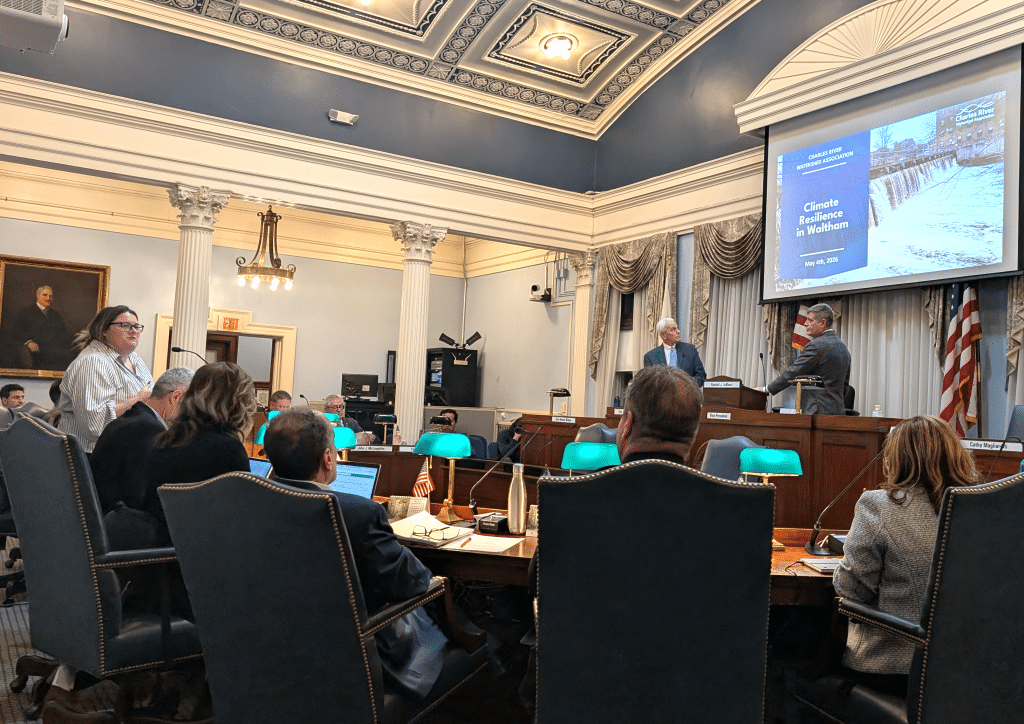
Arrianna Proia, a senior community organizer for the CRWA, visited the City Council’s meeting of the Committee of the Whole this week to discuss the organization’s insights into how Waltham can make itself more resilient to effects of the global climate crisis.
Proia said that two of the biggest climate-related threats facing the region are flooding and extreme heat.
When it comes to flooding, Proia praised Waltham’s existing stormwater policies, which require developers to prepare their buildings to handle catastrophic once-in-a-century storms when designing any new construction. She also noted Waltham’s tiered system of stormwater responsibility for different intensities of construction, which means all properties contribute to storm preparedness.
Still, she said more than 37% of the city is covered by materials impermeable to water such as asphalt, concrete and roofing. Proia suggested Waltham implement a stormwater utility fund to cover future anti-flooding stormwater management and infrastructure, collected as an annual fee for all properties based on the amount of their surface that is impermeable. This is a tool the organization has implemented with municipalities like Franklin, where the average homeowner pays around $60.72 a year.
One mechanism by which municipalities can regulate both stormwater and heat is increasing their local tree cover, since trees can retain or distribute water in the soil easily and provide significant shade. By the CRWA’s metrics, however, Waltham is falling behind on tree cover, Proia showed a chart that placed Waltham’s tree cover as the sixth-lowest among regional municipalities.
Proia encouraged Waltham to consider more policy options to protect local trees. She suggested the city require permits for private landowners to remove trees on their lots; define trees with diameters of over eight inches, which contribute even more significantly to shade and water management, as “significant trees” with additional legal protections; and create a municipal tree fund where developers would contribute mitigation funding whenever they removed trees during construction, which the city could later use for targeted tree plantings.
Author