
City budget up 28% in four years, driven by schools, city benefits
With additional analysis by Lorraine Moon.
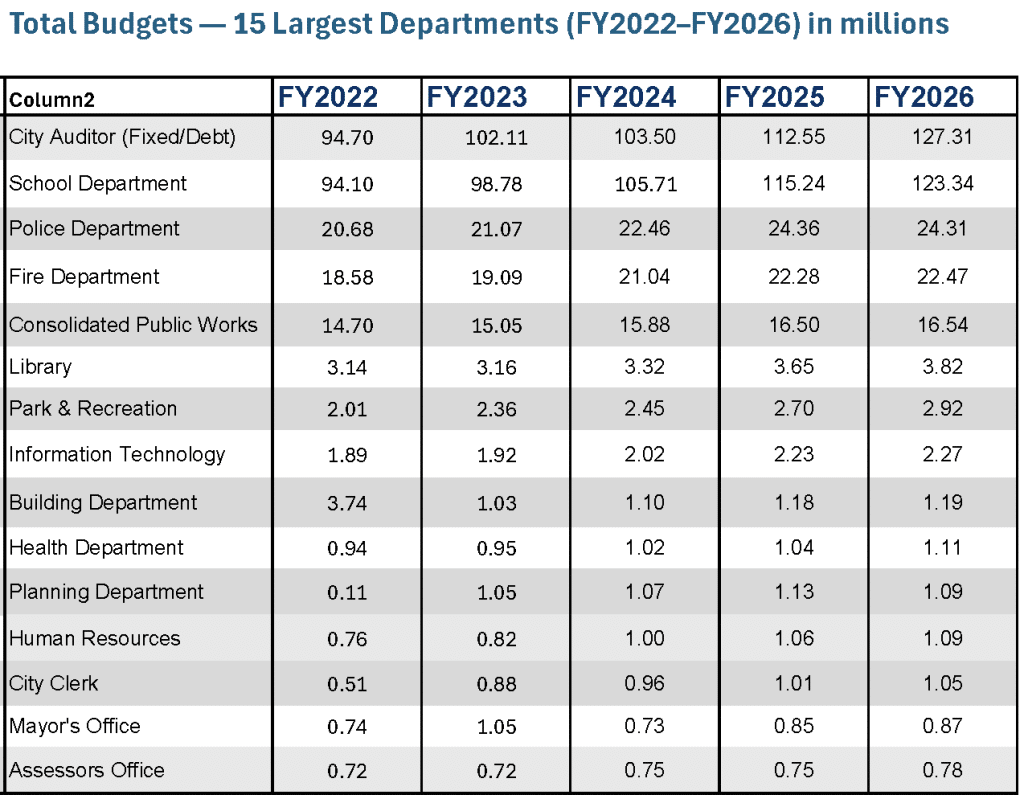
City expenditures have grown faster than inflation in recent years, according to an analysis by The Waltham Times as city officials head into budget season.
According to annual city budgets posted on Waltham’s website, expenditures have grown from $296.8 million to $380.6 million from fiscal 2022 to fiscal 2026, a roughly 28% increase that outpaces overall U.S. inflation of about 13.8% in that period.
Waltham’s fiscal growth is attributable to several structural forces: investment in city and school infrastructure, rising fixed costs such as health insurance and pensions, collective bargaining agreements and various inflationary pressures, according to Paul Katz, chair of the City Council Finance Committee.
In the fiscal 2026 budget, Waltham’s big-ticket items are the auditor’s section (which includes bond redemption, medical insurance and pensions, among other expenses) at $127.3 million, schools at $123.3 million, police at $24.3 million, fire at $22.4 million and public works at $16.5 million.
The factors that drive up Waltham’s budget are familiar to municipalities, which have seen inflation increase the cost of everything from utilities and purchasing construction material to negotiating contracts with public employee unions. (There are nine collective bargaining units in Waltham.)
Health insurance and contractual obligations represent fixed costs mostly baked into the budget.
However, some fiscal obligations — notably those associated with building the new high school — represent deliberate investment decisions. The costs are easy to see: Since 2020 Waltham has issued $238.9 million in bonds for the high school, which accounts for about 73% percent of bonds issued by the city. This represents a debt service that the city will carry for years to come.
In some respects Waltham residents have not felt the full force of the budget increases. Residential taxpayers benefit from the city’s commercial and industrial tax base, which accounts for nearly half of Waltham’s total tax levy. Waltham’s residential tax exemption, which provides substantial relief to homeowners, is the maximum 35% allowed by state law. The city also benefits from a strong bond rating (AA+ from S&P)
The average tax bill in Waltham is $5,189, according to the state Department of Revenue, while residents in some of the neighboring towns pay more than triple that rate annually.
Additionally, in contrast to some area communities, the state’s Proposition 2½ law (which caps annual property tax growth at 2.5%) has not forced the city to seek tax overrides to meet its obligations.
Waltham, for instance, was able to build its new high school without seeking an override, unlike neighboring Lexington, where residents voted to approve a tax override to fund a $660 million new high school, the most expensive in the state.
Waltham budgets conservatively, said Katz, asserting that city leaders work to spend money wisely. The city could raise taxes and stay within the constraints of Proposition 2½ but has chosen not to do so, he added.
“We’re not doing tax overrides. We’re not going to the voters for more. We’re very conservative about our tax increases and our tax rate. We have a strong commercial base, but we can’t take that for granted,” Katz said.
“The mayor and council wish to keep residential taxes relatively low, and we manage our budget accordingly,” he added. “While Waltham does retain some unused levy capacity, the city still faces legal limits on tax growth, and any decision to increase taxes beyond current policy choices is ultimately a policy and political decision.”
Waltham’s budgeting process
The annual city budget originates with the mayor in consultation with city departments. Waltham has a strong mayor form of government, meaning the mayor has primary authority over budget formation, and the role of the City Council is primarily review, oversight and approval.
By state law the City Council can accept the budget as submitted by the mayor or reduce specific line items, but the council cannot add to the budget. If councilors feel an increase is warranted, they must ask the mayor to propose one.
The role of the City Council Finance Committee is “more about transparency than it is about number crunching,” Katz said. Department heads meet with the Finance Committee in June over two days (not necessarily consecutive) in a series of public hearings where councilors review spending requests, ask questions about previous spending and discuss priorities before forwarding recommendations to the full council.
“This is our opportunity to poke holes, with the department heads coming before us, to ask questions such as, ‘Why are we doing this?’” Katz said. Committee members often ask about open positions, significant changes in line items and unused funds.
Katz said he likes to ask whether a department head really wanted to do something but cannot with the amount the mayor has budgeted. Typically, he said, the answer is no.
Citizens who would like to learn more about the city budget have a resource through the state’s OpenGov website. The site provides extensive budget information and uses data visualization tools to make the information easily comprehensible.
The best opportunity for citizen input into the budget is through ward councilors, Katz said, adding, “That’s the most important thing someone can do.” He fields questions and requests from constituents throughout the year.
Similarly, budgeting is a continual process, Katz said, not reserved for specific times when votes are taken or hearings held.
The one thing that should not happen in the June hearings, he stressed, is to hear a surprise request from a councilor for a budget item.
“Over the course of the year, we need to be talking to city departments and getting them to make those asks and build a case,” he said.
Author

Comments (4)
Comments are closed.






Lack of resources where? We are in the top ten in the state for cost per student. This school system has continued to decline not from resources but from a lack of leadership. The resources. The whole system needs to be gutted and fully revamped. Our kids need a system that actually educates them not more admin.
The excellent reporting in this article highlights a very interesting dynamic in our municipal budget process. I am happy to hear Councilor Katz say we utilize a fiscally responsible and conservative approach to budgeting. That said, as a Waltham resident, the key takeaway is how our city charter structures the timeline. Because our city charter puts primary fiscal authority in the executive branch, it does shift the City Council’s role to reviewing and reducing line items later in the process as Councilor Katz points out. It seems to me that what’s missing is having earlier collaborative input by the Council and citizens into the process.
While strong executive stewardship has served Waltham’s financial stability well, modern democratic practices across the Commonwealth show that expanding early collaboration can yield great results and increase civic participation and buy-in to the budget. We might want to consider a civic discussion on how we can naturally evolve our budget origination process to integrate a more locally representative system.
We could easily transition toward a more collaborative approach even given our current city charter. There are successful, established models right here in Massachusetts. For instance, we could implement a resident-led citizen advisory committee on finance, like the models used in Holyoke and Winthrop. Additionally, we could introduce council-led participatory budgeting like they have in Cambridge and Somerville.
Adopting these types of local ordinances and policies would allow for meaningful resident and council input early in the fiscal planning process, all while completely respecting and operating within our current executive-centric charter. It is a win-win that supports our leadership while empowering our citizens.
I like the city being conservative with their budget. It’s nice seeing politicians actually care about the citizens money and not use it as a blank check. But the school budget it out of control. Paying the superintendent a crazy amount of money with 10 percent pay raises every year for a failing system seems like a poor choice. The system needs a fix and with the amount of money the city spends (top 10 percent in the state) we deserve better. I heard teachers got a decent raise. Weird seeing how they got a big F for a report card. Our money could be spent a little better on a failing school system to get better results.
Cutting budgets and compensation in response to declining performance metrics may not be the best idea, particularly if lack of resources is determined to be the cause of worse performance, or we need to be able to offer more competitive compensation to be able to attract more talented district leadership.