
Waltham eighth-grader wins Israel Arbeiter Holocaust Essay Contest
The “universe of obligation,” a concept coined by sociologist Helen Fein in her 1979 book “Accounting for Genocide,” gave Jewish Community Day School eighth-grader and Waltham resident Tal Weiss Sadan a way to try to comprehend how something like the Holocaust could have happened.
“Looking at how the Holocaust moved from hateful words to organized violence shows that it was a lack of empathy and care by average German citizens that allowed the Nazis to orchestrate these crimes,” he wrote in his submission to the Israel Arbeiter Holocaust Essay Contest, sponsored by the Jewish Community Relations Council of Greater Boston each year for Yom HaShoah/Holocaust Memorial Day.
“By learning about the bystanders of the past, we can recognize our own responsibility to protect the safety and dignity of our future,” he wrote.
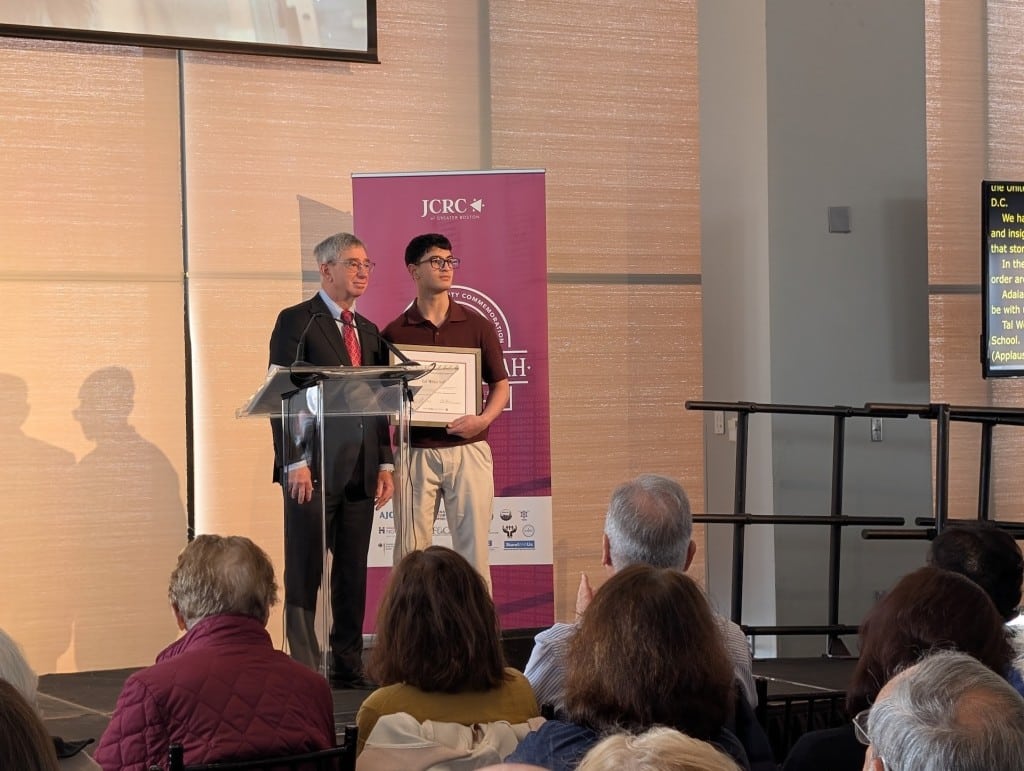
Grappling with a historic tragedy like the Holocaust is a tough order for someone so young, but Tal put heart and soul into his winning entry. And on April 12 during the annual JCRC Boston’s Community Holocaust Commemoration, he joined five other students on the stage at the State Room in Boston to accept a framed certificate from Arbeiter’s son Jack and a trip to the United States Holocaust Memorial Museum in Washington.
The essay winner ceremony, attended this year by Boston Mayor Michelle Wu, several Boston city councilors, state Treasurer Deb Goldberg, the German and Israeli consuls and other officials, is held each year in honor of “Izzy” Arbeiter, a beloved Holocaust survivor and co-founder of the New England Holocaust Memorial.
Tal is a remarkably accomplished young man who trains in competetive judo. This year he was able to train under Olympians at an international camp. Guided by this experience, he mentors junior judo club students. Tal is a top scorer and tutor on his school’s math team. He’s a school student ambassador, reaching out to prospective families, and he plays guitar in the school’s band. He also has a global reach. “Outside of school, I co-founded a nonprofit, the Jewish Miluim Fund, and led a team of over 10 volunteers,” he said. “Together, we’ve raised over $2,600 to cover medical costs for families who lost loved ones due to conflict in the Middle East.”
In his own life, Tal has overcome considerable challenges. When his family moved to the United States from Israel several years ago, he needed to reinvent. “As a newcomer, I had to build my communication skills from the ground up,” he recalled. “On my first day of American school, I accidentally placed my lunchbox in a reading bin because I couldn’t read the labels on the cubbies.” It wasn’t until the pandemic that he was able to improve his English skills and communicate with potential friends. “This experience built my self-confidence and taught me to take initiative over my academics, which led me to develop the skills needed to write my essay,” he said.
He has seen antisemitism firsthand. “As an Israeli Jew living in the United States, I have seen how antisemitism and Holocaust denial are rising, especially among people my age.” That inspires him to take action. “I believe that by writing this essay, I can show others in my community that we have the power to stand up and speak the truth and that even as students, our words can help fight against hatred and ignorance,” he said.
In his essay, Tal examines how the German people of the 1930s could have moved toward the acceptance of the atrocities committed by the Nazis, which he learned began slowly. “The Holocaust is a tragic example of what happens when hatred and prejudice grow because ordinary people choose to stay silent,” he wrote. “This event taught us that genocide does not start with mass murder; it begins with small acts of bias and the narrowing of a society’s circle of care. Looking at how the Holocaust moved from hateful words to organized violence shows that it was a lack of empathy and care by average German citizens that allowed the Nazis to orchestrate these crimes.” He found a lesson that does not redeem, but can instruct: “By learning about the bystanders of the past, we can recognize our own responsibility to protect the safety and dignity of our future,” he said.
Tal’s social studies teacher Josh Mocle encouraged him to enter the contest. It may have seemed like a heavy lift for a teen, but for Tal, age is inconsequential. “You are never too young to make a difference,” he said. “People often think you need to wait until you’re an adult to have your voice heard, but when a young person stands up to injustice, it sends an even stronger message.” He said he wanted to honor the 6 million lost lives and Arbeiter’s legacy, and help do his part.
“By refusing to accept prejudice in our schools and by choosing to speak up when others are excluded, we ensure that our shared humanity acts as a shield,” he wrote. “Breaking the silence is the only way to make sure that history never repeats its darkest chapters.”
He’s excited about the upcoming trip to Washington and the Holocaust Memorial Museum. “Since I relied heavily on their online resources while writing my essay, seeing the physical exhibits in person will be a very meaningful experience,” he said. “I believe that being inside the museum will be deeply inspirational and will help me connect even more with the history.”
But he has already made an important start and is determined to continue on its path. “By standing up and speaking out, I am making sure they are never forgotten. I want to turn my memory into action and show that even one voice, and the encouragement of a great teacher, can help create a kinder, safer world.”
Author









Comments (0)
There are no comments on this article.