
At Charles River Museum, volunteer Lynn Hallen brings history to life
There’s a dynamo inside the Charles River Museum of Industry & Innovation, but it’s not a machine. Rather, it’s the energetic Lynn Hallen, one of the unsung volunteer heroes named this spring in The Waltham Times. Stephen Guerriero, the museum’s director of education, noted that Hallen is “humble about it, but she’s a critical member of the team here.”
Hallen, a volunteer at the museum since 2022, created its most popular tour, Mill Girls in Story & Song.
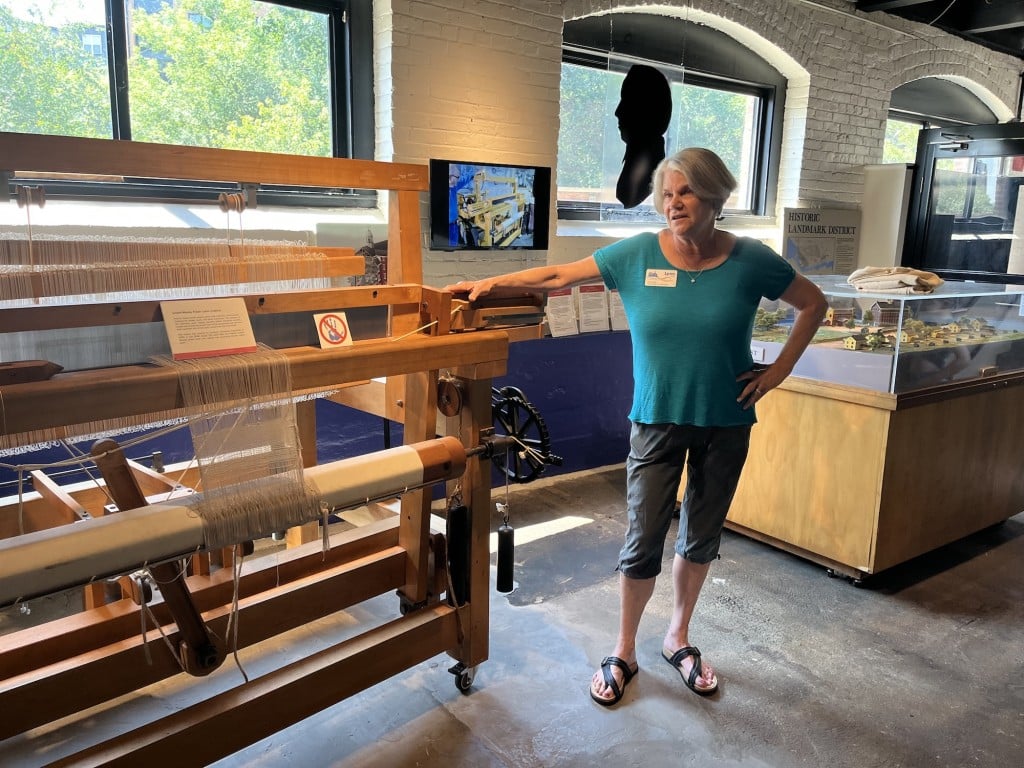
On a recent, high-energy tour, Hallen engaged museumgoers with a quick joke, blaming her fast talking pace on growing up near New York City. She dared visitors to ring the factory’s oversized bell. In front of a diorama of the factory, including its outbuildings and housing for the mill girls, she described how the young women had to dash between their dorms and the factory at the tolling of the bell at each day’s start, the brief midday breaks and at shift’s end. Girls who weren’t quick enough to start their 12- to 14-hour workday or return from their breaks would be left outside closed factory doors and would lose their day’s pay.
Hallen then delved deeper into the history and significance of the mill girls, “the first industrial workforce in the world” who apparently held the first industrial labor walkout in the United States. Francis Cabot Lowell opened Boston Manufacturing Co. in 1814, a time of war and labor shortages. So he developed the “Waltham system,” hiring local farm girls (and, later, immigrants) who were educated, strong and willing to work hard. The young women gained social independence, optional educational lectures and money in their purses, while performing wet, dirty and dangerous work and living under strict company rules.
For Hallen, the value of the museum goes beyond mill girls and machinery to insights into how our country changed from an agricultural society to an industrial one. “This is where it started,” she said.
Hallen pointed out that an agricultural society is organized by seasons and whatever tasks need to be done. But schedules rule a factory and thus change society. She explained that as society transforms, “the transformation itself gives rise to a need for more transformations. So there’s this constant back-and-forth of change happening, which I find fascinating.”
Birth of the ‘Mill Girls’ tour
For decades, Hallen was a clinical social worker. She closed her office during the COVID-19 pandemic, switched to Zoom for her patients and slowly cut back her hours. She was looking for a new activity when she noticed that the museum was seeking volunteers when it reopened after the pandemic-era shutdowns.
“I’ve always been a big fan of museums,” she said. “What I like is the opportunity it gives to people to learn things. I didn’t know much about industrial history myself [before volunteering].”
The young mill girls who operated the machinery fascinated her. According to Hallen, “The museum didn’t have any tour or anything about it. They said, ‘Go ahead and develop it!’”
Despite no recent research experience, Hallen began looking through the museum’s archives and discovered the museum performance by historian Diane Taraz of songs written by mill girls. With help from museum staff, Hallen wove together her newly gained knowledge, archival materials and excerpts from Taraz’s concert into a 45-minute tour that ranges through the museum.
Her volunteer work is both like and unlike her career as a clinical social worker. “Here I am talking all the time,” said Hallen. “When I was doing therapy, I was not doing all the talking. … One of the things that I loved as a social worker was the stories I heard.”
As a tour guide, she still hears stories. Museumgoers remember immigrant grandmothers who worked in the mill or great-grandfathers who were linotype operators. “You get to talk with people, and you learn interesting things,” she said.
Hallen also coordinates the scheduling of private, school and group tours and helps train new volunteers. “She was an instrumental person to me right in my first week,” noted Guerriero, who recently marked his second anniversary at the museum. “She’s taken on a greater role even in my time here,” especially as a collaborative partner.
The Mill Girls tour is one of four historical museum tours available at no charge on occasional Fridays and Saturdays.
“More and more people are coming, and there’s only a few of us giving [tours]. It can be a lot,” Hallen said.
She encouraged interested individuals to consider volunteering. “People get very intimidated, thinking, ‘Oh my god, I have to know all this stuff,’ but you don’t have to know everything to begin with. We have scripts that people can look at so they can learn the stuff.”
“We can teach you all the content, but great amazing people like Lynn are here to help you if you are interested in doing something like that. We could always use more volunteers,” Guerriero said.
Author

Comments (3)
Leave a comment
When commenting, please keep in mind we are a small non-profit focused on serving our community. Our commenting policy is simple:
- Common sense civility: we’re all neighbors, but we can disagree.
- Full name required: no anonymous comments.
- Assume the best of your neighbors.


So fun to read about Ms. Hallen. Makes me want to fly right up there and hope there is space for me! Also makes me think of volunteering locally. Thanks for this story.
I moved to Waltham a few months ago and found my way to the Museum one cold morning. I was the only visitor, and I started roaming among the exhibits — all impressively displayed and intelligently curated. A woman from the museum came up to me, seemingly out of nowhere, and offered some insightful info about the exhibit I was looking at, and she offered to show me other highlights. I recognize now that it was Lynn Hallen, of course, and she was incredibly knowledgeable, friendly, and generous with her time. That museum is a special place, not least because of its volunteers.
The Charles River Museum is an outstanding community resource where every resident should at least monitor their website for weekly events covering Waltham, concerts, history, and much more. Find the entrance directly under the smokestack!