
Proposed Fernald golf course gets committee’s OK pending restriction
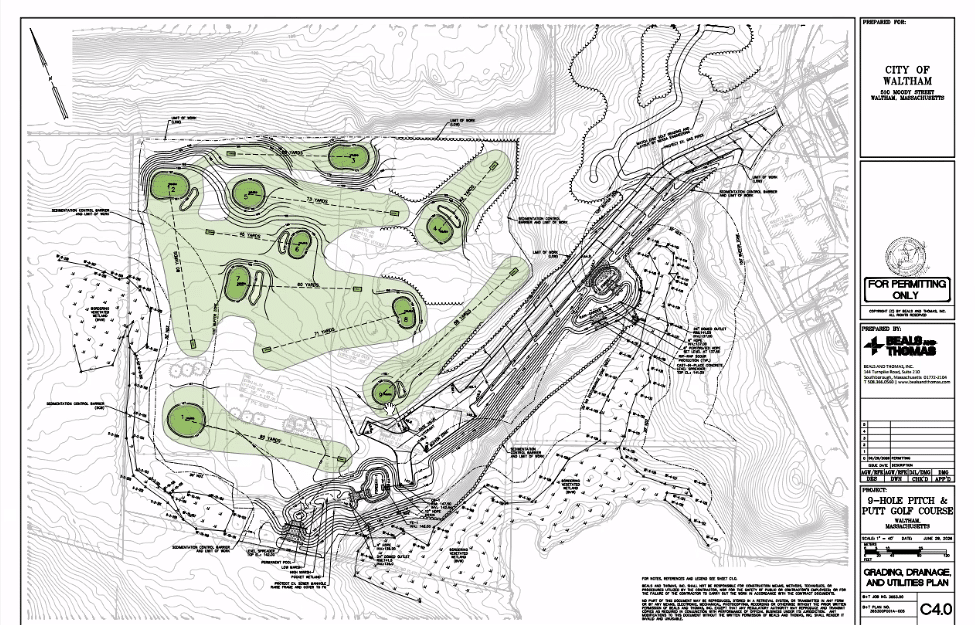
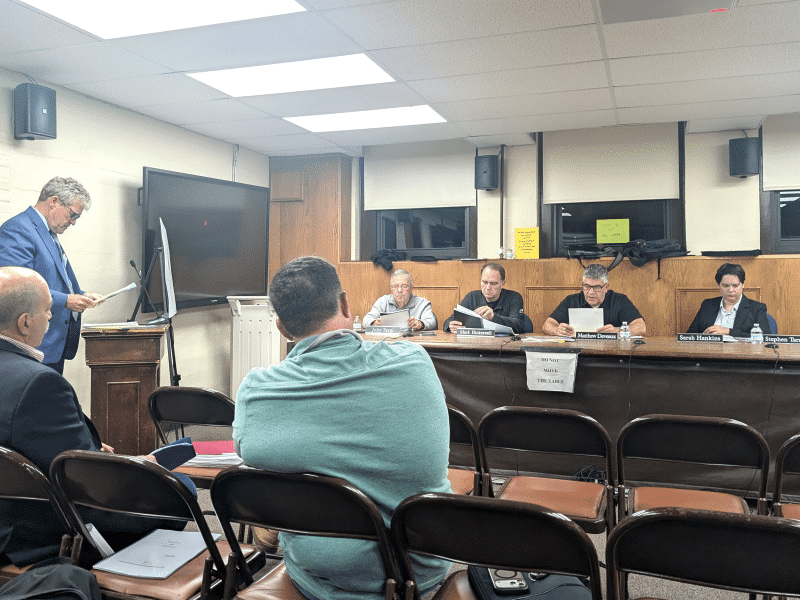
A nine-hole “pitch and putt” golf course at the former Fernald State School site received Conservation Commission approval last week.
The board gave its OK after pushing for an explanation on why a legal protection promised for the property over a decade ago still hasn’t been filed.
The city’s original plan for this part of the Fernald property was a full golf driving range, which the commission had already approved as part of a set of Fernald developments, including a controversial playground.
David LaPointe of Beals and Thomas, the development firm hired by the city, said this plan was abandoned after the recreation department concluded that ball-containment netting — reportedly up to 75 feet high — would pose a risk to birds.
Because that original driving range was bundled together with other projects, LaPointe had to withdraw his application for the commission’s review, and refile a new one that only covered the golf course.
The new proposal also works with existing topography, cuts parking in half to 19 spaces, and uses synthetic turf greens and tees. Seven trees would have to come down for landscaping work but would be offset by 15 replacements and 23 planted throughout the site.
LaPointe also reaffirmed an earlier commitment to clean up debris near a wetland on the site. Julia Abbott, the commission’s conservation agent, called it a clear improvement over the prior design and had no substantive concerns.
Despite Abbott’s assessment of the new proposal, commissioners discussed at length a conservation restriction that was supposed to have been placed on the Fernald property when the city bought it from the state in 2014.
A conservation restriction is a permanent, legally binding document placing a limit on how land can be used and is meant to lock in protections for open spaces. Because the city purchased the Fernald property using Community Preservation Act money, it is required to submit a conservation restriction for the land, and the sale is not technically final until it does so.
There is no universal conservation restriction; rather, each one is written with a specific piece of land in mind. Twelve years after it was supposed to be filed, LaPointe said he does not know what has happened with the restriction. “I’m not really familiar with the status of the conservation restriction … It’s the mayor who’s handling that,” he said.
Commissioner Anja Shafer asked why the restriction has not gone through and whether it was appropriate to keep approving construction without it. Chair Bill Doyle recalled that this situation had happened before with the first version of the golf course proposal. In that instance, the commission had tried to condition its approval on the conservation restriction being completed first.
The city then appealed that call to the state Department of Environmental Protection. DEP ultimately sided with the city, overruling the commission on the grounds that it lacked authority to require the restriction.
Based on this, the commission voted to approve the pitch and putt course but with the condition that the city must provide a legal justification for proceeding without the conservation restriction in place. The commission requires a response before its Aug. 13 meeting.
Author



Comments (0)
There are no comments on this article.