
Ballot question campaigns visit Waltham to make their cases
When you receive your November ballot, you’ll be greeted with a long list of ballot questions. A total of nine questions will be on the ballot this year — more than any election since 1994.
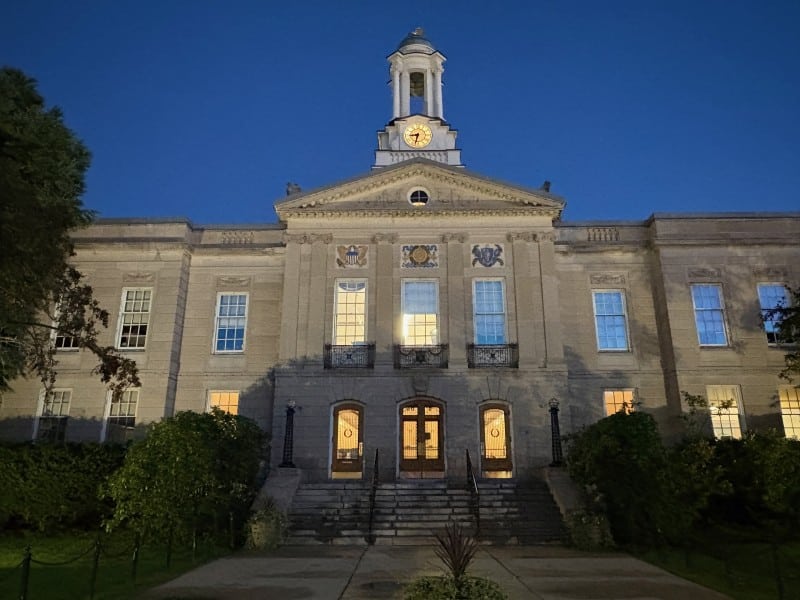
On Wednesday evening, Oct. 7, a handful of advocates from campaigns supporting and opposing these ballot measures gathered at the Arthur Clark Government Center to present their cases to Waltham voters.
The open house style event, organized by the Waltham Democratic City Committee, drew around 50 attendees over the course of the evening.
Although the WDCC contacted advocacy groups registered for or active in campaigns on both sides of each ballot question, not every campaign attended.
For more on each ballot question — and to read arguments from campaigns who didn’t attend Wednesday’s event — you can check out the red voter information book mailed out by the Massachusetts Secretary of State’s Office, or read the information on its website.
Here’s what Wednesday’s event attendees said.
Question 1: Expanding public records to the legislature and governor’s office
This question would allow people to make public records requests to access most documents from the state legislature and the governor’s office, not including direct requests for assistance from constituents.
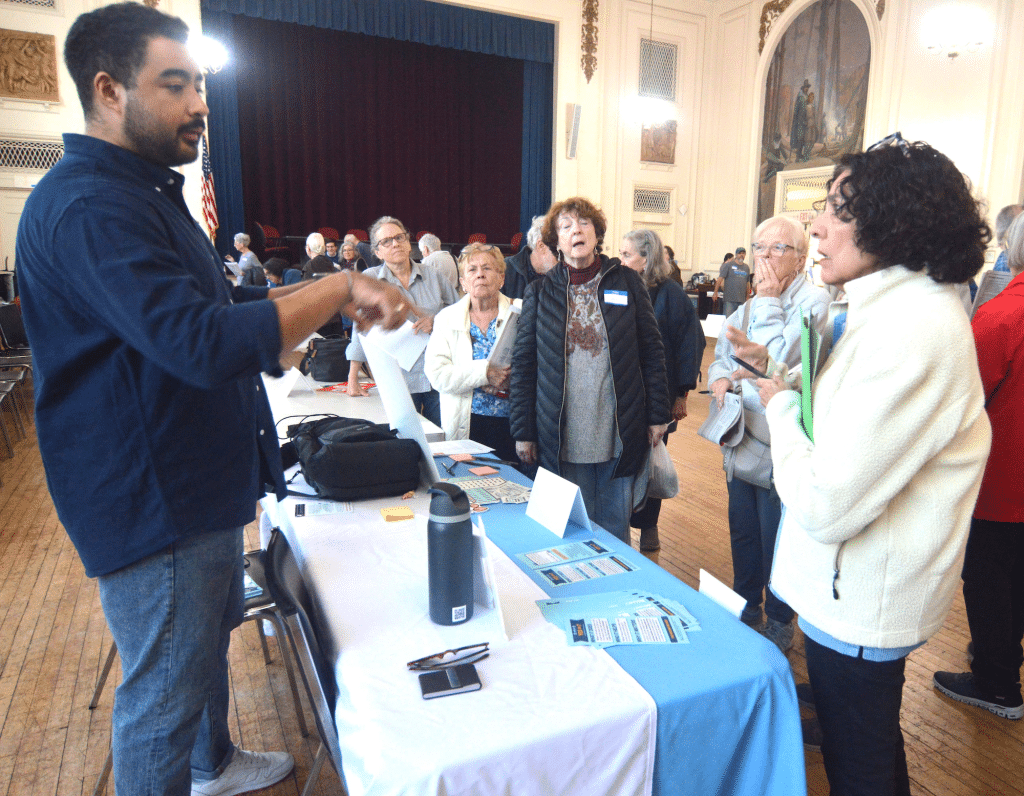
John Griffin of Partners in Democracy MA Action, which is in favor of Question 1, argued that records from most other governmental bodies in the commonwealth, including municipalities, are classified as public. In fact, Massachusetts is one of only two states that don’t apply public records law to the governor and legislature.
No one attended the event to speak against Question 1.
Question 2: Collective bargaining for public defenders
This question would allow employees from the Committee for Public Counsel Services, which includes public defenders, to unionize and engage in collective bargaining with the state.
No one attended the event to speak in favor of or against Question 2.
Question 3: Top-two state primary elections
This question would eliminate partisan primaries in state elections; instead, it would introduce a primary ballot that lists all potential candidates, and the two candidates with the most votes, regardless of political party, would advance to the general election.
Griffin said that Waltham, like most municipalities, sees a larger voter turnout for general elections than for primaries. In many majority Democrat areas of Massachusetts, Griffin said, the most contested elections voters see is often between candidates in the Democratic primary; this change could allow that competition to happen in the general election, where more people could weigh in on it.
No one attended the event to speak against Question 3.
Question 4: Election day registration
This question would allow voters to register on the day of an election at any polling place by providing documentation of their place of residence. Voters who don’t bring proof of residence would be able to cast a provisional ballot that would be counted if they are able to prove their residence within a set period of time.
Lydia Hurley from Common Cause Massachusetts said this change would make it easier for people to vote, especially during early fall primary elections, and therefore improve voter turnout. Hurley said it could build trust in elections. No one attended the event to speak against Question 4.
Question 5: Changes to state tax revenue cap
This question would change the amount of tax money the state can collect. At the moment, Massachusetts has a cap on how much it can collect in taxes, increased every year by average wage growth. If the state hits its limit, it must send taxpayers a rebate.
This question would instead impose a cap based on the tax revenue the state collected the previous year, meaning if the state collected less than the maximum allowed amount, its revenue limit would go down the next year.
The question would also allow previously excluded revenue from the “millionaire’s tax” to count toward the state’s tax limit.
No one attended the event to speak in favor of Question 5.
Jonathan Cohn from Progressive Mass argued against Question 5, saying the question was designed to lower the state’s revenue cap. He said that in the long term, lower tax revenue would mean cuts to essential services, and this change would make it harder for the state to save and invest excess money during especially productive years that it could use to prepare for economic downturns.
Question 6: Establishing a natural resource conservation fund
This question would create a statewide fund for conserving open space, wildlife and natural resources, along with a board to oversee its spending. That fund would be taken from money set aside from sales taxes on recreational vehicles, golf courses and sporting goods, such as ski and tennis equipment.
Andrew Sharpe of the Authentic Caribbean Foundation argued that Question 6 would help ensure communities have access to the money they need to preserve their health and the health of their open space, by providing a new avenue of up to $100,000,000 per year in funding through a mechanism similar to the Community Preservation Act. Sharpe added that the fund’s oversight board would draw on the expertise of existing well-established local advocacy groups.
No one attended the event to speak against Question 6.
Question 7: Allowing single family homes on smaller lots
This question would allow owners of residential lots as small as 5,000 square feet to build single-family housing on their land, so long as the lot is linked to public water and sewer services and conforms to other local zoning requirements.
Montell Khaldi of Abundant Housing Massachusetts argued that Question 7 was a step toward providing more housing to address the state’s shortage in a way that would preserve choice for landowners and avoid overtaxing dense neighborhoods; he predicted the proposal would have the biggest effect in less-dense areas farther away from Boston.
No one attended the event to speak against Question 7.
Question 8: Banning adult recreational marijuana use
This question would repeal laws allowing the legal sale of marijuana to adults and limit adults to possessing no more than one ounce of marijuana.
No one attended the event to speak in favor of Question 8.
A representative of campaign group No on 8 declined to comment at the event, but its campaign chair Ryan Dominguez later told the Waltham Times that existing recreational marijuana laws have allowed Massachusetts to crack down on illegal marijuana businesses and provide oversight and regulation of marijuana sales. He argued that delegalizing marijuana would cause job loss and decrease state tax revenue.
Question 9: Upholding recent firearms regulations
Unlike the other eight ballot questions, Question 9 doesn’t propose a new law; it’s a referendum on whether to support an existing gun regulation law passed in 2024.
The 2024 law contains a long list of provisions. Among other regulations, it bans modified or unregistered “ghost guns”; allows regulators to review prior gun license records and court-ordered mental health commitments before granting gun licenses; imposes additional licensing regulations on semiautomatic rifles and shotguns; allows teenagers to apply for a permit for self-defense sprays; allows the state to publish and study anonymized public data on gun ownership; and more. Voting ‘yes’ would support the 2024 law.
Ruth Zakarin of Yes on 9 argued that Massachusetts has one of the lowest records of gun violence in the country, and that’s in part due to its strong gun laws. Zakarin said the 2024 regulations significantly overhauled Massachusetts’ previous laws passed in 2014 and 2018 to account for new technology, including devices to turn semiautomatic weapons into machine guns.
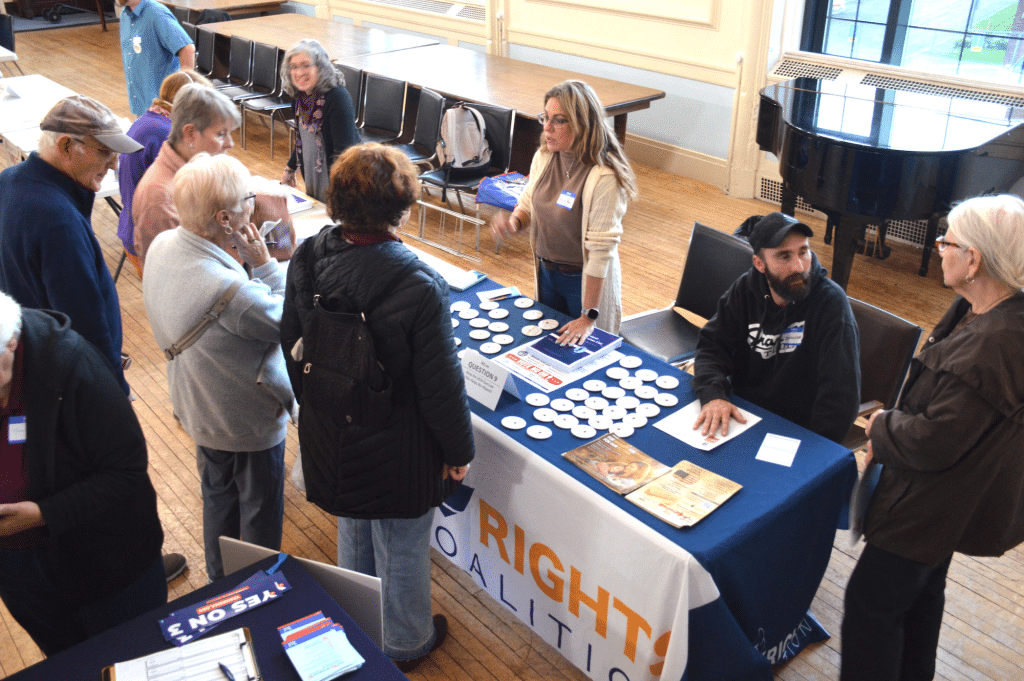
Kerrie Ann Auclair of the Civil Rights Coalition argued against Question 9. She said the 2024 law overly penalized legal gun owners. Auclair said many changes to licensing regulations — including reclassifying semiautomatic shotguns and rifles, and requiring deescalation, live fire, injury and suicide prevention classes for license renewal — were overly burdensome to legal gun owners. She argued that “ghost gun” laws would penalize legal gun owners trying to make personal accessibility modifications to their guns.
Author

Comments (2)
Leave a comment
When commenting, please keep in mind we are a small non-profit focused on serving our community. Our commenting policy is simple:
- Common sense civility: we’re all neighbors, but we can disagree.
- Full name required: no anonymous comments.
- Assume the best of your neighbors.





Since no one showed up to oppose Question 3, I’ll just remind voters that removing parties from primaries removes the only filter we have on candidacy and essentially means the most well-funded campaigns will float to the top. Top-two primaries empower corporate PACs and super-rich candidates, taking power away from grassroots candidates. Vote NO.
Thank you, Artie!