
Analysis: City reckons with increasing costs, development changes at budget hearings
In step with nationwide trends, Waltham faces rising costs over the next year. It’s coming as the city sees big, expensive changes likely to come in the next decade in its residential-commercial mix.
Waltham’s population is sure to grow, especially in the formerly commercial western edge of the city. In the past year, the city has approved three new large housing developments under Massachusetts General Law 40B, collectively promising to produce around 1,000 new housing units, as well as three large mixed-use residential districts around the I-95 corridor that could add an additional 1,850 units over the next decade.
As a part of these discussions, the city has been trying to measure what a population boom could mean to the city’s infrastructure — but some departments expressed at their budget hearings there are still a lot of unknowns.
Superintendent of Schools Marisa Mendonsa told the council earlier this year that the school district is equipped to handle an increased student population, but warned councilors she isn’t sure when the city would need to build a new school, which would mean additional unforeseen budget increases. Traffic Engineer J. Michael Garvin similarly told councilors he expected to see changes in city traffic needs: “It’s going to be an — upheaval might be the right word.”
The Fire Department plans to build a new station near I-95 to cover the growing population and had included a new engine and company for the area in its budget this year — although by the time the budget got to the City Council, Mayor Jeannette A. McCarthy had cut those line items.
One of the factors driving proposals for new housing is the worrying levels of vacancy seen among commercial properties in the city. Although the City Council has been exploring ways to mitigate this trend, City Assessor Frank Craig warned councilors that many companies have requested to lower the value of their land during tax assessments.
At June’s budget hearings, City Auditor Paul Centofanti told city councilors the city has a long-term plan and is still in a financially stable place, with a good credit rating and the largest cash reserves it’s ever had. Its commercial tax revenue is falling, but he sees some hopeful indicators that the city’s financial forecast will “slowly turn around.”
“We’re living on the high side, to be truthful, but we’ve been able to afford these projects on our existing levy,” Centofanti added. Still, he’s started to be concerned whether Waltham will need to expand its tax levy in the future.
In early June, McCarthy presented the council with a list of budgets for individual city departments. Over three meetings between June 9 and 22, the council’s Finance Committee held budget hearings to pick over budget minutiae and discuss departments’ needs, asks and plans for the 2027 fiscal year, which started July 1.
A few consistent themes emerged from these hearings: rising health and utilities costs, changes to Waltham’s residential and commercial neighborhoods, a search for skilled workers and opportunities to revisit some of the major stories from the past year’s council meetings.
Increasing costs for utilities and insurance
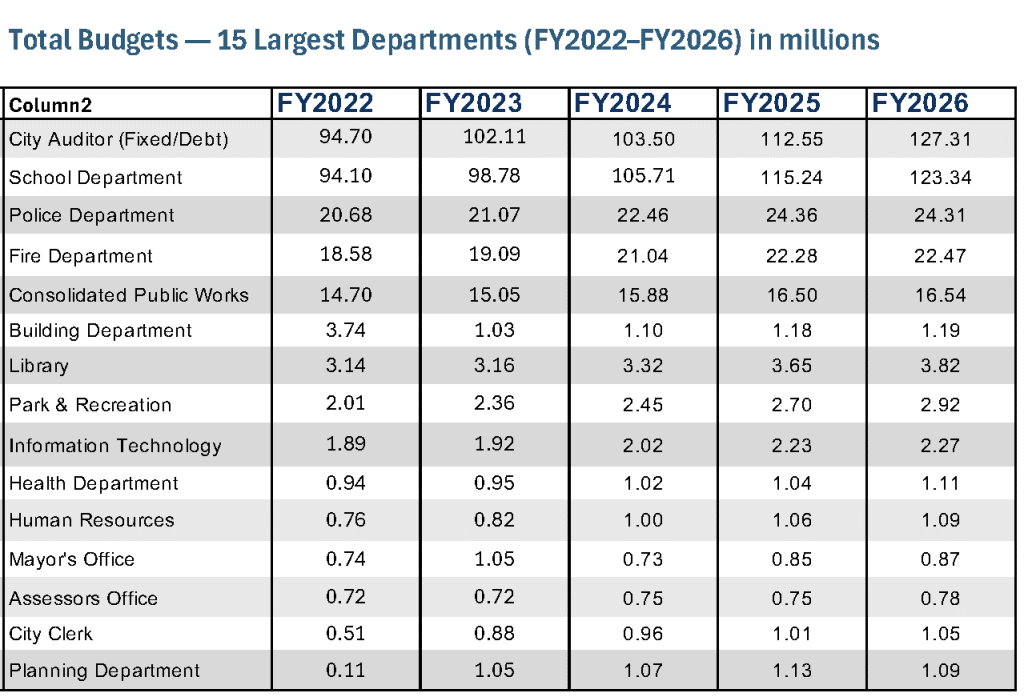
Health insurance costs are rising around the country. The largest increase in Waltham’s budget this year was from health insurance costs for its employees, which grew by $8.9 million from last year’s budget.
Many departments, including the School, Building Maintenance and Traffic Engineering departments, also saw rising costs in their utilities bills over the past year. The City Clerk’s Office reported that the utilities costs to maintain the city’s Rosario “Russ” Malone Archives and Records Center nearly doubled between FY2025 and 2026. The Recreation Department expects increases in its water bill for spray parks, which has risen nearly $90,000 since 2024.
A shortage of workers
The city’s emergency services have seen significant retirements since the end of last year, with seven empty positions in the Fire Department’s roster and 12 new retirements in the Police Department. According to Police Chief Kevin O’Connell, the city hired many emergency services workers at the same time decades ago, many of whom are now retiring together.
O’Connell told councilors he’s having trouble finding replacement candidates as a result of a “decimated” civil service hiring list. He said he’s planning to hire from sources other than the police academy, such as other municipalities and university security departments. Similarly, Fire Chief Andrew Mullin said his department has recently hired new firefighters, but it’ll take a while for them to finish training.
The Buildings Department asked to reclassify one of its code enforcement positions, since there’s a statewide shortage of qualified applicants, and train a current inspector to fill the more specialized role.
In the School Department, Mendonsa emphasized that the city’s out-of-district special education costs are so high in part because there’s an overall shortage of teachers with “severe” special education licenses: “Folks are just not going into that field, unfortunately,” she said.
Many departments also reported changes to their administrative positions as some long-time staffers retired. Still, the Health Department was granted a new full-time administrator position — a position Health Director Michelle Feeley has previously stated could help the department manage citywide issues such as rats.
Council meeting throwbacks
Some of the City Council’s pet projects this year also came up in discussions of the city budget.
This spring, councilors started making plans for the city to hire a new economic development manager who could help attract businesses to the city, and asked the clerk’s office to put together a job description for the position. Committee members were surprised to see the budget accounted for someone already hired to the position. Planning Director Robert Waters says the department decided not to make an external posting because it had identified a promising internal candidate.
Some projects, such as the Bluebikes bike-sharing project and modernized viewscreens in the City Council chambers, notably didn’t appear in the budget document. Others, such as the ongoing library renovation and discussions about whether the city may lose its hockey rink or gain a new one, loomed large over individual departmental budgets as councilors probed for updates.
Some broader trends surrounding Waltham’s residents’ experiences also resurfaced yet again in the budget, as councilors discussed how the city clerk’s office could increase voter turnout in local elections and McCarthy requested to formalize her benevolent fund, which is primarily earmarked for emergency housing assistance.
Author



Comments (0)
There are no comments on this article.