
From the frontlines of cancer care: Mental health and navigating new treatments
Like many other medical fields, oncology is constantly evolving. Cancer care providers have to keep up with emerging research, new treatment options and insights into how to deliver better care.
A group of nurse practitioners, physicians’ assistants, pharmacists and other local providers from Greater Boston’s hospital systems convened in Waltham this past March for a continuing education conference run by medical education company Horizon CME.
Together, providers discussed evolving research topics in oncology and learned ways to improve the experiences and outcomes of patients under their care.
Pharmaceutical advancements
The medical tools physicians have at their disposal to treat cancer are constantly in flux. Dr. Khaldoun Almhanna of the Brown University Health Cancer Institute told his audience about treatments that use specific proteins to target malignant cancer cells, saying these more-targeted medications “have fundamentally transformed the treatment landscape” of gastrointestinal cancers. These classes of targeted therapies aren’t limited to gastrointestinal cancer, and came up in talks throughout the conference.
Early results from new potential therapies, however, are frequently nuanced. Dr. Jacob Zaemes of Beth Israel Deaconess Medical Center, for example, discussed a type of radioligand therapy involving radioactive Lutetium 177, which physicians can use to target prostate cancer cells.
He presented complicated results from a recent study on the therapy, which observed patients who had not yet undergone chemotherapy but were receiving an existing type of hormone treatment. Although the study set out to compare patients who switched to radioligand therapy and those who switched to another hormone treatment, many patients moved between the two groups during the study, trying new approaches as their condition progressed.
Overall, the specific use of radioligand therapy the study tested didn’t seem to cause a significant effect on patients’ overall survival rates — but it seemed to slow down the decline in quality of life that patients were experiencing.
Physicians can also have a hard time applying the results of clinical research to specific patients in the context of their individual care plan and medical history. Zaemes suggested that a machine learning model trained on data from clinical trials could serve as a tool for physicians to bridge that gap and make more specific predictions. In fact, the National Comprehensive Cancer Network has begun to include information on AI diagnostic tools in its guidelines.
Zaemes warned providers, however, that changes in how scientists running clinical trials collect and format their results could introduce error into the predictions of tools trained on older data.
Mental health
The stress and distress surrounding cancer treatment can itself play a huge role in patients’ well-being.
Dr. Kelly Irwin, a psychologist at MGH and an instructor at Harvard Medical School, said that although a quarter of people with cancer show significant symptoms of depression and anxiety, these shouldn’t be written off as normal side effects of cancer. Depression and anxiety can have significant effects on overall health, causing worse outcomes in cancer treatment. One 2022 meta-analysis suggested that patients with cancer may be twice as likely to die by suicide compared to the general population.
Irwin emphasized that mental healthcare should be a standard part of the cancer treatment process, and patients and providers need to be able to talk about it. This can be especially important, because diagnosing mental illness can be harder in cancer patients, whose treatments may themselves cause symptoms of depression such as mood changes and fatigue.
Cancer also makes it harder to treat depression and anxiety, because standard depression medications may interact with cancer drugs. Irwin suggested trying new medications slowly, targeting specific clusters of symptoms and choosing medication that minimizes side effects.
Irwin also emphasized that patients’ mental health challenges often don’t end with cancer treatment. Oncological advancements have meant that more and more people have been able to survive a cancer diagnosis: In 2022, the American Cancer Society reported that over the past three decades, cancer mortality rates had dropped by 34%. Many survivors of cancer, though, see their mental health plummet in the weeks immediately after finishing cancer treatments as they try to build back to full capacity and adapt to their pre-treatment routines.
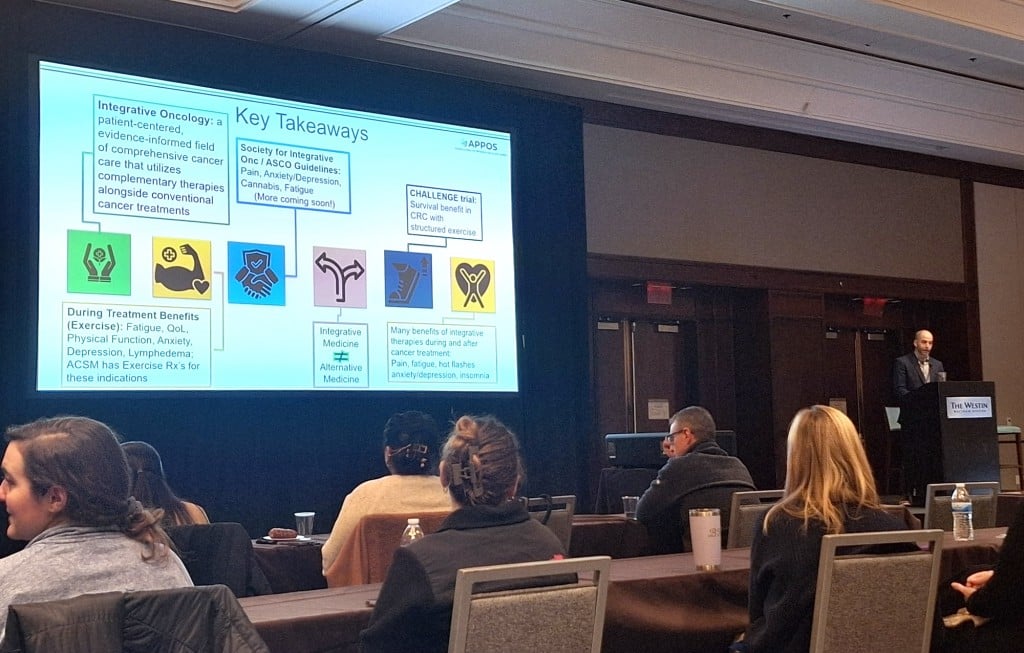
Dan Glidden, a physician’s assistant at Dana-Farber, advocated for treatment plans that integrate treatment to help improve patients’ mental and physical well-being. Lifestyle changes such as exercise, nutrition, mindfulness, massage and acupuncture cannot substitute for clinical cancer care, but Glidden said these approaches can complement ongoing treatment, improving quality of life by tackling psychological symptoms and helping with pain management.
Glidden encouraged providers to connect patients with free resources tied to their hospitals and local community institutions, such as the YMCA’s Livestrong program.
Author






Comments (0)
There are no comments on this article.