
Construction project uncovers soil and groundwater contamination near new apartment complex
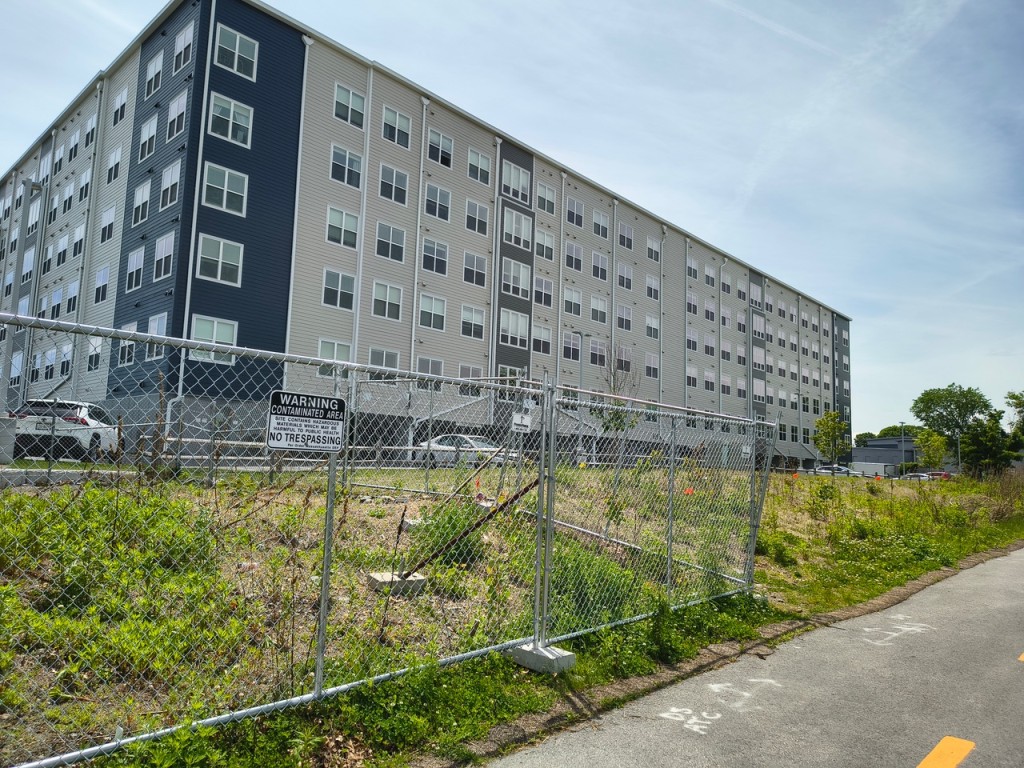
A plot behind the Alexan Waltham apartment complex at 73 Pond St. is contaminated with polychlorinated biphenyls, commonly abbreviated as PCBs, a known carcinogen.
The affected area sits between the newly constructed complex and the Mass Central Rail Trail. A sign warns that the fenced-off area is contaminated.
A June 5 report submitted to the Massachusetts Department of Environmental Protection by GEI Consultants Inc. says the contamination was discovered during the construction of the apartment complex.
In an email to the Waltham Land Trust, Gerald Aulter, director of trails and greenways at the Massachusetts Department of Conservation and Recreation, said the land belongs to the MBTA and DCR is not responsible for the contamination.
“We don’t know the MBTA’s timeline for remediation. MassDEP requested fencing and signage and the MBTA asked DCR for assistance because they didn’t have a simple contract mechanism for getting that done in a timely manner and we did,” Autler said.
Testing confirmed a plume of PCBs affecting the soil and groundwater in the area, with some present in the air in underground portions of Alexan Waltham but at a level below what is considered to be harmful. According to maps included in the report, the fenced-off area is where the highest concentration of PCBs is located. However, PCBs are present in the surrounding soil as well.
Ward 6 Councilor Sean T. Durkee said he has been aware of this contamination and thinks the mitigation systems in place will benefit residents. “Residents are much better off with the monitoring wells and filtration systems as opposed to a vacant lot just sitting there,” he said. “We can’t change the past, but we can mitigate the effects of bad prior practices.”
According to its report, GEI Consultants is creating a plan to excavate the contaminated soil from the site, dispose of the soil and encapsulate it so no more chemical leakage can happen.
Before implementing its plan, it will submit it to the U.S. Environmental Protection Agency for approval.
Some remediation efforts, including moving contaminated soil, injecting chemicals into the ground to neutralize the PCBs and installing a vapor mitigation system, have already been enacted.
Neither Trammell Crow Residential, which owns Alexan Waltham, nor the Massachusetts Department of Environmental Protection responded to requests for comments.
PCBs are man-made chemicals put in industrial products as a flame retardant between 1930 and 1979. The United States in 1979 banned their production due to their toxicity to humans and the environment.
“Short-term exposure is not expected to cause serious problems. Long-term exposure is the biggest concern,” said Keri C. Hornbuckle, a professor of civil and environmental engineering at the University of Iowa who studies PCBs.
Long-term exposure to PCBs can cause various health problems including cancer Hornbuckle said, adding that the presence of PCBs at the site is most likely due to former industrial activity there.
According to Waltham Historical Society treasurer Marie Daly, a metal fabrication firm called Artisan Industries used to own the site where Alexan Waltham now sits.
Author

Comments (4)
Comments are closed.



Thank you for letting Waltham residents know about this .
I appreciate the Waltham Times covering environmental issues like this one. I’m not sure how many folks remember Love Canal, but that (I think) was the largest issue of its day. Discovery of the problem had led to discoveries of other issues that had been previously swept under the rug because they are so costly and difficult to repair. It seems to me that some developers and some municipalities are so eager to move ahead now because sometime in the near future, development will need to slow down–maybe stop altogether–to preserve the environmental conditions necessary for good health.
thank you for this story! I hope you will provide updates on any remediation work–or lack of!
Thanks for breaking down this complex issue into understandable points.