
Waltham company’s shipping container keeps donor organs viable
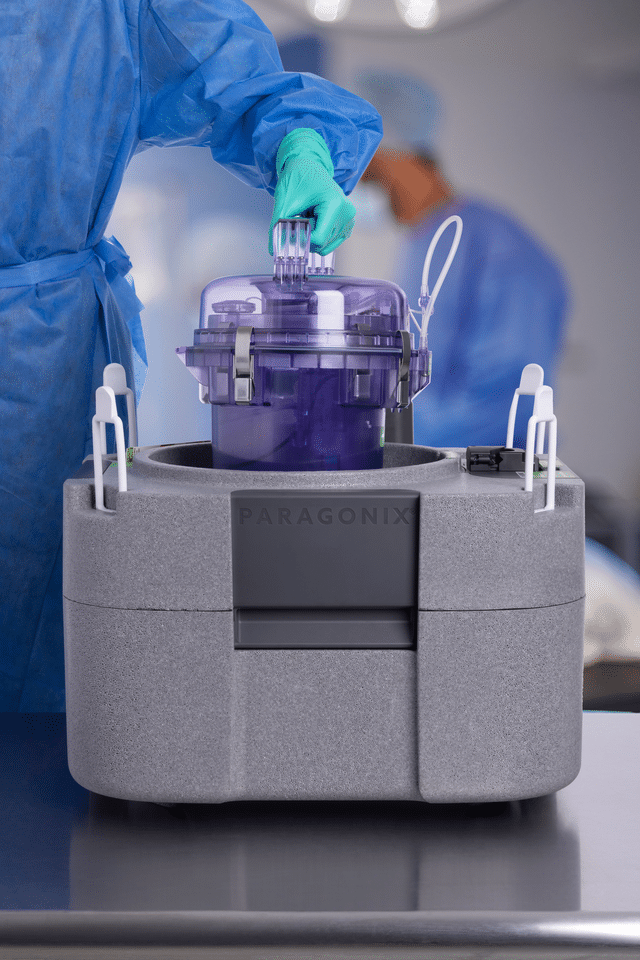
A Waltham company is contributing to significant advances in organ transplantation by revolutionizing a seemingly mundane aspect of the process — the shipping container.
Paragonix Technologies, located at 950 Winter St., has significantly extended the time donor organs can be kept viable outside the body with high-tech containers that keep organs at constant, optimal temperatures, monitor their condition and even run fluid or air through organs to keep them pumping or inflated. As a result, organs that previously would have been discarded are now suitable for use, a boon to patients who sometimes must wait years for surgery.
More than 100,000 people in the United States were waiting for donor organs as of May 2025, according to Organ Procurement & Transplantation Network data.
The Paragonix containers enable donor organs to remain viable for significantly longer than packing in ice, which has typically limited viability to about four hours. Most important for donor heart recipients, this technology has resulted in a 50% reduction in four-year mortality, giving patients a far better chance at long-term survival, according to the company.
“Since the introduction of the SherpaPak in 2019, we’ve seen tremendous adoption across the transplant community,” said Lisa Anderson, president of Paragonix Technologies. “Last year, over 50% of all donor hearts in the U.S. were transported using our system.”
Paragonix has provided container technology for more than 20,000 transplants of hearts, lungs, livers, kidneys and pancreases. In March the company announced the 1,000th kidney transplant using the KidneyVault Portable Renal Perfusion System.
Anderson said the KidneyVault system addresses “real-world challenges in kidney preservation, and this milestone reflects the collective commitment of the transplant community to continuous innovation in patient care.”
The company described a case in which surgeons declined a kidney at an out-of-state transplant center, and despite this surprise as well as multiple handoffs and two commercial flights, surgeons elsewhere successfully transplanted the kidney into a patient.
Recently, the company has funded a study to assess a new technique developed at the University of Washington that holds promise for significantly increasing the supply of donor hearts. Surgeons have typically used hearts from patients declared brain-dead but have been reluctant to use hearts from patients who died from circulatory failure (severe trauma, for instance). The new technique, which significantly reduces transplant costs, enables surgeons to determine if these hearts are suitable for transplant. Coupled with the Paragonix system, this technique could open a pool of previously unusable hearts and allow some patients to get access to a heart transplant faster.
As recently as seven years ago, Paragonix had 10 full-time employees. That number, according to the Boston Globe, has grown to 180, nearly half of whom work in Massachusetts. In 2024 Paragonix was acquired by Getinge, a Swedish medical technology company.
Author

Comments (1)
Leave a comment
When commenting, please keep in mind we are a small non-profit focused on serving our community. Our commenting policy is simple:
- Common sense civility: we’re all neighbors, but we can disagree.
- Full name required: no anonymous comments.
- Assume the best of your neighbors.





It’s so interesting that there are so many companies that the general public hardly ever, if ever, hear about, yet they do incredibly important work that can benefit everyone. It’s nice that Paragonix is featured here–I had never heard of them before!