
Blue Collar 101: Waltham museum panel makes the case for a railroad career
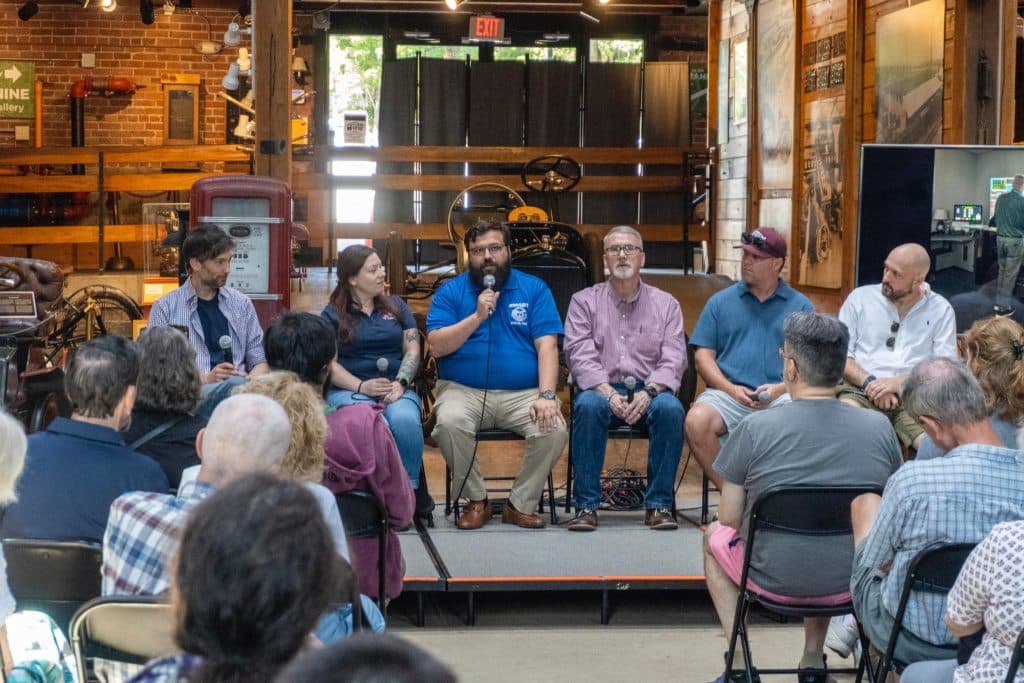
Railroad professionals spoke with members of the public at the Charles River Museum of Industry & Innovation about their work keeping the rail system running for the third session in the museum’s Blue Collar 101 series.
Sarah Gouthro joined the railroad industry after driving buses for six years. She said she saw more opportunities for growth in railroad work than bussing. She began in customer service where she learned the system to help her move into dispatching.
As a dispatcher, Gouthro said, she is responsible for the safe and efficient movement of freight and passenger trains.
She navigates the timing of train movements based on priorities. When a crew requests authority, the dispatcher either grants it or delays it.
About six years ago, when Gouthro had been a dispatcher for only a year, an MBTA commuter-rail train stopped near the Moody Street crossing and remained stretched across Elm Street, blocking traffic. Cole Czub was the conductor aboard the train.
Gouthro said a signal worker raised the gates to let cars pass, which triggered a red light that prompted the train to stop. She imposed a speed restriction and gave the crew permission to proceed but the train’s Positive Train Control system treated the red signal as an absolute stop.
Eventually, the issue was resolved, and the train could proceed.
Engineers are the “tip of the spear”
“Afterward, we had a conversation where I was like, ‘So sorry that happened,’” she said. “Six years later, here we are talking on panels.”
Gouthro and Czub later began dating and have been together ever since.
Czub said conductor ranks have grown rapidly since the COVID-19 pandemic, with union membership increasing from about 300 to 650 over the past three years as the railroad continues hiring. The conductor is responsible for the train and its passengers, while the engineer operates the locomotive. An assistant conductor also typically works aboard a passenger train.
The commuter rail’s locomotives are diesel-electric: a diesel engine generates electricity, while traction motors on the axles power the train. The newest HSP46 locomotives are rated at 4,600 horsepower, with roughly 4,300 horsepower reaching the wheels.
Locomotive engineer Bill Keay said locomotive technology and railroad safety systems have grown increasingly complex. Engineers are at the “tip of the spear,” he said, because they operate the equipment and must troubleshoot problems when technology fails.
Machinist Joseph Rumrey, who also serves as a union leader for Local 318 of the International Association of Machinists and Aerospace Workers, works in the Diesel House at the MBTA’s Boston Engine Terminal. Rumrey said machinists perform locomotive repairs, mechanical inspections and brake tests to ensure the equipment operates safely.
“Preventative maintenance is a major priority because some locomotives are nearly 50 years old and must be kept in service safely,” Rumrey said.
Growing demand, a worthwhile career
Rumrey said the opening of the MBTA’s South Coast Rail, which connects Fall River and New Bedford to Boston, contributed to mounting demands over the past 18 months, citing 26 daily runs and the need for about 70 locomotives. Preparing for the World Cup service added further pressure. Although he acknowledged that rail systems in parts of Europe and Asia “blow ours away,” Rumrey said he was proud of the machinists and other railroad workers who prepared the equipment for the increased capacity.
Keolis Commuter Services operates and maintains the Massachusetts Bay Transportation Authority Commuter Rail system under contract with the transit authority. Adam Sisk, an MBTA supervisor of locomotive reliability and performance, said he is part of an approximately 50-person team that monitors whether Keolis is meeting its contractual obligations and oversees day-to-day mechanical operations across the commuter-rail system.
“Everyone on [this] panel works for Keolis except me. I work for the MBTA,” he said. “We have inspectors and engineers who go out every day. Sometimes we start around 1 or 2 in the morning to make sure the startup work is being completed.”
After the panel was over, Gouthro expressed gratitude for all the people who attended. She hopes people see that working for the MBTA is a worthwhile career with good pay, good benefits, and a community-oriented environment.
“It gives them a broader understanding of who it is they are dealing with when they take the train,” Gouthro said.
Author



Comments (0)
There are no comments on this article.