
Privacy concerns persist over Waltham’s Flock Safety cameras as Massachusetts passes new consumer data protections
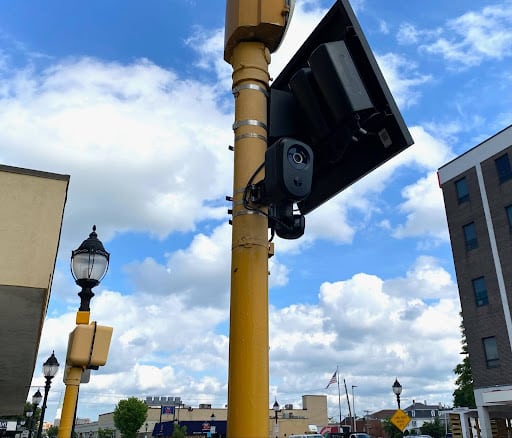
As Massachusetts moves to strengthen consumer data privacy, officials and advocates continue to weigh who should control the data collected by automated license plate reader cameras in communities such as Waltham.
This past fall the Waltham Police Department contracted with Flock Safety to install 16 automated license plate reader cameras across the city under a two-year $96,000 agreement. The department purchased the cameras using funds seized during court proceedings, meaning the purchase did not require City Council approval for financing.
According to the department’s transparency portal through Flock’s website, the cameras capture license plate information to assist criminal investigations and alert officers to vehicles associated with ongoing investigations.
On June 4 the Massachusetts House of Representatives unanimously passed the Massachusetts Consumer Data Privacy Act, which would give residents greater control over their personal data and prohibit the sale of precise geolocation information by companies.
State Rep. Thomas M. Stanley, a Democrat, of Waltham said it remains unclear whether the Consumer Data Privacy Act will apply to automated license plate readers because license plate information is not currently classified as sensitive data.
“It all depends on the final language,” he said.
State Rep. Steven Owens, also a Democrat, of Watertown has filed legislation that would limit retention of automated license plate reader, also known as ALPR, data to 14 days while requiring legal authorization for many searches. He has also proposed another bill allowing municipalities to use automated cameras for traffic enforcement under stricter privacy safeguards.
Massachusetts allows companies to collect location data on every driver through ALPR systems, but it does not allow municipalities to use similar camera technology to enforce many traffic violations.
“We’re in a situation now that is completely backwards,” Owens said. “We create a dragnet of everybody so that we’re watching everybody at all times, but we’re not able to use that same technology to enforce actual offenders.”
Waltham Ward 9 Councilor Robert G. Logan has been a vocal skeptic of the Flock Safety cameras since their inception.
“Before we go using government surveillance, you really need to make sure that it’s absolutely necessary and all safeguards possible are in place,” he said.
Logan has asked the Waltham Law Department to draft a citywide surveillance ordinance. While he said police audits have found no misuse of the cameras, he believes broader safeguards are needed.
ACLU policy counsel Gideon Epstein said police audits often contain vague search reasons such as “investigation,” making it difficult to monitor how the technology is used. He said the larger concern is widespread data sharing between departments without statewide guardrails.
“These vendors encourage local police departments to engage in widespread, often nationwide, data sharing, and that kind of data sharing opens the door for potential abuse,” he said.
The master services agreement states that Waltham retains ownership of the data collected through the Flock Safety system while granting the company a limited license to use anonymized data to improve its products.
Epstein said the larger concern is not ownership but how data is shared. He said Massachusetts, despite having more than 80 police departments using automated license plate readers, remains one of the only New England states without statewide guardrails governing the technology.
Stanley said he hopes to see more consensus-building across the legislature for a hard-nosed posture on protecting data in the commonwealth.
“We’re making strides in protecting private information, and it’s not the end,” he said.
Author

Comments (3)
Comments are closed.







Framingham has kicked them out. Cambridge. Greenfield. Natick. Watertown. And that’s just Massachusetts. Flock has been shown the door in 80+ communities across the country.
Why? Pick your reason. Repeated data leaks to Federal agencies despite laws against it. Security problems. Abuse by stalkers. Innocent people getting falsely accused or injured.
The interesting thing about Framingham, though, is that their city council is looking at drafting legislation restricting the use of such technology. Something that Waltham’s city solicitor recently admonished our council that they were not allowed to do.
Vermont effectively banned the operation of Flock-style cameras last year.
Vermont too liberal for you? New Hampshire technically allows them but requires that data be purged within three minutes, effectively prohibiting their use in retroactive fishing expeditions.
So this really isn’t a left-or-right thing. People all over the political spectrum don’t like Flock.
Have you heard the comeback about “Who cares about Flock when everyone has cell phones?” Well, just this week, the Supreme Court ruled *again* that using cell phone location data is a search for Constitutional purposes, and requires a warrant.
You also chose that phone. And the carrier. And the apps on it. Maybe you carefully picked a phone, carrier, and apps that prioritize privacy. Maybe you didn’t. Either way, that was your choice. A choice you have the right to make whether you chose the same as I did or not.
Flock, on the other hand, was chosen for us. And whether you would have wanted it to or not, that choice did NOT prioritize our privacy.
You are, of course, also free to turn your cell phone off any time you want for any reason. Try that with a Flock camera and see how it goes for you.
I remain hopefully that our city government will ultimately do the right thing. It merely remains to be seen whether they will exhaust all the other options first.
Framingham just canceled their Flock contract. Are we really willing to be worse than Framingham?
Personally I’m appalled our police haven’t done the right thing here and canceled the contract. If they really wanted to protect us – they would see that we need protection from big tech.
We do not want these cameras. We do not need to be watched by our every move. Watertown and Framingham have eneded their contracts with flock. Why does big brother need to know where we are and where we have been. Catch the bad guys the old fashion way without knowing everyone’s movement.