
Eighth graders outpace peers on state civics test
In only the second year of the Massachusetts civics exam, Waltham’s eighth graders outperformed students in 10 districts with comparable sizes and demographics.
The Department of Elementary and Secondary Education offers an online tool that matches every school district with 10 districts of similar population size and makeup. It allows schools to see how they stack up against similar communities and make “sound, meaningful comparisons,” as DESE puts it. It’s an alternative to comparing districts with neighboring communities, which can have widely fluctuating socioeconomic statuses and diversity.
In 2025, the first year of the civics test, Waltham topped nine of those 10. “The dragon we couldn’t slay last year was Somerville,” said Derek Vandegrift, director of history and social studies for grades six through 12. “This year, we beat 10 out of 10.”
Statewide, 40% of eighth graders met or exceeded expectations on their civics exams, DESE reported in September. Waltham students did better, with 43% meeting or exceeding expectations.
Vandegrift ran his own comparison. Pulling results by hand for the 26 Massachusetts communities with 50,000 or more residents, he found Waltham finished fifth, behind Brookline, Newton, Cambridge and Quincy.
“The dragon that we will most definitely slay this year is Quincy,” he said. “Look out, Quincy.”
A new subject for the MCAS
Until recently, Massachusetts didn’t test social studies at all. That changed in 2018 with “the civics bill,” ushering in a new history and social science framework for public schools. As part of the new emphasis on civic education, students complete civics action projects in eighth grade and in high school.
With civics now the state’s priority, a standardized test followed — seven years later. In spring 2025, students took the first civics section of the Massachusetts Comprehensive Assessment System. Vandegrift said DESE knew that implementation at such a large scale would take a while. Waltham started early, electing to participate in exam pilots.
“If there is a pilot of something that may end up being used to measure our students and our schools, we want to be a part of that,” he said. Taking part meant teachers could give feedback on the exam and learn how best to prepare students for it.
The test itself differs from other subjects in its relevance to students’ lives, Vandegrift said. He described the format as applicable beyond the classroom. Asked what they want for former students 10 years on, he said history teachers tend to give the same answers.
“I want a kid to be able to take a look at a source and understand its meaning. I want them to be able to make an argument and support it with evidence.”
Behind the scores
A set of immersive programs for middle schoolers helps engage students, Vandegrift said, along with their teachers’ efforts.
In seventh grade, every student takes part in a Model United Nations unit. Each represents a country, researches an issue and presents it at a mock General Assembly.
Discovering Justice is an afterschool option that offers a mock trial program run in partnership with the Boston nonprofit of the same name. Over the semester, students prepare a case and argue it before a federal or state judge from either Waltham District Court or the federal courthouse in Boston.
Middle-school-aged kids are hungry for adult roles, Vandegrift said. Stepping into them gives the student confidence and responsibility, and gets them excited to share what they’ve learned.
“It feels real,” he said, of the Discovering Justice mock court cases. When given the opportunity to, he said, “kids rise.”
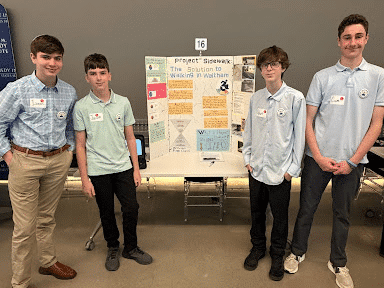
Last year, two Waltham projects were among only 40 statewide to earn a commendation at the statewide civics showcase in Boston.
Not done yet
Like nearly every district in the state, Waltham’s data shows achievement gaps between mainstream students and low-income students, English learners and students with disabilities.
Vandegrift said his own professional goal this year centers on helping teachers improve access for those students, using the civics results as one measure.
“Yeah, we’re exceeding the state, but we’re not done,” he said. “We’re gonna keep working to improve.”
Author
Comments (1)
Leave a comment
When commenting, please keep in mind we are a small non-profit focused on serving our community. Our commenting policy is simple:
- Common sense civility: we’re all neighbors, but we can disagree.
- Full name required: no anonymous comments.
- Assume the best of your neighbors.


As a former American history and government teacher, reading this makes me very proud of our Waltham 8th graders and teachers. These test results show that when we engage kids with hands-on civics in activities such as mock trials and the Model UN program, they don’t just learn civics, they excel at it. I really appreciate Mr. Vandegrift’s attitude here, too. Celebrating a huge win while staying focused on closing achievement gaps is exactly the leadership our schools need. Great work, WPS!